













CMI Entrance Exam Preparation 2027 requires a focused approach that goes beyond the rote memorisation of formulas and solving mundane questions to increase overall performance in tests. As subjects like mathematical concepts, analytical thinking, logical reasoning and problem-solving are evaluated through the exam, it is advised that candidates follow a planned CMI 2027 preparation strategy from day one. Strong fundamentals, solving quality problems, previous years' question papers, mock tests and frequent revisions are some of the stages to follow for effective preparation.
This SciAstra blog offers a holistic approach that guides students in strategising their preparation for the CMI Entrance Exam 2027 and enhances their chances of qualifying.
CMI Entrance Exam 2027 Highlights
Candidates planning to appear for the CMI Entrance Exam 2027 should understand the key details of the examination before beginning their preparation. Check out the complete details here:
Particulars | Details |
Exam Name | CMI Entrance Exam 2027 |
Exam Level | National Level Entrance Exam |
Exam Conducting Body | Chennai Mathematical Institute (CMI) |
Purpose | Admission to undergraduate and postgraduate programmes in Mathematics, Computer Science, Data Science, and related fields offered by Chennai Mathematical Institute (CMI) |
Exam Mode | Offline Mode (Pen-and-Paper-Based Test) |
Exam Frequency | Once a Year |
Duration | 3 Hours (180 Minutes) |
Medium of Exam | English |
Question Type | Part A: Numerical Answer Type (NAT), MCQs, True/False statements, and problems; Part B: Subjective Questions |
Total Questions | 27 Questions (Based on previous year pattern, for BSc courses) |
Subjects Covered | Mathematics (UG Courses) and programme-specific subjects for PG courses |
Maximum Marks | 120 Marks |
Official Website | Link will be provided once it is made live by the officials for the 2027-2028 session. |
Note: The exam pattern and other details are based on the previous year's CMI Entrance Exam trends and may be updated by the officials in the official notification.
CMI Entrance Exam Date 2027
Applicants need to know the CMI Entrance Exam Date 2027, including the release of the exam notification, application timeline, admit card availability, examination date, and result declaration. As the exam-conducting body has not announced the schedule for the CMI Entrance Exam 2027, we have mentioned below the tentative timeline based on the previous year's exam calendar CMI Entrance Exam Dates 2026 :
Event Name | Tentative Dates |
CMI Entrance Exam 2027 Notification | February 2027 |
CMI Entrance Exam 2027 Application Form Start Date | First Week of March 2027 |
CMI Entrance Exam 2027 Application Form End Date | First Week of April 2027 |
CMI Entrance Exam 2027 Admit Card Release Date | Fourth Week of April 2027 |
CMI Entrance Exam 2027 | First Week of May 2027 |
CMI Entrance Exam 2027 Answer Key | First Week of June 2027 |
CMI Entrance Exam 2027 Result Release Date | Second Week of June 2027 |
CMI Entrance Exam 2027 Interview Process | Mid-June 2027 |
CMI Academic Session Begins | First Week of August 2027 |
How To Prepare For CMI Entrance Exam 2027?
CMI Entrance Exam Preparation 2027 requires a systematic approach focused on strengthening conceptual understanding, analytical skills, and mathematical problem-solving abilities. Since the exam primarily evaluates candidates' mathematics skills, aspirants should build strong fundamentals, practise advanced-level problems, solve previous years' question papers, attempt mock tests, and revise regularly to improve their performance. The aspirants who have a well-planned strategy can strengthen their concepts, communication skills, accuracy and confidence for appearing in the examination.
Understand the CMI Exam Pattern 2027
At first, candidates need to understand how the CMI entrance exam is structured. The CMI exam tests mathematical aptitude, logical reasoning, and proof-writing ability rather than rote learning. Familiarise yourself with the marking scheme, exam duration, question types, and the balance between objective and subjective questions. Knowing the exam pattern will help you build the right preparation strategy from day one.
Based on the CMI Entrance Exam 2026 pattern, the UG entrance examination will consist of two sections: Part A and Part B. Part A will include different types of questions such as Numerical Answer Type (NAT) questions, problems, MCQs, and true/false statements, while Part B will consist of subjective questions. Candidates can check the section-wise distribution of questions and marks below:
Part | Number of Questions | Marks |
Part A | 21 Questions | 40 Marks |
Part B | 6 Questions | 80 Marks |
Total | 27 questions | 120 Marks |
Note: Candidates are advised that the number in Part A and the type of questions may vary, but the marks allocated to Part A will be constant. Numerical Answer Type (NAT) and True/False questions should be high on the agenda of preparation for Part A, as they are some of the most frequently asked question types, based on last year's trends.
Master the CMI Entrance Exam Syllabus 2027
Then the next step is to completely analyse the CMI syllabus 2027 and get information about each topic from Class 11 and 12 Mathematics, and focus on the following:
CMI Syllabus | |
|---|---|
BSc Mathematics, Physics and Computer Science | Download Now |
MSc/PhD Computer Science | Download Now |
MSc Mathematics | Download Now |
Note: The syllabus of the CMI entrance exam is not a fixed or chapter-wise one. The above-mentioned points are not only from the Class 11–12 mathematics syllabus but also include conceptual areas that have been consistently carrying much weightage in the examinations over the years. Students should pursue conceptual understanding & higher-order thinking instead of rote learning. CMI is more focused on understanding concepts than rote memorisation, so make sure you are aware of the "why" behind any particular concept.
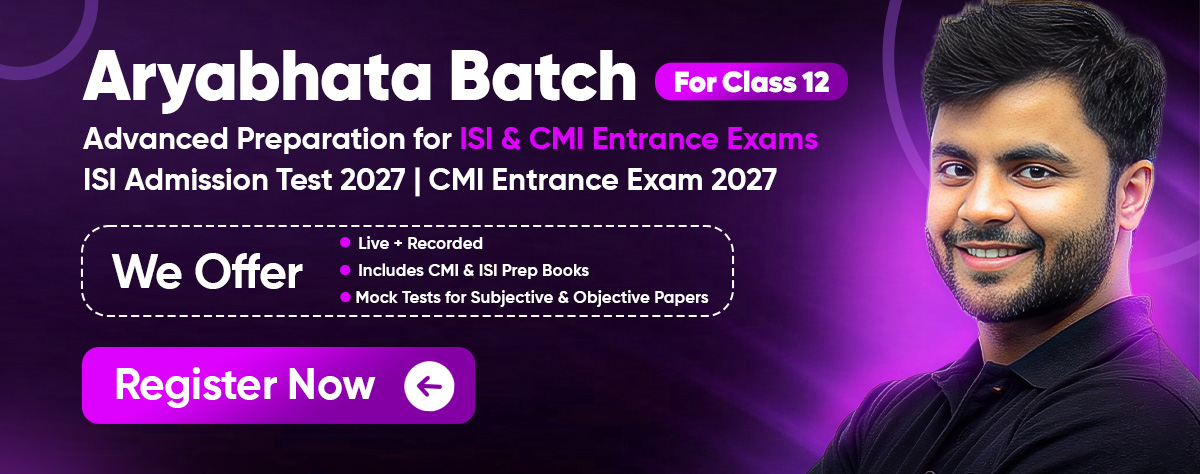
Crack CMI Entrance Exam 2027 with SciAstra's Aryabhata Batch!
Preparing for the CMI Entrance Exam 2027 requires much more than simply completing the syllabus. Success comes from building strong mathematical fundamentals, practising advanced problems, solving previous years' questions, attempting regular mock tests, and following a well-planned preparation strategy. SciAstra's Aryabhata Batch is designed to help you achieve exactly that under the guidance of mentors from India's premier science institutes.
Why Choose the Aryabhata Batch?
Complete coverage of the CMI and ISI syllabus with concept-focused classes
Expert mentorship from IISc, IISER, IIT, NISER, ISI, and CMI alumni
Structured one-year study plan with regular practice and revision
Previous Year Questions (PYQs) and CMI/ISI-level problem-solving sessions
Regular mock tests with detailed performance analysis
Comprehensive study material, assignments, and practice worksheets
Live interactive classes with real-time doubt resolution
Exclusive doubt-solving community and personalised academic guidance
Whether you're aiming for CMI or ISI, the Aryabhata Batch equips you with the right concepts, exam strategy, and rigorous practice needed to maximise your performance. Start your CMI Entrance Exam 2027 preparation with SciAstra's Aryabhata Batch and take a confident step towards your dream research institute.
Build Strong Mathematical Fundamentals
CMI questions are such that they analyse analytical thinking skills. In the first months, focus on your basics and avoid jumping directly to advanced problems. Try to learn various methods to solve maths problems, and practise writing proofs, logical deductions, and creative reasoning.
Strengthen Your Class 11 & 12 Mathematics Concepts: Understand the NCERT syllabus very well because this forms the basis on top of which higher-order mathematics reasoning can be performed. Learn concepts instead of memorising solutions.
Master important formulas: Keep a record of important formulas, not to be mixed with the concepts. CMI questions are tricky, and often they are a combination of concepts, so you need to know when to use what formula instead of just memorising them.
Understand theories and mathematical properties: Develop a clear understanding of the theorems, identities, and properties related to algebra, calculus, geometry, trigonometry, and number theory. The proof-based questions are your enemy of the day, and knowing why a theorem works will help you solve those unfamiliar ones.
Learn how to write proofs: Mathematical proofs use logic and argumentation step by step. It will improve your analytical thinking and get you ready for the subjective questions in the exam.
Use multiple approaches to solve the same problem: Whenever possible, try to solve the same problem using different methods. This ensures better conceptual clarity, increases flexibility in your thought process, and enables you to notice the solution that will take less time on the day of the exam.
Prioritise accuracy over speed: Initially focus on solving questions correctly rather than quickly. Practice regularly and also give a few mock tests at the end for speed practice once your concepts are strong.
Create a Monthly Study Plan
A good study plan is important in preparing for the CMI entrance exam. Rather than putting in effort to cover the syllabus in one go, split your preparation into phases and set a commitment and target. This aids you in developing concepts step by step, pinpointing the weak topics, and also helps you enhance your problem-solving skills and finally gives you enough time for revisions before the exam.
Divide your one-year preparation into four phases:
Phase 1 (Months 1–3): Complete basic concepts from every topic: Start by covering all the key concepts of each subject in the syllabus. Concentration in Class 11 and 12 basic mathematics theories, formulas, and principles. Before proceeding towards advanced problems, answer basic questions to get acquainted with the concepts and strengthen your conceptual clarity.
Phase 2 (Months 4–6): Solve standard-level problems and strengthen weak areas. After that, if all of your fundamentals are crystal clear, then find and solve some standard-level questions from each topic. Know your weaknesses, correct mistakes, and improve accuracy. This stage should be about repetitive practice to build confidence.
Phase 3 (Months 7–9): Practice advanced and proof-based questions.
Next, you should focus on difficult and proof-based questions that demand analytical research & creative problem-solving. Practice questions from previous years, look for multiple methods to solve a single problem, and build a solid foundation in mathematical reasoning.Phase 4 (Months 10–12): Revise, attempt full-length mock tests, and analyse mistakes.
Keep the last stage for revision of all the topics thoroughly. Take full-length mock tests under exam conditions, analyse your performance and work on the mistakes you are repeating while trying to figure out a proper strategy to manage time efficiently in the examination.
A structured timetable ensures balanced coverage of the syllabus while leaving sufficient time for revision and ongoing improvement.
Practise CMI Previous Year Question Papers (PYQs)
CMI entrance exam preparation includes solving previous years' question papers. It also helps candidates learn about the examination pattern, how difficult it will be, and which concepts are repeatedly asked. Practising regularly also enhances confidence, precision, and time-management skills before the test. CMI Previous Year Question Papers are among the most valuable resources for preparation. Solve papers from at least the last 10–15 years to get the following benefits:
Frequently tested concepts: Doing past papers makes you aware of which topics and even concepts tend to be repeatedly asked in the examination, enabling you to dedicate the appropriate amount of time to your preparation.
Difficulty Level: Last year's papers give a very good picture of the difficulty level and help in preparing you for the analytical and concept-based questions as required by the CMI Entrance Exam.
Better proof-writing: Many of the CMI questions require some (formal) logic as well as structured solutions. Doing past papers will also help you with the amount of mathematical justification and length of proof-writing expected of you in the exam.
Time Management: When you practise solving question papers within the time limit, you understand how to manage your time across various sections and types of questions.
Understand the question-solving techniques: You will get various methods to solve the mathematical problem through previous papers, thereby improving your speed, accuracy and overall problem-solving strategy.
Therefore, after every paper, analyse your errors thoroughly, review the concepts related to those questions and do more similar questions of that type to work on your weak points. The most important thing is not solving the papers but constantly analysing and revising your answers. The table below will provide you with past year question papers.
CMI Previous Year Question Paper (UG Course) | PYQ’s PDF |
CMI previous year question paper 2025 | Download Now |
CMI previous year question paper 2024 | Download Now |
CMI previous year question paper 2023 | Download Now |
CMI previous year question paper 2022 | Download Now |
Also Read:
Solve High-Quality Practice Problems Daily
Do daily problem-solving to build the analytical part of your brain and make math intuitive. The more you tackle tough questions, the better your accuracy and confidence.
Olympiad-level Mathematics: Attempt Olympiad-style questions to enhance problem-solving skills and strengthen conceptual understanding beyond the school syllabus.
Advanced Algebra and Number Theory: Solve some of the most challenging problems that employ algebraic techniques, divisibility, modular arithmetic, inequalities, and many other higher-level mathematics concepts.
Combinatorics Problems: Counting, arrangements, permutations, and combinations, as well as logical counting techniques, may improve reasoning skills.
Logical Reasoning Puzzles: Solve puzzles and reasoning-based questions that sharpen logical thinking, pattern recognition, and structured problem-solving.
Proof-based Exercises: Practise solving math proofs to enhance your skill in forming logical arguments, defending solutions, and confidently addressing open-ended questions.
Therefore, regular practice in these subjects leads you to develop mathematical intuition and gives you the confidence to tackle unknown problems in the CMI entrance exam.
Take Regular Mock Tests
Mock tests constitute an important element in CMI entrance exam preparation, as mocks prepare you to get better at the preparations and also test your exam temperament through the practice. The first test is for topic-wise tests (after completing the chapters of every subject), and thereafter, start switching to full-length mock tests under exam-simulating conditions in the last months. After every mock test:
Identify conceptual mistakes: Look through the questions that you compounded errors in and go back to the reading material to understand those concepts better so you can avoid repeating these same mistakes.
Improve speed and accuracy: Time yourself for every section and practise questions to solve them as quickly as you can without sacrificing accuracy.
Work on time allocation: Know how to manage your time well across sections and not get stuck on the tough ones.
Revise weak topics: Analyse the mock test results to identify your weak areas and revise them thoroughly via concept building and attempting additional exercises.
Revise Smartly During the Final Months
Reserve the last 6–8 weeks exclusively for revision. Maintain concise notes containing important formulas, theorems, identities, proof techniques, and frequently made mistakes. Regular revision improves retention and boosts confidence before the examination.
Keep simple revision notes: Revise important formulas, theorems, identities, and key concepts to create concise revision notes.
Revising proof techniques: Read about standard proof strategies and logical transformations to improve your thinking when challenged with subjective problems.
Revise common mistakes: Maintain a separate notebook for the slips made during practice and mock tests so that you are careful not to repeat them in the examination.
Concentration on heavy-weightage topics: Make sure you clear your concepts that are frequently asked in past years' papers, but also be aware of the entire syllabus.
Therefore, memorising new concepts is not recommended during the 3–4 weeks; this time will be for you to revise. Revising regularly reinforces your concepts, improves memory and helps you to write confidently under examination pressure.
Avoid Common Preparation Mistakes
Even when the candidates are strong in mathematical concepts, they tend to lose marks. If you can identify these mistakes early on and rectify them, it will allow you to better your preparation and get the most out of your performance when taking this CMI entrance exam.
Ignoring proof-writing practice: Proof-writing practice is essential to this subject, as it forms a key component of subjective and analytical questions.
Solving only easy problems: Formulating a strategy in problem-solving skills using the standard and advanced-level questions for an aptitude test.
Neglecting previous years' papers: Practise previous year question papers to know the pattern of the examination, concepts which are generally asked in the exam and the nature of questions being asked.
Focusing on speed over accuracy: First, do not correct and check the number of questions you solve correctly before getting into speed. Accuracy should always come first.
Skipping regular revision: Remember that all concepts, formulas, theorems, and techniques are very easy to forget; they should be revised regularly in order to be retained in the long term.
Not analysing mock test performance: Every mock test performed should be reviewed minutely to identify mistakes, strengthen your weak areas & improve exam strategy.
These common mistakes, if avoided along with a disciplined study schedule, regular practice and a strong understanding of the concepts, will greatly increase your chances of getting admission to the Chennai Mathematical Institute (CMI).
Conclusion
Answering the CMI Entrance Exam 2027 is not about solving the maximum number of questions; it is about a firm grip on maths, reasoning, and concepts. A disciplined preparation strategy, when amalgamated with regular practice, timely revision and deep analysis of your performance, will equip you to face the exam confidently.
Consistency in preparation, rather than mere memorisation of solutions and maximising quality study resources, mock tests and PYQs. If yes, now is the time to build on your preparation and confidently take a step closer towards admission at the Chennai Mathematical Institute (CMI) with the right guidance.