


.webp)




Biology plays a crucial role in the IISER Aptitude Test (IAT) 2026, especially for students aiming to secure admission into top IISERs and other IAT 2026 participating institutes. Over the years, the Biology section has focused heavily on conceptual clarity, NCERT-based understanding, application-oriented problems, and analytical thinking. Topics such as Genetics, Evolution, Human Physiology, Ecology, Biotechnology, Cell Biology, Plant Physiology, and Reproduction consistently carry significant weightage in the examination.
The IAT 2026 exam is scheduled to be held on June 7, 2026, at multiple exam centres across the country. Since the exam day is approaching, candidates’ preparation must now be in its final phase. For candidates who opted for PCM in Class 12, covering the IAT 2026 Biology subject can be challenging due to the vast syllabus and limited preparation time.
Candidates who want to score well in the Biology section must check out the IAT 2026 Biology 50 Most Important Questions to revise the syllabus during the final stage of preparation. Candidates must note that merely going through these 50 questions does not guarantee that questions in the examination will be directly asked from them. However, understanding the concepts behind these questions and studying each one analytically will definitely help candidates perform better in the Biology section.
To help aspirants prepare effectively, this SciAstra blog on IAT 2026 Biology 50 Most Important Questions provides a curated collection of highly expected and exam-relevant questions designed according to the latest IAT 2026 pattern and previous year trends. Whether you are beginning your IAT preparation or revising in the final months before the exam, these Biology questions will serve as an excellent resource for strategic preparation.
IAT 2026 Biology 50 Most Important Questions
These important questions are selected to strengthen your conceptual foundation while also improving speed and accuracy in solving Biology problems under exam pressure. Practising such targeted questions can help students identify frequently tested concepts, understand the difficulty level of the exam, and build confidence before taking the IAT 2026 exam.
Candidates can check out these 50 biology questions from here:
An action potential is a phenomenon that works on the principle of potential buildup and breakdown due to ionic and voltage gradients. An action potential was
generated by a weak stimulus. Which among the following options is not a possible change in the axon during the propagation of an action potential:
A. Sodium channels will open for the action potential to propagate.
B. Potassium channels will open to repolarise the membrane after the action potential has been generated.
C. A thick axon without myelination is the most efficient axon for an action potential to propagate.
D. Local currents are responsible for the forward propagation of action potentials.
In the pre-industrial period in England, peppered moths had light colouration, which effectively camouflaged them against light coloured trees and lichens. During the Industrial Revolution, many lichens died out, and trees became blackened by soot from factories, and interestingly, dark coloured moths were predominantly seen. This happened due to:
A. Natural selection of dark coloured moths, which were initially present in fewer numbers.
B. new mutation that arose due to environmental pollution.
C. macroevolution occurring due to environmental change.
D. natural selection of the camouflaging mechanism of the moths.
A newborn baby was kept in a hospital with other babies after checking his blood group. The baby got mixed up with other babies in the hospital. In order to confirm the correct baby, the blood groups of the parents were taken. Father had blood group AB, homozygous Rh+ and mother had B,Rh-. The blood group of the baby can be:
A. B, Rh
B. A, Rh+
C. O, Rh+
D. B
Flowers of an unknown angiosperm plant were taken. It was seen that the microspores inside the anther contain 12 chromosomes. Pollens were sprinkled on the stigma of the female flower of the plant. The aleurone layer of the resultant seed will contain how many chromosomes?
A. 12
B. 18
C. 24
D. 36
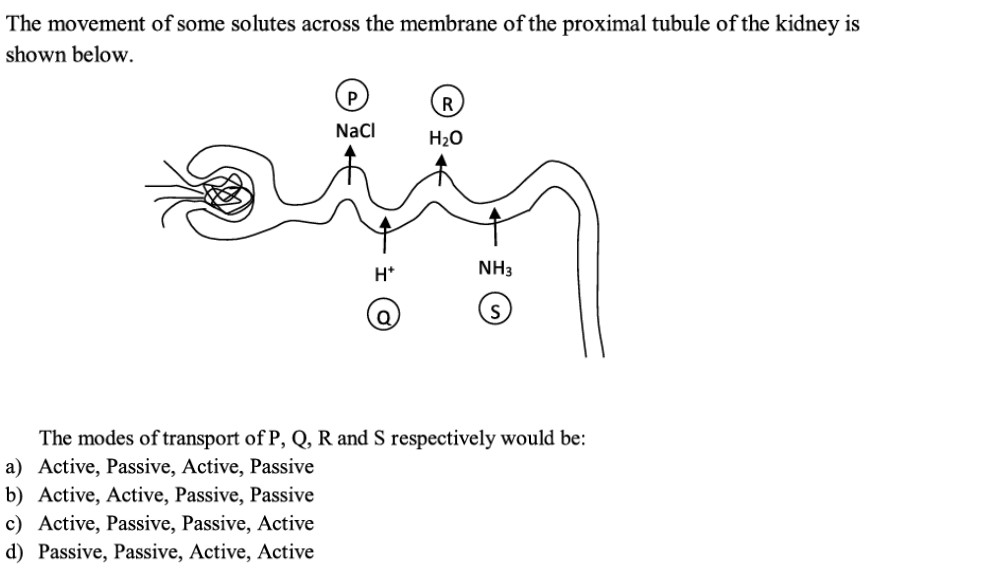
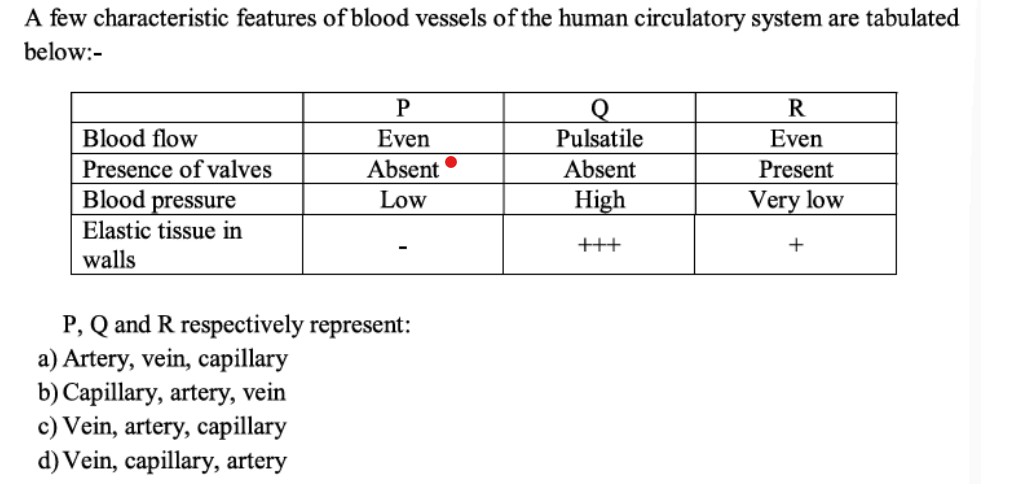
6. 
Kidneys are the important organs of excretion in higher organisms like humans. Apart from excretion, they produce hormones to regulate a few body functions. Which of the following sequences is correct regarding the regulation of blood pressure by the kidneys?
(a) Blood pressure decreases → Kidneys produce renin → Renin converts angiotensinogen to angiotensin → Angiotensin constricts arterioles → Blood pressure increases.
(b) Blood pressure increases → Kidney produces renin → Angiotensin and renin constrict arterioles → Blood pressure decreases.
(c) Blood pressure decreases → Kidney produces angiotensinogen → arterial endothelium secretes renin → Renin-angiotensin system constricts arteriole → Blood pressure increases.
(d) Angiotensin constricts arterioles → Blood pressure increases → Kidney produces renin → Renin dilates arterioles → Blood pressure decreases.
Which organelle's vesicles fuse to create the cell plate during cytokinesis in plant cells, and what is the main polysaccharide deposited?
A. Endoplasmic Reticulum; cellulose
B. Golgi apparatus; pectin
C. Lysosomes; lignin
D. Mitochondria; starch
How many chromatids are there in the daughter cells that develop from meiosis II at the metaphase if a somatic cell has 46 chromosomes at the beginning of interphase?
A. 23 chromatids
B. 46 chromatids
C. 92 chromatids
D. 0 chromatids (as meiosis II does not involve chromatids)
In a human cell that is treated with the drug X, the following two types of graphs are seen at the interval of 24 hours(1000 cells initially were taken)
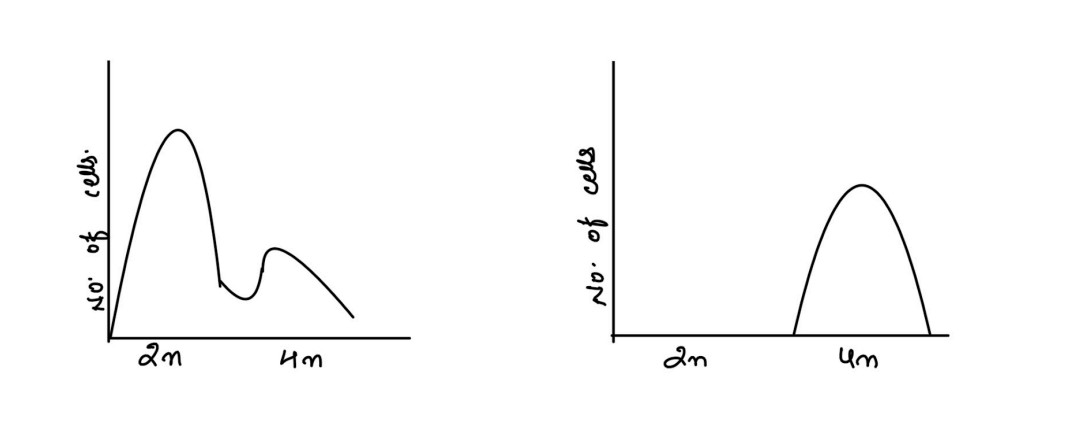
The above representative graphs show that:
A. The drug X inhibits the transition from G2 to M-phase of cell division
B. The drug X inhibits the replication of DNA from G1 to S phase
C. The drug X inhibits the G1 phase of the cell cycle
D. All of the above
Which of the following best explains why Carl Woese's 3-domain system was revolutionary compared to previous classification systems?
A. It was the first to categorise organisms based on morphological features.
B. It utilised 16S rRNA sequence analysis to reveal that Archaea are more closely related to Eukarya than Bacteria.
C. It proposed the endosymbiotic origin of mitochondria and chloroplasts.
D. It grouped organisms primarily by their mode of nutrition.
A fungal species reproduces asexually using conidia and has septate hyphae. It most likely belongs to:
A. Zygomycota
B. Ascomycota
C. Basidiomycota
D. Chytridiomycota
Recent studies suggest chloroplast evolution in green algae shares ancestry with land plants. Which feature of Chlorophyceae best supports this evolutionary link?
A. Pyrenoids store mannitol
B. Presence of chlorophyll a and c
C. Starch storage in cytoplasm
D. Chlorophyll a & b in chloroplasts with starch stored in pyrenoids
Match the following organisms with their respective plant groups and identify the correct pair associated with peat formation:
(a) Chlamydomonas (i) Moss
(b) Cycas (ii) Pteridophyte
(c) Selaginella (iii) Algae
(d) Sphagnum (iv) Gymnosperm
A. (a)-(iii), (b)-(iv), (c)-(ii), (d)-(i)
B. (a)-(ii), (b)-(iv), (c)-(i), (d)-(iii)
C. (a)-(iii), (b)-(ii), (c)-(iv), (d)-(i)
D. (a)-(i), (b)-(iii), (c)-(ii), (d)-(iv)
A mutation renders Complex I in plant mitochondria completely non-functional. Which of the following outcomes would be most accurate in describing the potential impact on oxidative phosphorylation, considering unique plant mitochondrial components?
A. Complete arrest of electron transport and ATP synthesis due to the inability to oxidise NADH
B. Partial continuation of electron flow through alternative NADH dehydrogenases, but with reduced proton motive force and ATP yield.
C. Total compensation by Complex II, leading to an unchanged proton gradient and ATP production
D. Immediate switch to photosynthetic electron transport in mitochondria to bypass the block in Complex.
Download SciAstra App to Practice 50 Most Important Biology Questions with Answers
Get access to the 50 Most Important Biology Questions for IAT 2026 carefully selected by expert mentors based on previous year trends, NCERT analysis, and expected high-weightage topics. Practice concept-based and application-oriented questions from Genetics, Human Physiology, Ecology, Biotechnology, Cell Biology, Plant Physiology, Evolution, and more. These questions are designed to boost your accuracy, strengthen revision, and help you score higher in the IISER Aptitude Test.
Unlock the complete question set now on the SciAstra App and supercharge your IAT 2026 preparation- Click Here
Candidates can check out the detailed explainations to the answer from the SciAstra YouTube Video from here:
How to prepare for IAT 2026 Biology section
To prepare for the Biology section of IAT 2026, candidates must study concepts of Class 11 and Class 12 from NCERT Biology textbooks. For this, they should understand the IAT 2026 Biology syllabus, learn the concepts mentioned in the NCERT Biology textbooks of Classes 11 and 12, strengthen their knowledge of the high-weightage topics, and refer to the best books designed for IAT 2026 preparation. These strategies have been explained below.
Cover IAT 2026 Biology Syllabus
The first step towards preparing for the IAT 2026 Biology section is to know the exam syllabus for this subject. The syllabus of the IISER Aptitude Test 2026 Biology section has been provided below to help you with this step.
Learn Biology NCERT Classes 11 & 12 concepts
The syllabus of IAT 2026 is based on concepts from NCERT Biology textbooks of Classes 11 and 12. Therefore, to build conceptual knowledge of the topics related to the IAT 2026 Biology section, candidates must study the NCERT textbooks thoroughly.
Focus on the high-weightage topics
Academic experts at SciAstra have analysed the IAT previous year question papers from 2017 to 2024 to identify high-weightage Biology topics for the exam. Based on this analysis, they have shortlisted the most important Biology chapters and concepts from which questions are frequently asked in the exam every year.
Understanding IAT Biology Concepts Theoretically
To strengthen your knowledge about IAT Biology topics, you must learn theories related to them. The SciAstra Mastering Biology Volume 1 and Volume 2 books.
These books cover theoretical concepts of Classes 11 & 12 Biology textbooks. It also has diagrams to explain concepts visually. Purchase link below:
Mastering Biology Volume 1 (Class 11) | |
Mastering Biology Volume 2 (Class 12) |
How to Attempt IAT Biology Section
To score well in the Biology section of IAT 2026, candidates need to approach it correctly. The right approach for PCB students is to learn all the facts related to the syllabus topics because Biology is one of their Class 11 and 12 subjects and they are well versed in it.
PCM students do not learn Biology in Classes 11 and 12. Therefore, they must study the subject conceptually by learning all the important theories and concepts. After this, they can learn Biology-related facts associated with the IAT syllabus topics.