
Scientific Computing is the core of scientific discoveries and innovation. It is a field in which the knowledge of Science, Mathematics, and Computer Technology is combined to solve real-world problems that are too complex for human minds.
Individuals with knowledge of Computing Science stay far ahead of the competition in the job market and receive handsome salaries, as expertise in this field is required in almost every industry. If you want to explore what Scientific Computing is and its career scope, read this SciAstra article. It serves as a comprehensive guide to the field.
What is Scientific Computing?
According to numerical analyst Gene H. Golub and mathematician James M. Ortega, the use of computers to solve problems related to Science and Engineering expressed as mathematical models is called Scientific Computing.
In simple terms, Scientific Computing is a field that combines Science, Mathematics, and Computer Technology to solve problems in the form of mathematical models that are too complex for humans to calculate manually. It helps researchers, scientists, and engineers use computers to simulate, model, and analyse real-life systems such as the atmosphere, the human body, and more.
Examples of Scientific Computing
Examples of Scientific Computing can be widely found in the real world. Some of them are mentioned below:
1. Weather Forecasting
In weather forecasting, Scientific Computing is used to analyse airflow, temperature, pressure, and other components of the atmosphere. Based on these details, computers simulate and predict weather conditions for the future.
2. Designing Racing Cars
Testing the performance of racing cars is essential to predict potential dangers and evaluate their efficiency through simulation. Scientific Computing analyzes all the data related to car designs and simulates how air flows over these cars, how much drag (air resistance) they experience, and how downforce pushes them to the track. Based on these simulations, engineers learn how to make cars faster, safer, and more stable.
3. Civil Engineering
Scientific Computing plays a vital role in testing the integrity, safety, and functionality of structures. It simulates how buildings, bridges, and other structures are affected by wind, gravity, and other factors that influence their firmness and stability.
The practical uses of Scientific Computing are not limited to the examples mentioned above. These are simply the most common cases where this discipline is applied.
Importance of Scientific Computing
Scientific Computing is important because of the following reasons:
1. Helps avoid risks
Scientific Computing is often used to test the design of vehicles and other modes of transport through simulation. This process allows engineers to identify efficiency, precision, and potential dangers related to cars, aircraft, trains, and other vehicles. As a result, they can modify these designs to eliminate risks and maximise performance.
2. Saves time and money
Testing scientific inventions directly by building full prototypes can be slow, risky, and expensive. Scientific Computing helps overcome this problem by creating computer-based simulations. These simulated models allow scientists and engineers to evaluate how well an idea works, identify possible issues, and assess feasibility—without needing to build the real product first. This saves a significant amount of time, effort, and money.
3. Solves complex problems
The mathematical models that Scientific Computing handles are often too complex for humans to solve manually. With the help of computing, these problems can be solved efficiently and accurately.
4. Applicable to many fields
Scientific Computing can be applied to a wide range of fields, including:
Genetic Engineering
Drug Discovery and Molecular Design
Computational Fluid Dynamics (CFD)
Climate Modeling and Weather Prediction
Crash Simulation and Vehicle Safety Analysis
Astrophysical Simulation (stars, galaxies, black holes)
Quantum Chemistry and Molecular Simulation
Earthquake and Seismic Wave Modeling
Autonomous Vehicle Simulation and Robotics Control
Spacecraft Trajectory and Mission Simulation
Is Scientific Computing a Good Career?
Scientific Computing is an excellent career option for those who enjoy problem-solving, mathematics, and using computers to understand how things and phenomena work in real-world systems. The following points explain why it is a great career choice:
1. High Demand Across Many Industries
Scientific Computing experts are needed in a wide range of sectors that drive societal progress, including:
Space research
Climate and weather prediction
Healthcare and drug development
Automotive and aviation design
Finance and risk modeling
Artificial intelligence and robotics
Bioinformatics and genetic engineering
This strong demand creates many career opportunities.
2. Strong Salary Growth
Work related to Scientific Computing is highly technical and specialised. Therefore, salaries in this domain are generally high and continue to grow as industries become more data and simulation-driven.
3. Opportunity to Work on Real-World Impact
Scientific Computing careers allow professionals to contribute to meaningful work, such as:
Predicting natural disasters
Designing safer vehicles
Developing life-saving medicines
Creating clean energy solutions
Exploring space
It’s a career where your work can truly make a difference.
4. Constant Learning and Innovation
This field evolves rapidly with new tools, faster computers, and advanced algorithms. If you enjoy learning and staying updated with technology, working in the Scientific Computing domain can be exciting and refreshing.
5. Flexible Career Paths
Scientific Computing provides a wide range of career paths. Students can choose from roles such as:
Computational Scientist
Data Scientist (with a modeling focus)
Simulation Engineer
Research Scientist
HPC (High-Performance Computing) Specialist
Scientific Computing Career Jobs
The job options available after studying Scientific Computing include these and other related roles across various industries.
Job | Role Description |
Computational Scientist | Uses maths, algorithms, and simulations to solve scientific or engineering problems. |
Simulation Engineer | Creates computer simulations for cars, aeroplanes, machines, climate systems, and more. |
Computational Biologist / Bioinformatician | Uses computing to study genes, DNA, proteins, and biological systems. |
Computational Chemist | Simulates molecules, chemical reactions, and materials to support drug design or materials research. |
Data Scientist (Scientific Modeling Focus) | Uses data, statistics, and simulations to solve scientific or industrial problems. |
HPC (High-Performance Computing) Engineer | Works with supercomputers and parallel computing to run large simulations. |
How to Learn Scientific Computing
The job market is evolving rapidly with the rise of modern technologies. Consequently, competition among job seekers is increasing, making it challenging for candidates to find high-paying jobs.
Only candidates with expertise in in-demand and growing technologies can sustain the competition in the job market.
If you are a Science student who wants to overcome these challenges, you should learn Scientific Computing. SciAstra can help you achieve this goal through the SciAstra Scientific Computing Workshop.
Registration for the workshop will start on December 10, 2025, at sciastra.com
The duration of this workshop is three weeks.
SciAstra Scientific Computing Workshop | |
Features | Price & Purchase Link |
👉 Fundamental Tools Used in Scientific Computing 👉 Coding Basics 👉 How to Approach Scientific Problems Computationally 👉 Skills Industries Genuinely Look For 👉 15 Live Classes 👉 Guided Hands-on Sessions | INR INR 1,509 |
SciAstra Scientific Computing Workshop: Eligibility
This workshop is open to candidates from any background—engineering, physics, chemistry, or even non-technical fields—who are looking to move into computational biology or scientific computing.
No prior coding knowledge or experience is required to enrol in the workshop.
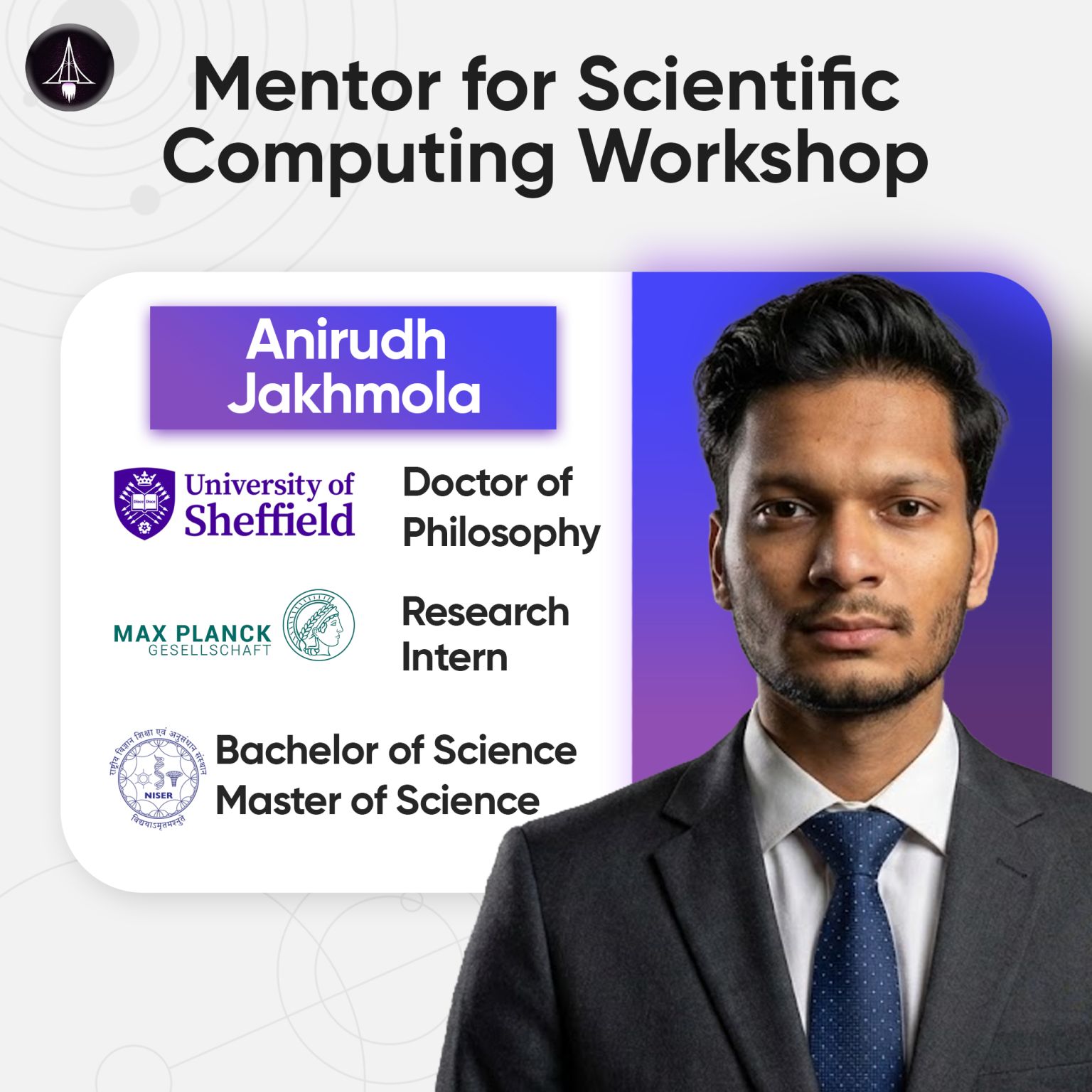
SciAstra Scientific Computing Workshop: Mentors
The mentors who will be teaching in the workshop come from top-tier institutes such as the University of Sheffield and the Max Planck Institute for Multidisciplinary Sciences.
Mentors | Profile |
| PhD researcher at The University of Sheffield |
| Former Head of bioinformatics at 4baseCare |

Conclusion
Scientific Computing is a rapidly developing area that shapes the face of contemporary science, engineering, and technology. Its role in solving complicated problems, assessing risks, saving time, and fostering innovation has made it indispensable in space research and climate studies, as well as in healthcare, finance, and robotics. Given the dynamics of modern challenges, the demand for modellers, simulators, and analysts is unprecedented. Learning Scientific Computing enables one not just to enter a wide array of well-paid positions but also contributes to activities relevant to society.