NEET 2026 Vs IAT 2026 Syllabus: NEET and IAT are two of the most popular undergraduate-level entrance exams for Science students after Class 12. NEET paves the way to promising careers in the medical field, but it is among the most competitive exams in India. Therefore, candidates who appear for NEET also appear for other entrance exams to explore various career paths. One of the excellent alternatives to NEET is IAT, an exam that helps candidates get admission to the Indian Institutes of Science Education and Research (IISERs) and pursue careers in Science and Research.
If you are planning to appear for IAT 2026 along with NEET 2026, you must know the syllabi of the two exams and the key differences between them. This SciAstra article highlights the differences between the NEET 2026 syllabus and the IAT 2026 syllabus. This will help you modify your preparation strategy according to the syllabus and score well in both exams.
What is IAT?
The IISER Aptitude Test (IAT) is a national-level entrance exam conducted for admission to undergraduate courses offered by the Indian Institutes of Science Education and Research (IISERs). These courses include integrated BS-MS, BTech, and 4-year BS programmes.
IISc Bangalore also accepts IAT scores for admission to its Bachelor of Science (Research) Programme. To check the details of the courses offered through IAT at a particular participating institute, candidates must visit the official website of that institute.
If you are planning to appear for IAT 2026, check out the complete overview of the exam below:
IAT 2026 Overview | |
Features | Details |
Exam Name | IISER Aptitude Test (IAT), IISER Entrance Exam |
Exam Organising Institute | One of the IISERs |
Exam Level | Undergraduate Level |
Courses Offered |
|
Exam Mode | Online |
Exam Frequency | Once a year |
Registration Fee | Gen/OBC/OBC-NCL/EWS - INR 2,000 SC/ST/KM/PwD - INR 1,000 Note: The registration fee is subject to change |
Type of Question | Multiple Choice Question (60 questions) |
IAT Negative Marking Scheme | Each correct response = +4 marks Each incorrect response = -1 mark Each unattempted response = 0 mark |
Official Website | |
What is NEET?
The National Entrance Cum Eligibility Test (NEET) is a national-level entrance examination in India conducted by the National Testing Agency (NTA). It is mandatory for students who wish to pursue medical and allied health science courses after Class 12.
To know more about NEET, check out the overview of the exam below:
NEET UG Overview | |
Exam conducting body | National Testing Agency (NTA) |
Official website | |
Exam level | National Level |
Exam frequency | Once a year |
Exam mode | Offline |
Offered courses | MBBS, BDS, BSc Nursing, BAMS, BUMS, BVSC & AH |
Exam duration | 3 hours |
Exam medium | 13 Languages including: English, Hindi, Bengali, Urdu, Assamese, Gujarati, Marathi, Odia, Kannada, Tamil, Malayalam, Punjabi and Telugu |
Total marks | 720 marks |
Total questions | 180 questions |
Marking scheme | Each correct response = +4 marks Each incorrect response = -1 mark Not attempted questions = 0 mark |
Colleges accepting the exam scores | 1600+ government and private colleges |
IAT Vs NEET: Dates
Candidates who are targeting both exams, IAT 2026 and NEET 2026 can check all the dates related to their important events here.
IAT 2026 Dates
The application form for IAT is generally released in the month of March, based on recent exam schedules. Therefore, the IAT 2026 application form is also expected to be released in March 2026. All the important dates related to the exam are given below.
IAT 2026 Dates | |
Event Name | Dates (Tentative) |
IISER 2026 Notification | Fourth week of January 2026 |
IISER Application Form 2026 | March 2026 - April 2026 |
IISER Admit Card 2026 | Third Week of May |
IISER Exam 2026 | Fourth week of May 2026 |
IISER Provisional Answer Key 2026 | The same day after the exam |
IISER Final Answer Key 2026 | Third week of June 2026 |
IISER 2026 Result | Fourth week of June 2026 |
IAT 2026 Counselling | July 2026 |
NEET 2026 Dates
The dates for NEET 2026 are expected to be announced soon. Once released, all the exam dates will be provided here. Based on last year’s exam schedule, check out the tentative dates for NEET 2026 below:
NEET 2026 Dates | |
Exam Events | Dates (Tentative) |
Exam Notification | February 2026 |
Application Form Start Date | February 2026 |
Registration Last Date | March 2026 |
Application Correction Window | March 2026 |
Admit Card | April 2026 |
Exam Date | First Week of May 2026 |
Answer Key | First week of June 2026 |
Result | Second/ Third week of June 2026 |
Counselling | July 2026 |
IAT Vs NEET: Syllabus
The syllabi for NEET and IAT are based on Class 11 and Class 12. However, there are some key differences between them that candidates preparing for both exams must know. The differences between the NEET 2026 syllabus and the IAT 2026 syllabus have been highlighted as follows.
NEET 2026 Syllabus PDF (Official) | |
IAT 2026 Syllabus PDF (Official) | To be released |
NEET Only Includes PCB
The syllabus of NEET has three sections: Physics, Chemistry and Biology. It includes topics from Class 11 and Class 12 NCERT Physics, Chemistry and Biology textbooks. The IAT syllabus includes NCERT Class 11 and Class 12 Physics, Chemistry, Biology and Maths.
IAT Vs NEET Syllabus: Differences in Topics
Check out the comparison between the topics covered in the NEET syllabus and the topics covered in the IAT syllabus:
IAT Vs NEET Syllabus: Differences in Topics | ||
Biology | NEET | IAT |
Some plant families have been added in NEET out of NCERT (malvaceous, cruciferae, compositae & graminae). Dengue and chikungunya, which have been added to the Health and diseases section of the NEET syllabus. | All topics from the NCERT Class 11 and Class 12 syllabi. | |
Physics | No change (All the topics of ncert is the syllabus). | No change (All the topics of ncert is the syllabus). |
Chemistry | The S & P block and gaseous state have been added to the NEET syllabus as compared to the NCERT but not in the IAT syllabus. | S & P block and gaseous state topics have not been covered in the IAT syllabus. |
Maths | In NEET, there is no maths section. | But in IAT, all the topics of NCERT are in the syllabus, but questions of much higher understanding are asked as compared to NCERT. |
IAT Vs NEET: Exam Difficulty Level
In order to compare the difficulty level of NEET and IAT, SciAstra mentors have analysed the previous years’ question papers of these exams. The parameters for comparison are the nature of the questions, the number of questions and the required number of correct answers to score well in the exam.
Check out the comparison between the difficulty levels of IAT and NEET:
NEET Vs IAT Comparison | |
Biology | Nature of Questions: IAT Biology questions are a level higher than NEET questions but NEET has more questions, which needs speed. Number of Questions: The IAT Biology section has 15 questions. There are 90 questions in the Biology section for NEET. Required Number of Correct Questions: For IAT, candidates need at least 10+ correct answers with zero wrong answers. For NEET, they need at least 80+ correct answers as per the PYQ of 2025 but 85+ correct answers as per the rest of the PYQ trend. Conclusion: Both exam have their own challenges IAT wants more in-depth knowledge, while NEET is more oriented towards speed and accuracy. |
Physics | Nature of Questions: IAT Physics questions are more research-orientated than NEET questions but NEET has formula-based questions at a level higher than NCERT except for NEET 2025 which had advanced difficulty of physics section. Number of Questions: The IAT Physics section has 15 questions. There are 45 questions in the Physics section for NEET. Required Number of Correct Questions: For IAT, candidates need at least 10+ correct answers with zero wrong answers. For NEET, they need at least 30+ correct answers as per the PYQ of 2025 but 38+ correct answers as per the rest of the PYQ trend. Conclusion: IAT requires more advanced-level practice, while NEET is easier to prepare for. |
Chemistry | Nature of Questions: IAT Chemistry questions are a level higher than NEET questions but NEET has more questions and NEET has varying questions and there is unpredictability. Number of Questions: The IAT Physics section has 15 questions. There are 45 questions in the Physics section for NEET. Required Number of Correct Questions: For IAT, candidates need at least 12 correct answers with zero wrong answers. For NEET, they need at least 35+ correct answers as per the PYQ of 2025 but 40+ correct answers as per the rest of the PYQ trend. Conclusion: IAT preparation requires more in-depth knowledge (research-orientated application). Candidates can also do NEST PYQ), while NEET is more oriented towards Basics and NCERT depth knowledge. |
IAT Chapter-Wise Analysis
Academic experts at SciAstra have analysed IAT question papers from 2023 to 2025. Based on the analysis, we are providing the information about the most important topics for the IAT Physics, Chemistry, Maths and Biology sections. These details are available below:
IAT Chapter-Wise Analysis: Biology
As per the IAT chapter-wise analysis, the most important Biology topics/chapters for IAT are Human Physiology, Plant Physiology, Genetics, Molecular Biology and Reproduction (Human Health).
Biology | ||||
Section | Chapters | 2023 | 2024 | 2025 |
Diversity | - | 1 | 1 | |
Morphology and Anatomy | 2 | 1 | - | |
Cell Biology and Biomolecules | Cell Biology | 1 | - | 1 |
Biomolecules | 2 | - | 1 | |
Plant Physiology | 1 | 2 | 2 | |
Human Physiology | 1 | 3 | 3 | |
Molecular Biology | Genetics | 1 | 1 | 2 |
Molecular Biology | 1 | 1 | 2 | |
Evolution | 1 | - | - | |
Human Health | Human Health & Disease and Microbes in Human Welfare | 1 | 1 | - |
Reproduction | 2 | 2 | 1 | |
Biotechnology | 1 | 2 | 1 | |
Ecology | 1 | 1 | 1 | |
IAT Chapter-Wise Analysis: Chemistry
The Chemistry chapters from which most of the questions have been asked in the past 3 years in IAT are Aldehydes, Ketones and Carboxylic Acids, Chemical Bonding and Thermodynamics.
Chemistry | ||||
Section | Chapters | 2023 | 2024 | 2025 |
Physical | Some Basic Concepts of Chemistry | - | - | - |
Atomic Structure | 1 | 1 | 1 | |
Thermodynamics | 2 | 1 | 1 | |
Equilibrium | - | - | - | |
Solution | 1 | 1 | - | |
Electrochemistry | - | 1 | 2 | |
Chemical Kinetics | - | 1 | 1 | |
Inorganic | Periodicity | - | 1 | 1 |
Chemical Bonding | 1 | 2 | 2 | |
Coordination | - | 2 | 1 | |
d- & f- block | - | - | 1 | |
Organic | Introduction To Organic And GOC | 2 | 1 | - |
Hydrocarbon | 1 | 1 | - | |
Alcohol Phenol and Ether | - | 1 | - | |
Haloalkanes and Haloarenes | 1 | - | - | |
Aldehyde Ketone and Carboxylic Acids | - | - | 5 | |
Amines | - | 1 | - | |
Biomolecules | 1 | 1 | - | |
IAT Chapter-Wise Analysis: Physics
The Physics chapters from which most of the questions were asked in the past years in IAT are Modern Physics, Rotation, Magnetism and Simple Harmonic Motion. There is a probability that most questions from these topics will occur in the IAT 2026 question paper.
Physics | ||||
Section | Chapters | 2023 | 2024 | 2025 |
Mechanics | Kinematics | 1 | 1 | - |
Laws Of Motion | - | - | 2 | |
Work Power Energy | - | - | 1 | |
System of Particles | - | - | - | |
Rotation | 2 | 2 | 1 | |
Oscillation | Simple Harmonic Motion | - | 3 | |
Waves | 1 | - | 2 | |
Mechanical Properties of Matter | Properties of Matter | - | - | - |
Fluid Mechanics | - | 1 | - | |
Kinetic Theory of Gases | - | 1 | - | |
Thermodynamics | 1 | 1 | - | |
Gravitation | 1 | - | - | |
Electricity | Electrostatics | 2 | 1 | 1 |
Capacitors | - | 1 | - | |
Current | 2 | - | 1 | |
Electromagnetism | Magnetism | 1 | 1 | 2 |
Electromagnetic Induction | 1 | - | - | |
Alternating Current | - | 1 | - | |
Electromagnetic Wave | - | - | - | |
Optics | Ray Optics | 2 | - | 2 |
Wave Optics | - | - | - | |
Modern Physics | Modern Physics | - | 2 | 3 |
Semiconductors | 1 | - | - | |
IAT Chapter-Wise Analysis: Mathematics
As per the IAT chapter-wise analysis, the most important Mathematics topics/chapters for IAT are Application of Derivatives, Continuity & Differentiability, Functions, Straight Lines, and Probability.
Mathematics | ||||
Section | Chapters | 2023 | 2024 | 2025 |
Algebra | Set Theory | - | - | 1 |
Quadratic Equation | 1 | - | - | |
Complex number | - | 1 | 1 | |
Sequence & Series | - | 1 | 1 | |
Binomial Theorem | - | 1 | 1 | |
Matrices & Determinants | 1 | 1 | 1 | |
Mathematical induction | - | - | - | |
Differential Calculus | Basic Maths | 1 | - | - |
Relations | - | - | - | |
Functions | 1 | 1 | 1 | |
Application of Derivatives | 2 | 1 | 1 | |
Continuity & Differentiability | 1 | 1 | 2 | |
Limits | - | - | - | |
Probability and Statistics | Probability | 1 | 1 | 1 |
Statistics | 1 | - | - | |
Permutation & Combination | - | - | 1 | |
Integral Calculus | Differential Equation | 1 | 1 | 1 |
Indefinite & Definite Integral | 1 | 1 | 1 | |
Area under Curve | 1 | 1 | - | |
Geometry | Straight Lines | 1 | 2 | - |
Conic Sections | 1 | - | 1 | |
Circles | 1 | - | - | |
Vectors | - | 1 | 1 | |
3D geometry | - | 1 | - | |
Trigonometry | Trigonometric Equation | - | - | - |
IAT Weightage Trends
Knowing the chapters on which you can focus more on for IAT 2026 preparation can help you improve your overall scores. For this, you must know the weightage of Class 11 and Class 12 chapters from which most of the questions were asked in IAT in the past. Based on the analysis of the IAT previous question papers (2017-2025), SciAstra has also provided chapter-wise weightage for Physics, Chemistry, Biology and Mathematics. Check out these details below.
IAT Biology Weightage
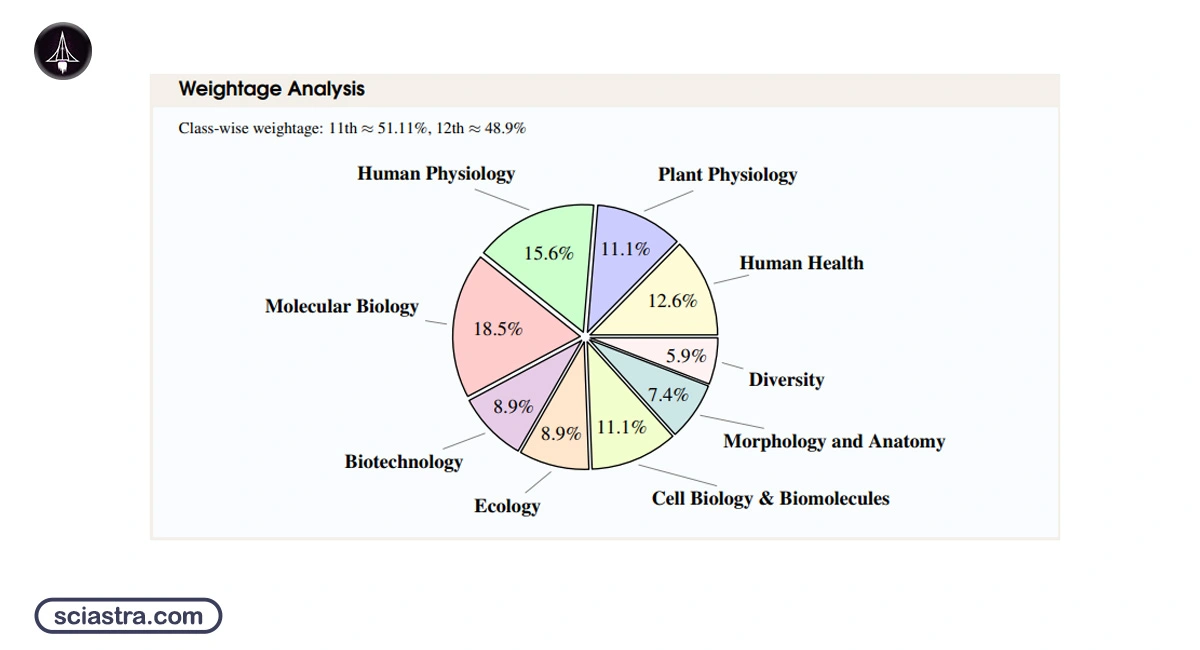
Based on the weightage analysis for the IAT Biology section, the most important chapters are Molecular Biology (with 18.5% weightage), Human Physiology (with 15.6% weightage) and Human Health (with 12.6% weightage). Check out the complete weightage analysis for the subject below:
IAT Chemistry Weightage
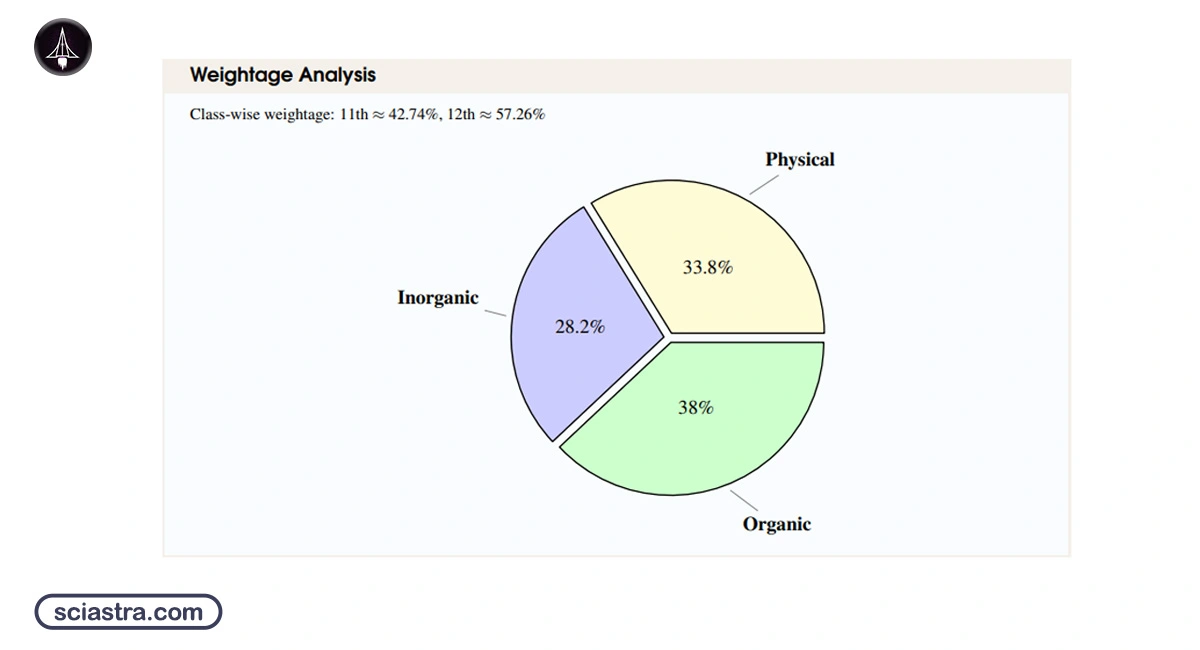
The most important chapters for the IAT Chemistry section are Organic Chemistry (with 33.8% weightage) and Inorganic Chemistry (with 28.2% weightage).
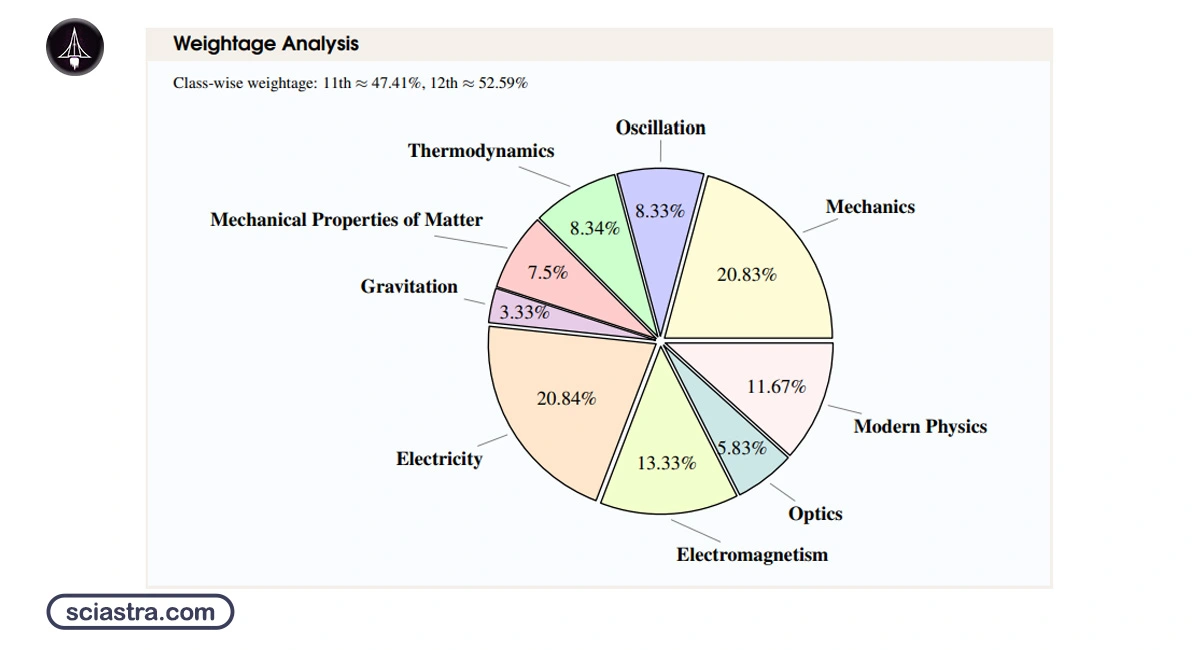
IAT Physics Weightage
According to the weightage analysis for the IAT Physics section, the most important chapters are Electricity (with 20.84% weightage), Mechanics (with 20.83% weightage) and Electromagnetism (with 13.33% weightage). Check out the complete weightage analysis for the subject below:
IAT Mathematics Weightage
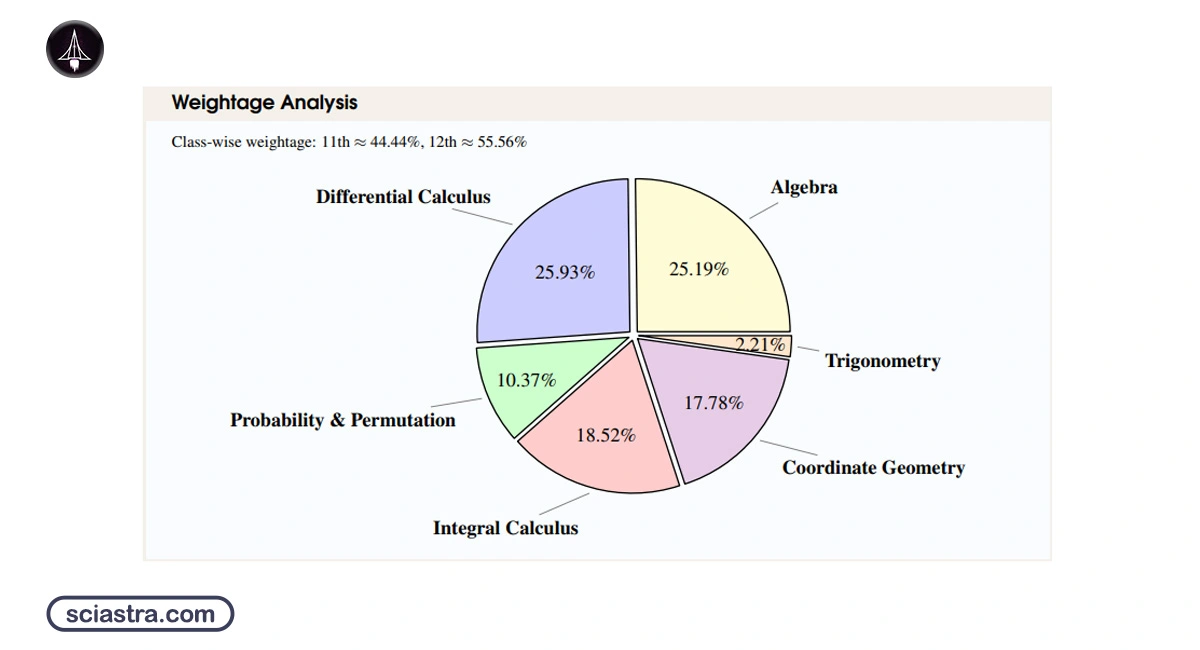
The Maths chapters with the highest weightage for the IAT Mathematics section are Differential Calculus (with 25.93% weightage), Algebra (with 25.19% weightage) and Coordinate Geometry (with 18.5% weightage). The complete weightage analysis for the subject is below:
Conclusion
Both IAT and NEET happen to be extremely competitive national-level entrance tests but are targeted toward different career paths. IAT suits those students who have an inclination towards scientific research, interdisciplinary learning, and problem-solving skills. On the other hand, NEET will be ideal for aspirants who have a dream of getting into medicine and other allied health science-based courses that require one to have speed, accuracy, and excellent command over concepts based on NCERT. Chapter-wise analysis and weightage trends are proof that IAT requires deeper conceptual understanding and analytical skills, while NEET basically aspires for extensive syllabus coverage and time management. The choice between IAT and NEET should be determined by a student's subject preference, aptitude, and long-term career vision. Candidates will be able to plan a focused and effective preparation strategy with a clear understanding of the differences outlined in this article for IAT 2026, NEET 2026, or both.
Best Books for IAT 2026 Preparation
Crack IAT 2026 with SciAstra’s Expert-Guided Prep Books!
Dive in and see how easy structured IAT prep can be.
SciAstra IAT & NEST Prep Books | ||
Features | Books | Purchase Link 👇 |
☑️ IAT & NEST Level Theory ☑️ Chapter-Wise IAT PYQs (2017–24) ☑️ Answer Keys for All Questions ☑️ Diagram-Based Questions | Biology (Class 11) | |
Biology (Class 11) | ||
Chemistry (Class 11) | ||
Chemistry (Class 12) | ||
Physics (Class 11) | ||
Physics (Class 12) | ||
Maths (Class 11) | ||
Maths (Class 12) | ||