Are you planning to appear for both the upcoming NEET and NEST exams? To prepare for both exams simultaneously, one needs to have a strategic approach to cover both exam syllabi.
Recently, NEET 2026 has released its updated syllabus on the official website. Also, the NEST 2026 exam notification is out, and the exam conducting authority mentioned the NEST 2026 syllabus. A detailed comparison of the NEST vs NEET 2026 syllabus plays an important role in taking admissions in their desired institutes.
NEET and NEST are two highly competitive national-level exams, but they serve very different purposes. A clear comparison helps students identify syllabus overlap, topic weightage, and exam difficulty levels, enabling them to plan an effective preparation strategy.
This SciAstra article provides a detailed analysis of the NEET and NEST 2026 syllabi, exam timelines, and difficulty levels, with a special focus on NEST preparation. With the help of the SciAstra academic team, aspirants will also get guidance on study resources, mock tests, and structured learning support to help aspirants prepare confidently and make informed decisions about their exam journey.
NEET vs NEST 2026
This SciAstra article will compare NEET vs NEST 2026, which are two distinct national-level entrance exams with different objectives. NEET is designed for medical aspirants who are seeking admission to MBBS and related courses, focusing on PCB subjects. In contrast, NEST targets science and research-oriented students, emphasising on the conceptual understanding across Physics, Chemistry, Mathematics, and Biology.
What is NEST 2026?
NEST, National Entrance Screening Test, is conducted every yera to provide admissions to the five-year Integrated MSc programme in Biology, Chemistry, Mathematics, and Physics at NISER, UM-DAE-CEBS.
NEST 2026 application form will be released online on January 5, 2026, on the official website, i.e., nestexam.in. Candidates who meet the NEST 2026 eligibility criteria, including educational qualifications, nationality, and other requirements, will be able to fill out the NEST 2026 registration form until April 6, 2026.
Also Read: NEST 2026 Eligibility Criteria
Check out the NEST 2026 overview from here:
Features | Details |
Exam Name | National Entrance Screening Test (NEST) |
Exam Conducting Body | National Institute of Science Education and Research (NISER), Bhubaneswar University of Mumbai – The Department of Atomic Energy, Centre for Excellence in Basic Sciences, Mumbai |
Exam Level | Undergraduate Level |
Courses Offered | 5-year MSc in Physics 5-year MSc in Chemistry 5-year MSc in Biology 5-year MSc in Mathematics |
Exam Mode | Online (Computer-Based Test) |
Exam Frequency | Once a year |
Registration Fee | Female candidates (all categories) – INR 700 SC//ST/PwD candidates – INR 700 Male candidates (UR/UB category) – INR 1,400 Note: The registration fees are subject to change. |
Type of Question | Multiple Choice Question (80 questions) |
Marking Scheme | +3 Marks will be awarded for correct answer -1 Mark will be deducted for the incorrect answer |
Official Website |
What is NEET 2026?
NEET 2026 exam is again a national-level entrance examination, which is conducted by NTA guidelines set by the National Medical Commission (NMC) to provide admissions to the undergraduate medical and allied health science courses in India.
Candidates who wish to take enrolment in courses like MBBS, BDS, AYUSH, BVSc, and other medical programmes offered by government and private institutions it is mandatory to take the NEET 2026 exam. The exam will test candidates on Physics, Chemistry, and Biology domain knowledge based on the Class 11 and 12 syllabus
Also Read: How to Crack NEET in 30 Days
Check out the NEET 2026 exam overview from here:
NEET UG Overview | |
Exam conducting body | National Testing Agency (NTA) |
Official website | |
Exam level | National Level |
Exam frequency | Once a year |
Exam mode | Offline |
Offered courses | MBBS, BDS, BSc Nursing, BAMS, BUMS, BVSC & AH |
Exam duration | 3 hours |
Exam medium | 13 Languages including: English, Hindi, Bengali, Urdu, Assamese, Gujarati, Marathi, Odia, Kannada, Tamil, Malayalam, Punjabi and Telugu |
Total marks | 720 marks |
Total questions | 180 questions |
Marking scheme | Each correct response = +4 marks Each incorrect response = -1 mark Not attempted questions = 0 mark |
Colleges accepting the exam scores | 1600+ government and private colleges |
Also Read: Which is Better? NEST or NEET?
NEET vs NEST 2026 Exam Dates
The NEST 2026 exam dates have been released, and the exam authorities have scheduled the NEST 2026 examination to be conducted on June 6, 2026. Meanwhile, the National Testing Agency (NTA), the conducting body for NEET, is yet to release the NEET 2026 notification for the 2026–27 academic session.
It is important for aspirants appearing for the NEET 2026 and NEST 2026 examinations to be aware of the complete admission timelines in order to plan their preparation in a structured and efficient manner. Both examinations follow a well-defined schedule that includes the release of official notifications, application form submission, admit card release, examination dates, result declaration, and counselling or admission processes.
Check out the NEET 2026 and NEST 2026 exam date outlines for all major events below:
Exam Events | NEET 2026 (Tentative Dates) | NEST 2026 |
Exam Notification | February 2026 | 15-Dec-2025 |
Application Form Start Date | February 2026 | 5-Jan-2026 |
Registration Last Date | March 2026 | 6-Apr-2026 |
Application Correction Window | March 2026 | 13-Apr-2026 (From 10:00 am) to 14-Apr-2026 (Till 10:00 am) |
Admit Card | April 2026 | 15-May-2026 |
Exam Date | First Week of May 2026 | 6-Jun-2026 |
Answer Key | First week of June 2026 | Second week of June 2026 |
Result | Second/ Third week of June 2026 | Last week of June 2026 |
Counselling | July 2026 | Second week of July 2026 |
Also Read: NEST 2026 Exam Dates
NEET vs NEST 2026 Syllabus Comparison
The exam officials of both the exams has released its syllabi on the official website. While starting the NEST 2026 & NEET 2026 exam preparation, the very first thing that candidates must do is anlayising the syllabus of the exam. NEET focuses on Physics, Chemistry, and Biology strictly aligned with the Class 11 and 12 curriculum for medical admissions, whereas NEST covers Physics, Chemistry, Mathematics, and Biology with a strong emphasis on analytical thinking and problem-solving skills.
Check out the syllabi of both the exams from here:
Exam | Syllabus Download |
NEET 2026 Syllabus | |
NEST 2026 Syllabus |
Candidates can check out the NEET 2026 and NEST 2026 syllabus comparison from here:
NEST vs NEET Syllabus: Differences in Topics | ||
NEET | NEST | |
Biology | Some plant families have been added in NEET out of NCERT ( malvaceae, cruciferae, compositae & graminae) as compared to NEST | Digestion and absorption added in the NEST syllabus. |
Dengue, Chikungunya added in the Health and diseases section of both NEET and NEST syllabus. | ||
Physics | There is no change in the syllabus. One can say that the syllabus of NEST and NEET are quite similar. However, the level of questions is very different.
| |
Chemistry | S & P block and gaseous state is added in NEST & NEET syllabus as compared to NCERT | |
Maths | In NEET, there is no maths section. | |
Also Read: NEST 2026 Exam Pattern
NEST vs NEET Exam Difficulty Level Comparison
NEST vs NEET 2026 exam difficulty level comparison will help the aspirants to understand the level of preparation and skill set required which is required to ace botht the exam separately. Although in both the exams, the exam officials will test the domain knowledge in science concepts, but they differ significantly in terms of depth of concepts, number of questions asked in the exam and analytical demands.
SciAstra academic team has curated the NEST and NEET 2025 exam difficulty level comparison across subjects, enabling candidates to assess their strengths and align their preparation strategies accordingly.
NEET Vs NEST Comparison | |
Biology | Level of MCQ Questions- NEST questions require an in-depth knowledge. Usually, they are lengthy and more research-based than NEET questions, but NEET has more questions, which need speed. Number of Questions - There are 20 Biology questions that are asked in the NEST, and there will be 90 Biology MCQ questions for the NEET exam. Comparison- Both the exams have their own challenges. IAT questions require more in-depth knowledge, while NEET is more oriented towards speed and accuracy. Required number of correct questions - NEST needs at least 15 correct answers with zero wrong answers (for 2025) & needs at least 12 correct answers with zero wrong answers (as per the rest of the years), and NEET needs at least 80+ correct answers as per PYQ of 2025 but 85+ correct answers as per the rest of the PYQ trend. |
Physics | Level of MCQ Questions- NEST questions are more focused on an in-depth knowledge level higher than NEET questions, but NEET has formula-based questions, which are a level higher than NCERT, except for NEET 2025, which had advanced difficulty in physics. Number of questions - There will be 20 MCQ questions for NEST, and NEET will have 45 MCQ questions. Comparison - NEST wants more conceptual clarity, while NEET needs formula revision. Required number of correct questions - NEST needs at least 11+ correct answers with zero wrong answers and NEET needs at least 30+ correct answers as per PYQ of 2025, but 38+ correct answers as per the rest of the PYQ trend. |
Chemistry | Level of MCQ Questions- The questions asked in the IAT exam are a level higher than NEET questions, but NEET has more questions, and NEET has varying questions, and there is unpredictability. Number of Questions- There will be 20 MCQ questions for NEST, and NEET will have 45 MCQ questions. Comparison - IAT wants more in-depth knowledge(research-oriented application, can also do NEST PYQ), and NEET is more oriented towards Basics and NCERT depth knowledge. Required number of correct questions - NEST needs at least 13 correct answers with zero wrong answers, and NEET needs at least 35+ correct answers as per PYQ of 2025, but 40+ correct answers as per the rest of the PYQ trend. |
NEET vs NEST cut off comparison
Based on previous years’ trends, a NEST 2026 safe score is generally considered to be 105 marks or above, as observed from the 2025 previous year question paper (PYQ) analysis, However in the past years, apart from 2025 admissions sessions, a score of 85 marks or above has been sufficient for admission.
Likewise, NEET 2026 safescore is anticipated to be around 650 marks or higher (As per 2024 or other years session admissions) However, in NEET 2025, due to the comparatively higher difficulty level of the paper, the safe score dropped to approximately 530 marks.
Also Read: NEST 2026 Selection Process: Merit List, SMAS & MAP
NEST Topic Trend Analysis
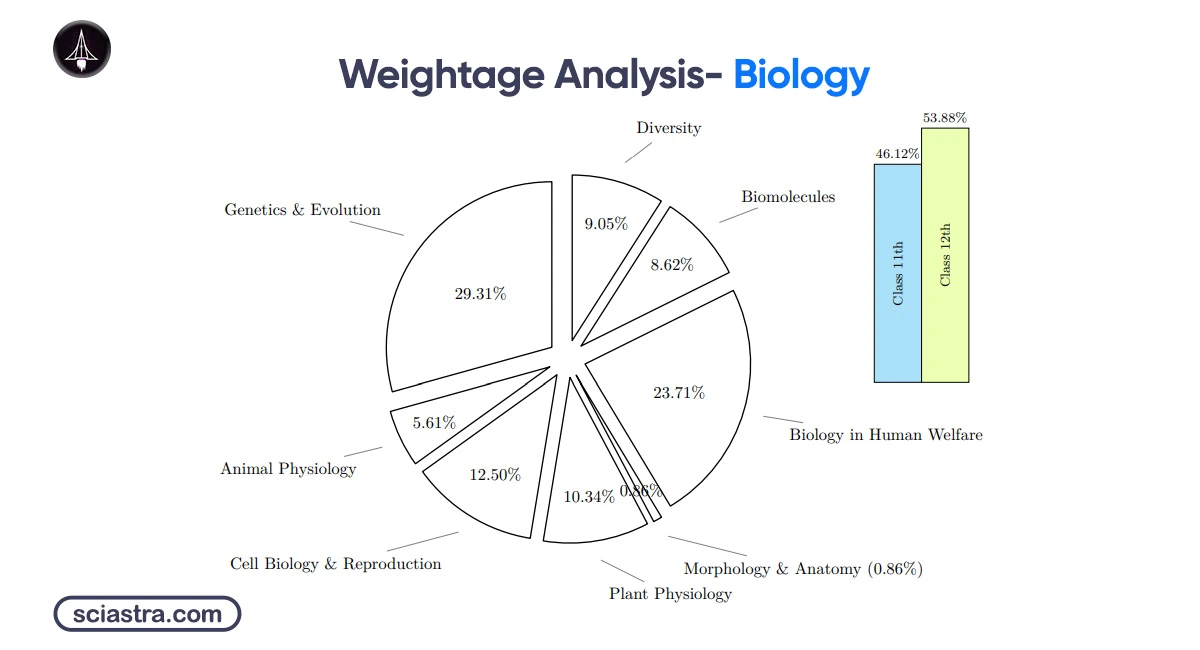
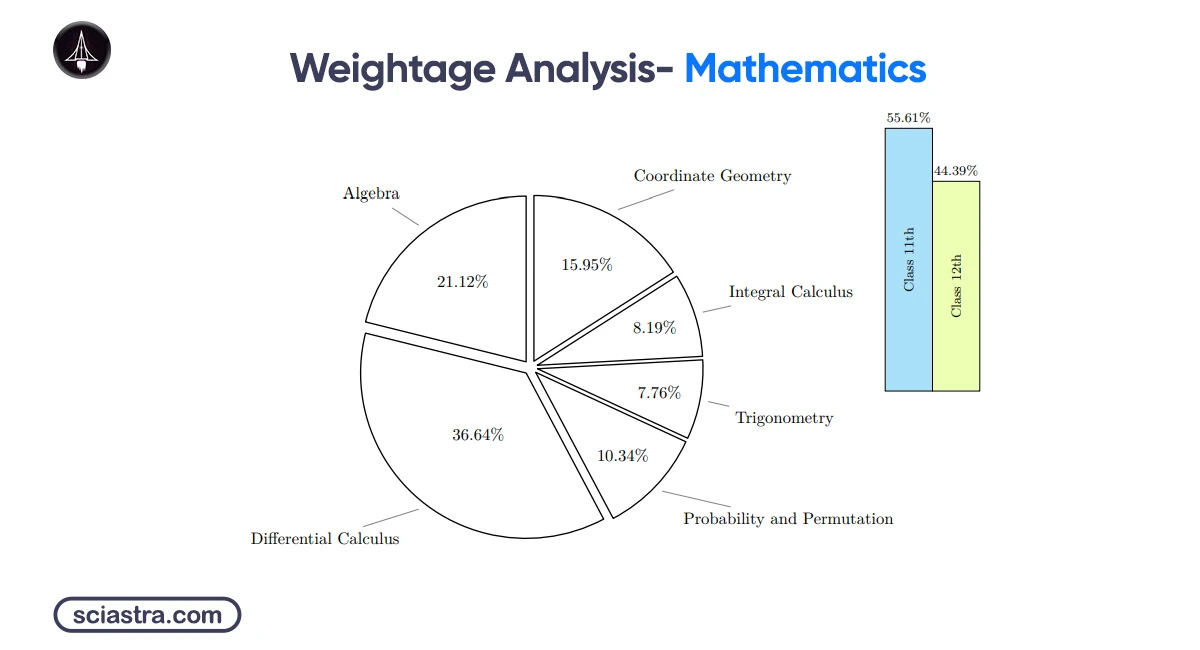
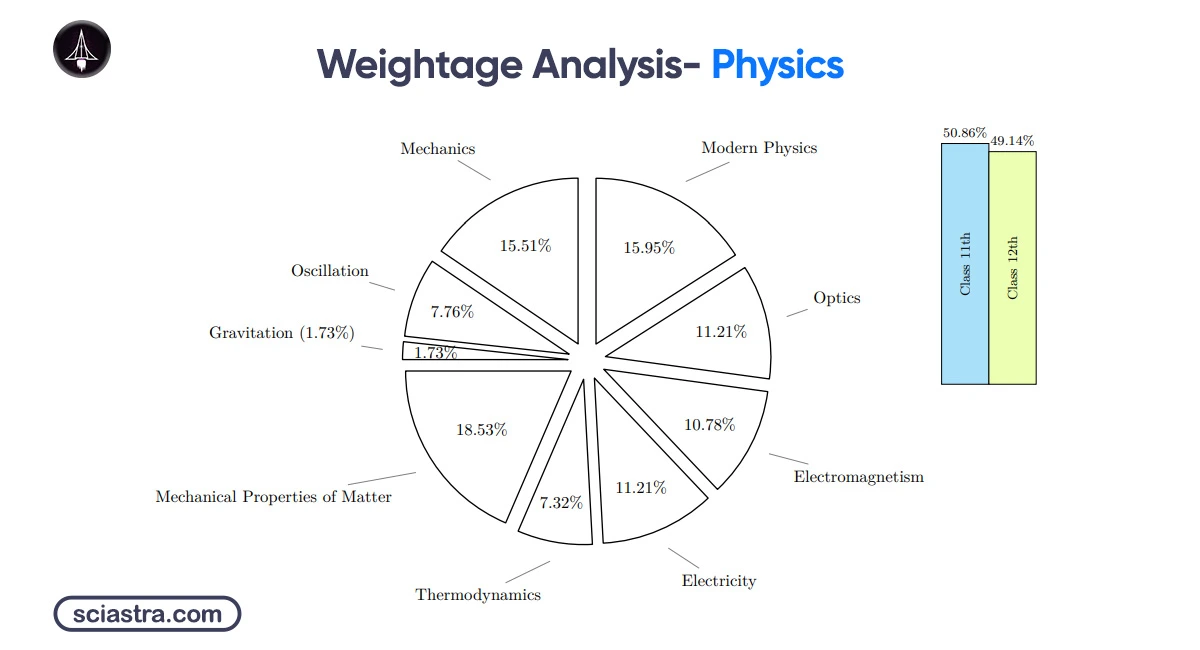
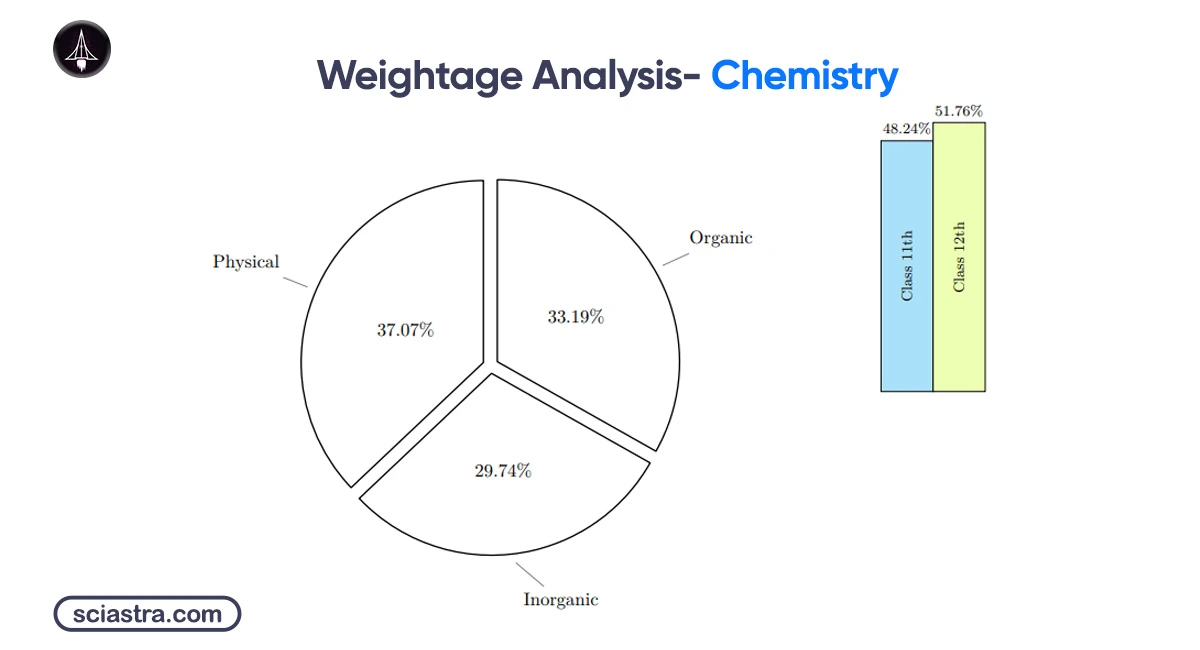
It is essential for candidates to understand that while preparing for NEST 2026, their topmost priority should be to cover the entire syllabus thoroughly. To enhance their preparation and achieve a higher score, candidates should be aware of the chapter-wise weightage based on previous year trends.
Based on the NEST 2024 unit wise trends, here is the subject wise NEST weightage analysis
Biology
Mathematics
Physics
Chemistry
Conclusion
For the aspirants who are aiming for both the NEST and NEET examinations, it becomes very important for them to understand the key differences in the syllabus. In this SciAstra blog, the NEET vs NEST 2026 syllabus comparison will highlight that both examinations test a strong foundation in Physics, Chemistry, and Biology, but their objectives and preparation strategies differ significantly. Also, candidates appearing for the NEST exam need to prepare for the Mathematics subject.
NEET primarily focuses on medical aspirants with a syllabus aligned to Class 11 and 12 concepts and strong domain knowledge in Biology. Whereas NEST emphasizes analytical thinking, problem-solving skills, and conceptual depth for students aiming for research-oriented science programmes. Therefore, candidates preparing for both exams need to understand the differences in syllabus structure, exam difficulty, and topic weightage, which will help the aspirants in planning their preparation more effectively.
Also Explore!
NEET examination is highly competitive, where a large number of aspirants appear each year for a limited number of medical seats. Likewise, students who pursue their career in research-oriented fields in the Science domain, the NEST exam is one of the most recognised ones.
For the exam preparation of such exams where seats are limited, the right guidance, high-quality study material, and consistent practice under real exam conditions are required. SciAstra offers a comprehensive and result-oriented learning ecosystem designed to help aspirants strengthen their conceptual understanding and maximise their performance.
SciAstra Batches
Candidates can enrol in SciAstra’s expert-led preparation batches, curated specifically for NEST and NEET aspirants, which focus on concept clarity, problem-solving skills, and exam-oriented strategies.
Exam Name | Batch Name | Link |
NEST |
| Homi Batch Vikram Batch Raman Batch Kalam Batch |
NEET | Homi 3. 0, Vikram 3.0, Raman 3. 0 |
SciAstra Books
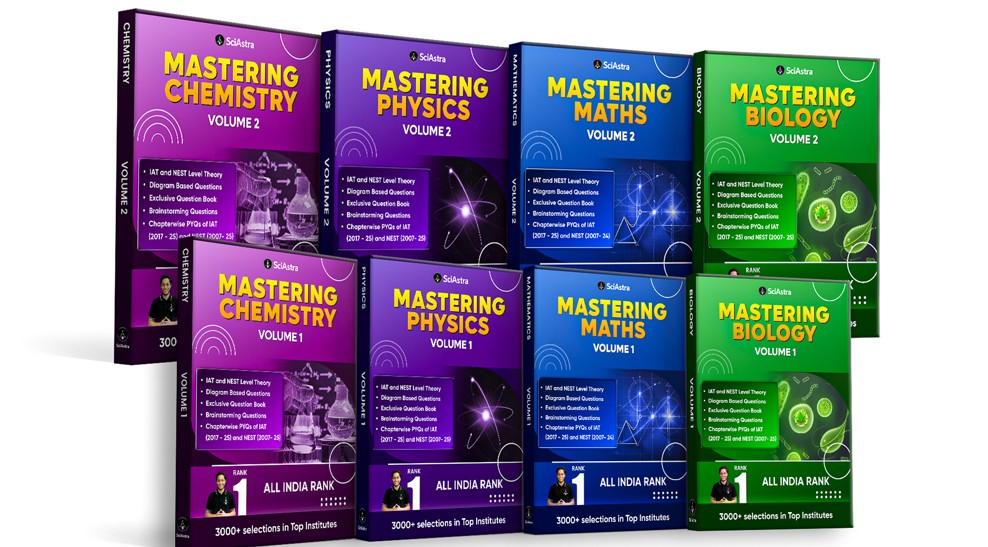
Additionally, SciAstra also provide well-researched NEST preparation books which will cover the complete syllabus with chapter-wise explanations, solved examples, and practice questions aligned with the latest exam pattern. Check out the book links from here-
SciAstra Focus Test Series
To enhance the exam preparation of the candidates, SciAstra offers the FOCUS test series, which offers real-time exam simulations, detailed performance analysis and insights into strengths and improvement areas. Check out the NEST 2026 FOCUS Test Series, NEET 2026 FOCUS Test Series from here-