




.webp)







The NEST 2026 result was announced on June 24, 2026 on the official NEST exam website - nestexam.in. Thereafter, NISER Bhuabneswar and CEBS Mumbai will release the exam scorecard for the qualified candidates on June 30, 2026 on the same website.
Earlier, the exam authorities published the final answer key for the exam on June 17, 2026 on the official NEST exam website – nestexam.in. Check out the complete details of the admission process, including the application form, exam dates, exam pattern, syllabus, admit card, result, cutoff, counselling, and other important information on the NEST exam in this SciAstra article.
NEST 2026 Exam Analysis
The NEST 2026 exam was conducted on June 6, 2026, in online (CBT) mode. Based on feedback collected from candidates, the Physics section was generally considered to be of moderate difficulty. Opinions on the Biology and Chemistry sections varied, with some students finding them relatively easy, while others felt they were moderately challenging. The Mathematics section saw lower participation, as many candidates either skipped it entirely or attempted only a limited number of questions.
Several students also mentioned that SciAstra's preparation initiatives, such as the 50 Most Important Questions, Rescue Series, and Maha Revision/Marathon sessions, played a valuable role in their preparation. According to them, these resources helped reinforce important concepts and enabled them to solve multiple questions in the exam with greater confidence.
The exam was conducted according to the NEST 2026 exam pattern and included 80 multiple-choice questions (MCQs). The question paper will consist of four sections: Mathematics, Physics, Chemistry, and Biology. For merit list preparation, only the best three subject scores will be considered.
Latest Update:
NEST 2026 Final Answer Key OUT
NEST Answer Key 2026 Release Date
The NEST 2026 provisional answer key was released on June 9, 2026. The answer key objection window is open from June 10, 2026 to June 12, 2026.
Steps to Download NEST Answer Key 2026
The NEST answer key 2026 will only be made available online at nestexam.in. The steps to download it are mentioned below:
Go to the official NEST exam website – nestexam.in.
Click on the “Login” option and enter Application No./Login ID and password.
Enter the given Captcha Code.
Click on the “Login” option below.
The answer key will be displayed on the screen.
Download and save it as a PDF.
NEST 2026 Admit Card
The NEST Admit Card 2026 was released on May 18, 2026 on the official website. Candidates were able to download the NEST hall ticket 2026 by logging in to their registered accounts with the help of the username and password. The NEST admit card 2026 is a piece of information that acts as an online document to display the exam centre and carries candidates' personal and exam paper details. Without the admit card, candidates will not be allowed to enter the examination hall.
How to Download NEST Admit Card 2026?
To download the admit card of NEST, candidates must visit the official NEST exam website. Once on the website, they can follow these simple steps to download their admit card:
Go to nestexam.in.
Click on the “Login” option.
Enter your application number or registered email address and password.
Submit these details.
Your admit card will be displayed on the screen.
Click on the download icon to save it as a PDF.
NEST 2026 Question Paper Solution
Check out the solution to the NEST 2026 question paper on YouTube:

Details Mentioned on NEET Admit Card 2026
The NEET 2026 admit card contains important information related to the candidate and examination. Students must carefully verify all details, including:
Candidate’s Name
Roll Number
Application Number
Exam Date and Time
Exam Centre Name and Address
Photograph and Signature
Reporting Time
Important Exam Day Instructions
NEST Syllabus 2026
Candidate’s domain knowledge in Physics, Chemistry, Mathematics and Biology will be tested by the exam officials from the specified NEST syllabus 2026. The exam officials will ask questions from the Science stream subjects of NCERT Class 11 and 12.
Check out the subject-wise headers of the NEST 2026 syllabus from here:
Subject Name | NEST Syllabus |
Biology | 1. Diversity in Living World2. Structural Organisation in Animals and Plants 3. Cell Structure and Function 4. Plant Physiology 5. Human Physiology 6. Reproduction7. Genetics and Evolution8. Biology and Human Welfare9. Biotechnology and Its Applications10. Ecology and environment |
Chemistry | Some Basic Concepts of Chemistry, Structure of Atom, Classification of Elements and Periodicity in Properties, Chemical Bonding and Molecular Structure, States of Matter: Gases and Liquids, Thermodynamics, Equilibrium, Redox Reactions, Hydrogen, s- Block Elements (Alkali and Alkaline earth metals), Some p-Block Elements, Organic Chemistry – Some Basic Principles and Techniques, Hydrocarbons, Environmental Chemistry, Solid State, Solutions, Electrochemistry, Chemical Kinetics, Surface Chemistry, General Principles and Processes of Isolation of Elements, p-Block Elements, d and f Block Elements, Coordination Compounds, Haloalkanes and Haloarenes, Alcohols, Phenols and Ethers, Aldehydes, Ketones and Carboxylic Acids, Organic Compounds Containing Nitrogen, Biomolecules, Polymers, Chemistry in Everyday Life |
Physics | Physical World and Measurement, Kinematics, Laws of Motion, Work, Energy and Power, Motion of System of Particles and Rigid Body, Gravitation, Properties of Bulk Matter, Thermodynamics, Behaviour of Perfect Gas and Kinetic Theory, Oscillations and Waves, Electrostatics, Current Electricity, Magnetic Effects of Current and Magnetism, Electromagnetic Induction and Alternating Currents, Electromagnetic Waves, Optics, Dual Nature of Matter and Radiation, Atoms and Nuclei, Electronic Devices, Communication Systems. |
Mathematics | Sets, Relations and Functions, Trigonometric Functions, Principle of Mathematical Induction, Complex Numbers and Quadratic Equations, Linear Inequalities, Permutations and Combinations, Binominal Theorem, Sequence and Series, Straight Lines, Conic Sections, Introduction to Three- Dimensional Geometry, Limits and Derivatives, Mathematical Reasoning, Statistics and Probability, Inverse Trigonometric Functions, Matrices, Determinants, Continuity and Differentiability, Applications of Derivatives, Integrals, Applications of the Integrals, Differential Equations, Vectors, Three-Dimensional Geometry, Linear Programming, Probability. |
NEST Previous Year Questions
While preparing for the exam, one must go through the NEST previous year question papers, as this will help the candidates in analyzing the question paper difficulty, trend of the topics and other details.
Check out the NEST previous year question paper from here:
Year | Session 1Question Paper | Session 2Question Paper |
2024 | ||
2023 | ||
2022 |


NEST Exam Pattern 2026
NEST 2026 Pattern depicts the type of questions asked in the examination from the sections mentioned in the NEST syllabus 2026. Check out the section-wise exam pattern and NEST 2026 marking scheme from here:
Subjects | Types of Questions | Number of Questions | Total Marks |
Biology | MCQ | 20 | 60 |
Chemistry | MCQ | 20 | 60 |
Mathematics | MCQ | 20 | 60 |
Physics | MCQ | 20 | 60 |
NEST 2026 Negative Marking Scheme
Check out the marking scheme of the exam below:
Marks Awarded | Correct Answer | Incorrect Answer | Unanswered/ Marked for Review |
+3 Marks | +3 marks awarded | Not Awarded | Not awarded |
-1 Marks | Not Awarded | -1 mark awarded | Not awarded |
What is NEST exam?
National Entrance Screening Test, also known as NEST, is a computer-based examination held at various exam centres across the nation to provide admissions to the five-year Integrated MSc programme in Biology, Chemistry, Mathematics, and Physics.
What are the participating Institutes in NEST exam?
As per the previous year's trend, candidates wishing to take the NEST exam will get admission to the integrated BSc-MSc programme at
NISER, Bhubaneswar (National Institute of Science Education and Research); NISER is off off-campus centre of the Homi Bhabha National Institute (HBNI)
UM-DAE-CEBS (University of Mumbai- Department of Atomic Energy Centre for Excellence in Basic Sciences.
Why give NEST Exam?
Candidates must know a few features of the NISER, UM-DAE-CEBS before taking the NEST exam:
NISER and UM-DAE CEBS are equipped with one of the best teaching and research laboratories, modern computational facilities, and excellent libraries.
Students are accommodated in hostels on campus and are provided with a conducive environment.
Admitted candidates will be eligible to receive an annual scholarship.
Summer Internship grant.
Besides, top performers at NISER and UM-DAE CEBS securing overall grades above a certain threshold at the end of the programme, are eligible to appear directly for the interview for admission to the Bhabha Atomic Research Centre (BARC) training school.
Scholarships at NEST
Candidates who are enrolled in the courses offered through the NEST exam will be offered an annual scholarship and summer internship grants. Check out the details from here:
DISHA Programme: Students will be eligible to receive an annual scholarship of INR 60,000 through the DISHA program of the Department of Atomic Energy, Government of India.
Scholarship recipients receive a grant of INR 20,000/- per annum for summer internships.
Candidates selected by DST for the INSPIRE-SHE program are endorsed for the INSPIRE
Scholarship by NISER and UM-DAE CEBS.
NEST 2026 Highlights
Check out the overview of NEST exam 2026 from the below mentioned table:
Particulars | Details |
Exam Name | National Entrance Screening Test, NEST Exam |
Exam Conducting Body | NISER Bhubaneswar and UM-DAE CEBS Mumbai |
Exam Level | Undergraduate ( National-Level Exam) |
Exam Frequency | Once a year |
Mode of Exam | Computer-Based Test (CBT) |
Courses Offered | Integrated MSc/ BSc-MSc |
Exam Fee |
|
Duration of Exam | 3 hours |
Total Marks | 240 marks. Result/cutoff will be prepared from 180 marks. (Best of three subject score will be calculated) |
Total Number of Questions | 80 |
Marking Scheme | +3 for correct answers and -1 for incorrect answers. |
Medium of the Question Paper | Bilingual (Hindi or English) |
Colleges Accepting NEST Scores | NISER Bhubaneswar, UM-DAE CEBS Mumbai |
Number of Seats | 257 (200 seats in NISER and 57 seat in UM-DAE-CEBS) |
Exam Cities | 140 |
Official Website |
What is NEST 2026 Exam Date?
NEST exam date 2026 is announced by the exam officials and the exam will be held on June 6, 2026 in an online/CBT mode at various exam centres across the nation. Check out the complete list of important dates of the events from here:
Event Name | Dates (Tentative) |
Application Form Start Date | January 5, 2026 |
Application Form End Date |
April 8, 2026 |
Application Correction Window | April 17, 2026 (from 10 am) till April 18, 2026 (till 10 am) |
Admit Card Release Date |
May 18, 2026 |
NEST 2026 Exam Date | June 6, 2026 |
Provisional Answer Key Release | June 8, 2026 |
NEST 2026 Final Answer Key | June 17, 2026 |
NEST 2026 Result Date | June 24, 2026 |
Who can appear for NEST 2026?
Only the candidates meeting the minimal NEST 2026 eligibility criteria will be able to appear for the examination. NEST eligibility criteria 2026 stipulate the educational, national and age limit criteria that a candidate needs to satisfy. Check out the NEST eligibility in the section below:
Educational Requirement:
Candidates must have passed the class XII examination from any recognised Board in India in the year 2024 or 2025 or should be appearing for the same in 2026.
Unreserved Candidates need to secure at least 60% in aggregate in the XII standard board examination. For SC/ST/Divyangjan candidates, this requirement is 55%.
Candidates seeking admission to NISER and UM–DAE CEBS for the Integrated MSc programme 2026–31 should have at least three out of the four disciplines of basic sciences, namely, Biology, Chemistry, Mathematics and Physics, in classes XI and XII.
Where only letter grades are available, a certificate from the concerned Board specifying an equivalent percentage of marks is required to be submitted. In the absence of such a certificate, the decision of the admissions committee of the concerned institution will be final.
Age limit:
There is no upper age limit for appearing in the NEST 2026 examination and admission to either NISER or UM-DAE CEBS provided all the above eligibility criteria are fulfilled.
Subject Combination:
In Class 11, Students need to choose the Science stream and must have studied Physics, Chemistry, Biology/Mathematics.
NEST 2026 Seat Intake
Candidates securing the NEST 2026 cutoff will be getting admissions to the courses offered at NISER and UM-DAE-CEBS. Check out the category and institute-wise seat intake from the section below:
Category | NISER | UM-DAE CEBS |
General | 101 | 23 |
General – EWS | 0 | 06 |
OBC – NCL | 54 | 15 |
SC | 30 | 09 |
ST | 15 | 04 |
Divyangjan | 5% seats in each category | 5% seats in each category |
Total Seats | 200 | 57 |
J & K, Ladakh | 02 | 02 |
Total intake | 202 | 59 |
NEST 2026 Admission Process
In order to get admission to the NISERs and UM-DAE, one needs to appear for the NEST entrance exam. Before appearing for the exam, candidates are required to understand the complete admission process thoroughly to have a hassle-free admission process.
NEST admission process 2026 is extensive and includes many events like the application process, satisfying the eligibility criteria, pattern, syllabus, admit card, appearing for the exam, result, counselling, cut off details. Know the step-by-step process here:
Step 1: Release of Notification – NISER Bhubaneswar and UM-DAE CEBS Mumbai release the official NEST 2026 notification on the exam portal.
Step 2: Online Registration – Candidates must register on the official NEST website and fill out the application form with personal, academic, and contact details.
Step 3: Uploading Documents – Upload scanned images of the photograph, signature, and other required documents as per the specified format.
Step 4: Application Fee Payment – Pay the application fee online via debit/credit card, UPI, or net banking.
Step 5: Download Admit Card – After successful registration, candidates can download the NEST 2026 admit card from the official website.
Step 6: Appear for NEST 2026 Exam – Candidates must appear for the computer-based test (CBT) at their allotted exam centre.
Step 7: Answer Key Release – Provisional answer key will be released; candidates can raise objections if needed.
Step 8: Declaration of Result – Results and scorecards are released on the official NEST portal.
Step 9: Merit List Preparation – A merit list is prepared based on candidates’ performance in NEST.
Step 10: Counselling Process – Qualified candidates are invited to participate in online/offline counselling at NISER and UM-DAE CEBS.
Step 11: Seat Allotment & Admission – Seats are allotted based on rank, preference, and availability. Candidates must confirm admission by verifying documents and paying fees.
NEST 2026 Registration Process
Candidates will be able to fill out the NEST application form 2026 from January 5, 2026. At first, candidates need to create a registered account and username and password will be generated. From the registered account, candidates need to fill out the registration form by adding personal, educational, and address information, exam city preference, and document upload.
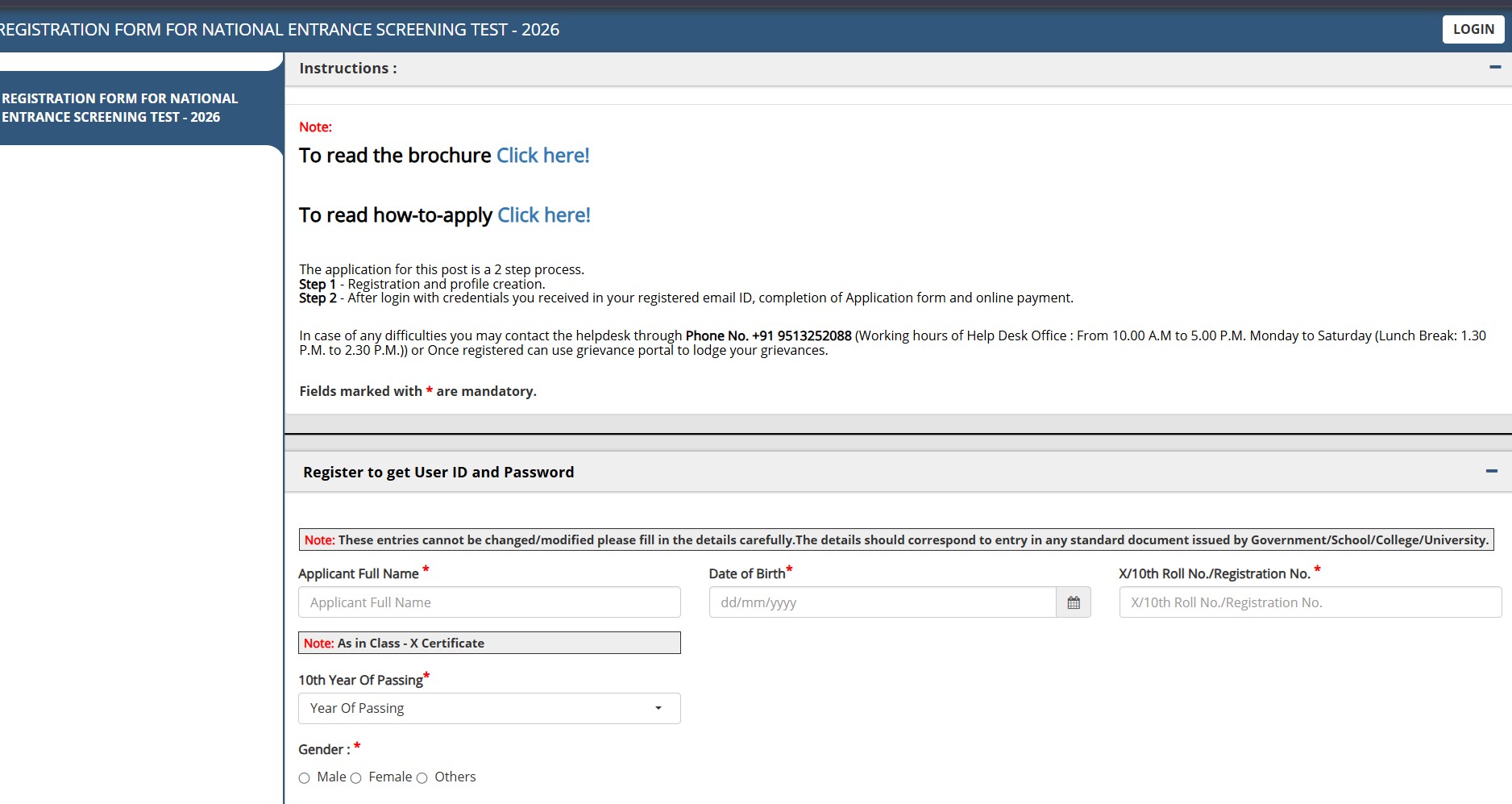
The exam authorities will accept the form only when the applicants pay the NEST 2026 Registration fee online via credit/debit card or UPI payment. The last date to fill out the NEST 2026 registration form will be April 6, 2026.
Also Read:
Candidates can check out the complete NEST 2026 Application Process from here:
Document Upload and Dimensions
After filling out the basic details about the candidates, they need to upload the required documents asked by the exam officials. Below are the documents required by the candidates to upload;
Class 10 mark sheet/ report card
Class 12 mark sheet/ certificate
Candidate’s photograph
Candidate’s signature
Check out the dimensions in which the documents are required to be uploaded from here;
Document Type | File Size | File Format |
Photograph | 200 KB (Maximum) | JPG/JPEG |
Signature | 200 KB (Maximum) | JPG/JPEG |
Conclusion
By understanding the NEST 2026 eligibility criteria, exam pattern, syllabus, and admission process, candidates can plan their preparation effectively and increase their chances of success. The exam not only tests conceptual understanding but also evaluates analytical and problem-solving skills—qualities essential for a career in scientific research. With a transparent result and counselling process, NEST ensures that deserving candidates secure admission to integrated MSc programmes. For science enthusiasts aiming to build a strong foundation and contribute to advanced research, excelling in NEST 2026 is the first step towards achieving their academic and career goals.