
.webp)



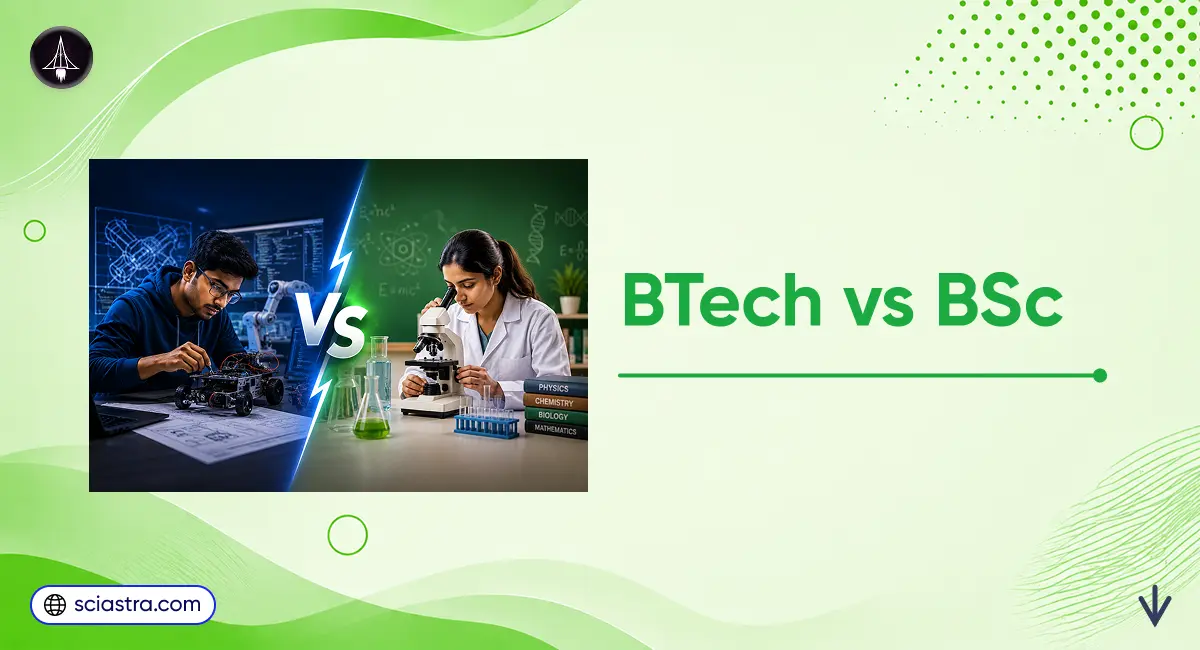
BTech vs BSc: It is common to spiral around one of the biggest decisions of our career and choosing between BTech and BSc since both mark their popular presence among students, but they differ significantly in their curriculum, career scope, skill development and future opportunities. This often leaves them with multiple questions.
Students' choice entirely depends on their interest, strengths and the career they want to build. Whether you aspire to become an engineer, a researcher, a data scientist, or an academician, understanding the key differences between BTech and BSc is essential before making your decision.
This SciAstra blog presents you with a comparison between BTech and BSc that will help you in making your choice better based on course structure, eligibility, entrance exams, career opportunities, salary prospects, top institutes, and future scope, helping you choose the path that is the right fit.
What is BTech?
BTech (Bachelor of Technology) is a 4-year undergraduate degree in engineering and technology that is all about applying scientific and mathematical principles to solve real-world problems like building roads or designing electric cars. Students usually prefer it to continue after Class 12 through entrance exams like JEE Main, JEE Advanced, or state-level engineering exams.
The core of BTech lies in its contribution to technological and industrial development. We have often noticed the sweat of engineers in innovations in almost every sector, from software applications to smart cities, from electric vehicles to space exploration. One can pursue higher studies like MTech, MBA, or research careers that will help you to go ahead with high-growth careers in both India and abroad.
Students benefit from BTech in multiple ways. It provides hands-on learning through labs, projects and internships. Guess what, it not only helps you to build technical skills but critical skills too, like logical thinking, coding ability, and project management.
BTech is widely used across multiple sectors. Let's understand the work of engineers from the following points-
In the Information Technology and Software sector, engineers build apps, artificial intelligence systems, and cybersecurity frameworks.
In the Manufacturing and Industrial sector, they design machines and work on developing robotics.
The Construction and Infrastructure sector views engineers for building roads and smart cities.
In the Electronics and Communication sector, they work on mobile technology, communication networks and satellites.
The Automotive and Transportation sector depends on engineers for designing vehicles, aerospace systems, and railway technologies.
Even the Healthcare and biotechnology sectors use engineering for medical devices, diagnostic machines, and AI-powered healthcare solutions.
What is a BSc?
BSc (Bachelor of Science) is a 3-year undergraduate degree focused on the study of scientific principles, theories, and experiments. Unlike engineering, it helps you understand how and why things happen in nature and science. If you are someone who is interested in pure science, research or analytical thinking, then this course is for you. Students typically pursue a BSc degree after completing Class 12, with a science background (PCM, PCB, or PCMB), depending on their chosen specialisation.
BSc offers a wide range of subjects such as Physics, Chemistry, Mathematics, Biology, Computer Science, Biotechnology, Environmental Science, and more. Each of them helps students learn more about a specific scientific field. The significance of a BSc lies in its strong academic and research foundation. If you are curious to learn scientific knowledge, do laboratory work or contribute to innovation through research and discovery, then this course is for you.
Students benefit from a BSc in many ways.
It helps them develop strong conceptual understanding, analytical thinking, and research ability.This can make them move ahead to careers in research institutes, education, healthcare, data science, environmental organisations, and government sectors.
BTech vs BSc
Check out the comparison between BTech and BSc from here:
Basis | BTech (Bachelor of Technology) | BSc (Bachelor of Science) |
Full Form | Bachelor of Technology | Bachelor of Science |
Course Duration | 4 years | 3 years |
Focus Area | Application of engineering and technology | Theoretical and conceptual study of science |
Nature of Study | Practical, technical, industry-oriented | Theoretical, research-oriented |
Eligibility | 10+2 with Physics, Chemistry, Mathematics (PCM) | 10+2 with Science stream (PCM/PCB depending on specialisation) |
Entrance Exams | JEE MAIN, JEE Advanced, state engineering exams | Mostly merit-based; some institutes conduct entrance exams |
Skill Development | Engineering design, coding, problem-solving, technical implementation | Analytical thinking, observation, research, conceptual understanding |
Career Orientation | Industry jobs, engineering roles, IT sector, technical fields | Research, academics, higher studies, specialised science fields |
Major Fields | IT, Mechanical, Civil, Electrical, Electronics, AI/ML | Physics, Chemistry, Mathematics, Biology, Biotechnology, Computer Science |
Higher Studies Options | MTech, MBA, MS, professional certifications | MSc, PhD, research programs, teaching qualifications |
Job Opportunities | Software engineer, civil engineer, data engineer, system designer | Scientist, researcher, lab technician, teacher, data analyst |
Average Salary Scope | Generally, higher starting packages in tech/engineering roles | Varies; higher growth after MSc/PhD or specialisation |
Industry Exposure | High (internships, industrial training compulsory) | Moderate (depends on specialisation and institution) |
Goal of the Course | To build and implement technology solutions | To understand and explore scientific principles |
BTech vs BSc Average Salary
One should not choose their career on the basis of salary range but should be driven by interest and passion. But if we talk about the earning potential of both the courses, it depends on various factors such as skills, experience and the industry you work in. Below is a table that presents how both career paths differ.
Career Aspect | BTech | BSc |
Average Starting Salary | INR 3–8 LPA | INR 2–5 LPA |
Mid-Career Growth | INR 8–20+ LPA (based on skills & experience) | INR 5–15+ LPA (higher with MSc/PhD or specialisation) |
Highest Earning Potential | AI, Software, Data Science, Robotics, Product Engineering | Data Science, Biotechnology, Research, Analytics, Healthcare |
BTech vs BSc Career Scope
Both courses differ in the opportunities they provide. While BTech will teach you how designs are built and how modern technology shapes the world, BSc has its core in pure science, research and healthcare. Let's explore the career opportunities available after each degree.
Career Opportunities After BTech
When we talk about a BTech degree, our minds spiral around technology or engineering. Let us dive deep into the following career paths; however, one can choose depending on skills-
1. Software Developer/Engineer: Develop websites, mobile applications, and software solutions for businesses, startups, and global technology companies.
2. Data Scientist or AI/ML Engineer: This team is involved in analysing data, building machine learning models, and developing AI-powered solutions for industries such as finance, healthcare, and e-commerce.
3. Civil Engineer: Looking outside our windows, we see a line of vehicles going by. Civil Engineers are the ones who design and oversee the construction of roads, bridges, buildings, dams, and other infrastructure projects.
4. Mechanical Engineer: Work on designing, making, and improving machines, automobiles, industrial equipment, and production equipment.
5. Electronics and Communication Engineer: EngineerDevelop communication systems, embedded devices, IoT solutions, and consumer electronics.
6. Electrical Engineer: Plan and maintain power generation, transmission, renewable energy systems, and electrical equipment.
7. Cybersecurity Specialist: In the current environment, this is growing quickly in fields like network security, applications, and digital infrastructure
8. Product Engineer or Product Manager: Work with design, engineering, and business teams to create innovative products and enhance user experiences
9. Government Engineer: One can get this through competitive exams and go into government sectors like PSUs, Indian Railways, DRDO, and ISRO.
10. Entrepreneur or Startup Founder: One can use their technical knowledge to develop innovative products, create startups, or start businesses.
Also check out: BTech at IISERs
Career Opportunities After BSc
The degree can lead to employment in pure science fields such as healthcare, education, environmental studies, technology, and data science. Students can also opt to complete Higher studies to develop further and widen their career options.
1. Research Scientist: Continue to perform research in laboratories, research centers, universities, or private organisations.
2. Data Analyst: These analysts interpret and analyse data to help businesses make more informed decisions in sectors such as finance, healthcare, retail, and technology.
3. Biotechnologist: This is a career that combines bio and technology and involves developing health solutions, vaccines, agricultural innovations, and biotechnology products.
4. Environmental Scientist: Suppose you love being outside, know the great outdoors, or love studying the environmental aspects of climate change and sustainability.
5. Clinical Research Associate: Assist in clinical trials, medical research, and drug development for pharmaceutical and healthcare companies.
6. Teacher or Lecturer: Obtaining higher education certifications is necessary in order to start a teaching career at a school, college, or university.
7. Healthcare Professional: Depending on your specialty, you can work in diagnostics, public health, microbiology, nutrition, or medical laboratories.
8. Government Sector: Preparation for UPSC, SSC, CDS, AFCAT, banking and various state-level exams. Join scientific organisations through recruitment exams.
9. Higher Studies and Research: Obtain an MSc, PhD, or specialist certification to establish a career in research, academia, or advanced scientific fields.
Take the First Step Towards Your Dream Science Career with SciAstra
Choosing between BTech and BSc is the start of your academic journey. The challenge that follows is to get admission into a well-known institute that fits with what you want to do in your career. If you want to be a researcher, data scientist, AI expert, engineer, or innovator, entering India's top science and research institutes can give you a good foundation.
At SciAstra, we help aspiring students achieve their goals through:
Comprehensive IAT & NEST Preparation Programmes
Dedicated ISI & CMI Mathematics Courses
Expert Mentorship from IISER, ISI, CMI, NISER, and IIT Alumni
Live Classes, High-Quality Study Material, Mock Tests, and Previous Year Question Practice
Personalised Doubt Solving, Academic Guidance, and Career Mentorship
Whether you are a BTech student or a BSc student, preparation today can land you in top institutes and great jobs. Start your journey with SciAstra and start your journey to the best of science and technology.
Top Institutes for BTech and BSc
How your dream career turns out depends not only on the course you choose but also the college you choose. A good college will provide you with experienced faculty, modern infrastructure, research opportunities, internships, and placement support. Whether you are looking to pursue BTech or BSc, choosing the right college can help you plan for your dream career. Below are some of the top institutes in India for both degrees.
Top Institutes for BTech
Many prestigious engineering institutes offer excellent academic training, industry exposure and job placement opportunities. We've got you covered! Look at the table below for more information-
NIRF Ranking | Institute Name | State |
1 | Indian Institute of Technology Madras | Tamil Nadu |
2 | Indian Institute of Technology Delhi | Delhi |
3 | Indian Institute of Technology Bombay | Maharashtra |
4 | Indian Institute of Technology Kanpur | Uttar Pradesh |
5 | Indian Institute of Technology Kharagpur | West Bengal |
6 | Indian Institute of Technology Roorkee | Uttarakhand |
7 | Indian Institute of Technology Hyderabad | Telangana |
8 | Indian Institute of Technology Guwahati | Assam |
9 | National Institute of Technology Tiruchirappalli | Tamil Nadu |
10 | Indian Institute of Technology (BHU) Varanasi | Uttar Pradesh |
Top Institutes for BSc (NIRF Ranking of Universities)
Many reputed universities and colleges in India offer highly focused BSc programs with strong research and conceptual learning. Check out this list of top institutes for BSc
NIRF Ranking | Institute Name | State |
1 | Jawaharlal Nehru University | Delhi |
2 | Manipal Academy of Higher Education | Karnataka |
3 | Jamia Millia Islamia | Delhi |
4 | University of Delhi | Delhi |
5 | Banaras Hindu University | Uttar Pradesh |
6 | Birla Institute of Technology & Science, Pilani | Rajasthan |
7 | Amrita Vishwa Vidyapeetham | Tamil Nadu |
8 | Jadavpur University | West Bengal |
9 | Aligarh Muslim University | Uttar Pradesh |
10 | S.R.M. Institute of Science and Technology | Tamil Nadu |
11 | Homi Bhabha National Institute | Maharashtra |
12 | Saveetha Institute of Medical and Technical Sciences | Tamil Nadu |
13 | Vellore Institute of Technology | Tamil Nadu |
14 | Siksha Anusandhan | Odisha |
15 | Indian Agricultural Research Institute | Delhi |
Also, check out- Does a BSc Have Scope in India?
Entrance Exams for BTech and BSc
The right exam for a particular institute and course is an important decision. BTech and BSc courses are entrance exams or merit-based, depending on the institute and the course. These exams assess the student’s knowledge of the fundamental subjects like Physics, Chemistry, Mathematics, and Biology as well as their analytical and problem-solving abilities.
BSc Entrance Exams in India
BSc entrance exams in India are designed to allow students to enter BSc programs through competitive tests to asses their knowledge in Physics, Chemistry, and Mathematics, as well as their analytical and reasoning skills. These exams offer entry to some of the best engineering institutes in the nation, including IITs, NITs, and other top government and private colleges. Because of competition, it is important to be aware of these exams.
Domain | Name of the Exams |
Research and Science Focused | IISER Entrance Exam |
CMI Entrance Exam | |
ISI Admission Test | |
Agriculture/Allied Sciences | ICAR CUET |
Rajasthan JET | |
MCAER CET | |
UPCATET | |
OUAT | |
CG PAT | |
KEAM Agriculture | |
SHIATS | |
Teaching (BEd) Oriented | |
RIE CEE | |
Punjab BEd CET | |
IGNOU BEd CET | |
AP/TS EDCET | |
General | CUET Exam |
Nursing | NEET UG |
AIIMS B.Sc. Nursing Entrance Exam | |
INICET |
BTech Entrance Exams in India
Admission into a BTech program is extremely competitive. Entrance exams are conducted at the national, state, or university level. Entrance exams test a student's understanding of Physics, Chemistry, Mathematics, and their thinking and problem-solving abilities. Since leading engineering colleges in India have very few seats and demand, these entrance exams are vital in determining whether a student is admitted to reputed colleges and whether he or she pursues an engineering career.
Domain | Name of the Exams |
National Level Engineering Exams | JEE Main |
JEE Advanced | |
WBJEE (West Bengal Joint Entrance Exam) | |
MHT CET (Maharashtra CET) | |
KCET (Karnataka CET) | |
TS EAMCET (Telangana EAMCET) | |
State Engineering Entrance Exams | AP EAMCET (Andhra Pradesh EAMCET) |
KEAM (Kerala Engineering Architecture Medical) | |
UPSEE / UPTAC (Uttar Pradesh Technical Admission) | |
Private University Entrance Exams | BITSAT (Birla Institute of Technology and Science Admission Test) |
VITEEE (VIT Engineering Entrance Exam) | |
SRMJEEE (SRM Joint Engineering Entrance Exam) | |
MET (Manipal Entrance Test) | |
Other Engineering Admission Routes | CUET (used by some central universities for BTech programs) |
How to Choose Between BTech and BSc: Tips for Students
Deciding whether to choose BTech or BSc might appear confusing after Class 12, but it gets easy once an individual has knowledge about what they like, what they are good at, and their future plans. Here are some easy ways to help them decide:
Identify your field of interest: It would be wise to choose BTech if you like creating and designing things as well as working with technology. You should go for BSc if you are more interested in theories, experimentation, and science.
Think about your future goals: If an individual wants to have jobs in industries like IT and engineering, they should choose BTech. They should go for BSc if they plan to do some research or teach, or get an MSc and PhD degree.
Consider your comfort level with subjects: BTech requires strong interests in Mathematics and problem-solving. While choosing a BSc degree, one gets a chance to choose a specialization as per his/her interest such as Physics, Chemistry, Biology or others.
Think about learning preferences: BTech is skill-based while BSc is more theory-based.
Consider future educational opportunities: Both BTech and BSc will open up possibilities for higher education but BTech is more career-based while BSc is ideal for academic research-based career.
Don't let yourself be driven by peer pressure: It is essential to select a course of one's own choice considering one's interests rather than going with the crowd.
Conclusion
The choice of BTech or BSc includes not only deciding upon which degree to complete but also figuring out which one is aligned with interests and long-term career goals. BTech will be a better choice for those who are highly interested in applying technology to solve problems and would like to build a career in engineering or technology industries as it offers good industry exposure and job opportunities. On the other hand, BSc can be a better choice for those who are interested in basic scientific concepts or lab work.
Which one is better for Data Science, BTech or BSc?
Both BTech and BSc will be equally beneficial for developing career in Data Science. BTech in Computer Science, Artificial Intelligence, or Information Technology provides good technical and programming skills. Similarly, BSc in Computer Science, Mathematics, Statistics, or Data Science helps in improving skills of analysis and calculation. Everything depends upon one's interests and certifications.
Which one is better BTech or BSc?
There is no better choice between BTech and BSc. Both are good and it depends upon the interest and career plans of individuals. BTech is good for those who would like to build their career in engineering, technology, software and others, while BSc is ideal for those interested in research work, academics or health care or planning to go for further studies like MSc and PhD.
Which course has better placement opportunities?
Placement chances are better for BTech graduates, mostly in engineering, IT, and other fields. On the other hand, BSc placements are subject-based, and some BSc students choose to pursue further studies before joining a job. Some specialised courses of BSc, including Computer Science and Data Science, have very good placement opportunities.
Is it possible to do an MBA after BSc?
Yes, definitely. It is easy for BSc graduates to go for an MBA to learn management skills. People usually opt for this course to get into careers like consultancy, marketing, finance, operations and management. Admissions require entrance examinations including CAT, XAT, MAT and others.
Is it good to pursue a research career after BSc?
Yes, absolutely. BSc can be good for building a career in the research field. It enables individuals to develop their scientific knowledge and analysis skills that can help to join MSc or PhD programs and then work in research organisations, including universities, pharmaceutical companies, biotech firms, and government organisations, and others.
Can BSc students earn more than BTech graduates?
Certainly, yes. Even though BTech graduates earn more initially, BSc graduates can make more money through their skills and experience. Some industries where BSc graduates can earn much more include data science, biotechnology, research and others. So, in the end, everything depends on the experience and industry where the person works.