Scope of BSc in India: There's a common notion in India that science students can only build successful careers in engineering through a BTech degree, since all industries supposedly require engineering expertise to function.
But that's only one side of the reality. Many other domains, such as healthcare, renewable energy, bioinformatics, biotechnology, and forensics, also need brilliant scientific minds to solve social and industrial problems.
Earning just an engineering degree won't support operations in these fields. For that, you have to start with a BSc and specialise in the relevant area.
If you are unaware of the scope of a BSc in India or how to get admission to this course, here is a complete overview.
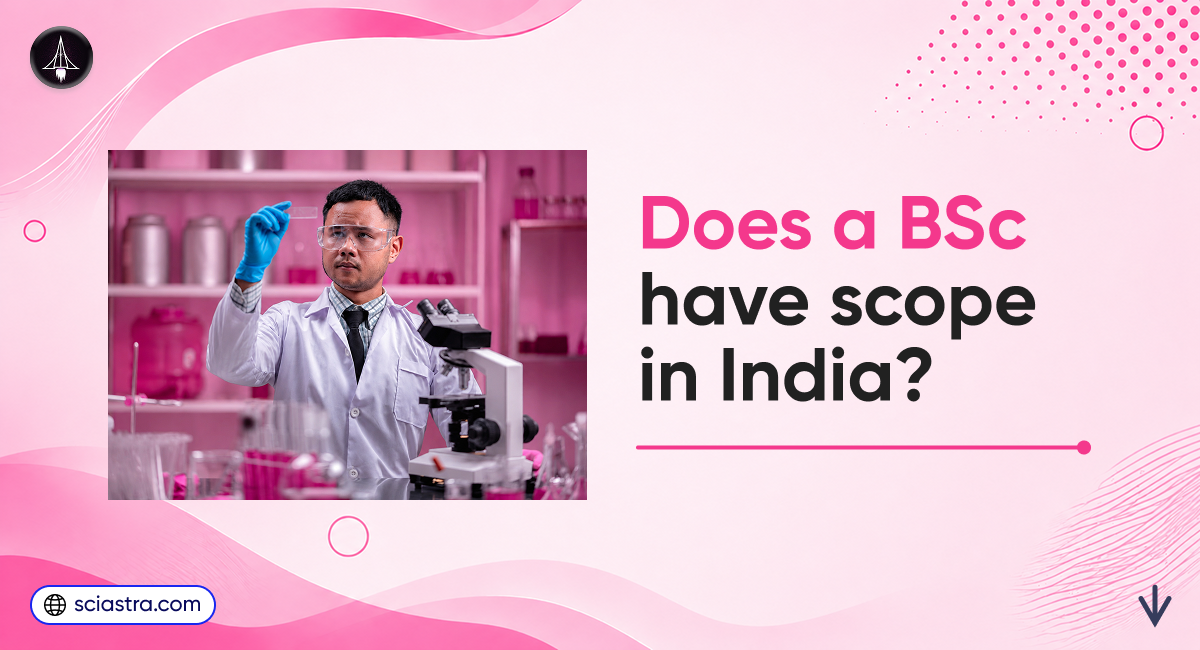
Does a BSc have scope in India?
Students who have passed Class 12 in the science stream (PCM, PCB, or PCMB) from a recognised board in India can pursue a BSc.
About BSc
A Bachelor of Science (BSc) is the primary pathway for building a career in fields like nursing, agriculture, forensics, astrophysics, and many others. It is a three-year course that provides general knowledge of your selected science subjects if you choose a BSc General.
You gain access to structured, specialised knowledge of your chosen science subject, say astrophysics, along with other general science subjects when you select BSc (Hons). Therefore, it’s essential to understand the differences between BSc and BSc (Hons) before choosing either one.
To build a career in non-engineering fields in India, students must pursue a BSc, which equips them with in-depth knowledge of their preferred field.
Reality Check on BSc Scope
The bitter truth: Without in-depth practical knowledge, your BSc is just a degree, and you’ll end up in jobs that don’t match your qualifications.
According to a Times of India report based on the Economic Survey 2024-25, only 8.25% of graduates are employed in roles matching their qualifications, highlighting a critical skills mismatch in India’s workforce.
Over 50% of graduates are stuck in low-skill jobs due to inadequate vocational training and an outdated education system.
Is a BSc Worth Pursuing?
As discussed, to build a career in science fields beyond engineering, you must pursue a specialised BSc or BSc (Hons) course.
Without specialisation, you won’t gain the strong knowledge needed to secure jobs in your preferred domain.
Here are the most in-demand BSc/BSc (Hons) specialisations:
BSc / BSc (Hons) Specialisation | Main Subjects | Top Career Options |
BSc Computer Science (Students interested in technology and coding) | Programming, AI, Databases, Cloud Computing | Software Developer, AI Engineer, Web Developer |
BSc Data Science / AI (Students interested in AI and data) | Statistics, Machine Learning, Python, Analytics | Data Scientist, ML Engineer, Business Analyst |
BSc Nursing (Students interested in healthcare) | Anatomy, Physiology, Healthcare | Registered Nurse, Clinical Specialist |
BSc Biotechnology (Research and medical science enthusiasts) | Genetics, Molecular Biology, Biochemistry | Biotech Researcher, Pharma Scientist |
BSc Agriculture (Government jobs and agritech careers) | Agronomy, Soil Science, Plant Science | Agriculture Officer, Agribusiness Manager |
BSc Psychology (Students interested in mental health) | Human Behaviour, Counselling, Mental Health | Counsellor, Psychologist, HR Specialist |
BSc Forensic Science (Crime investigation and lab work) | Criminalistics, Toxicology, DNA Analysis | Forensic Expert, Crime Analyst |
BSc Mathematics (Analytical and logical thinkers) | Algebra, Calculus, Statistics | Data Analyst, Actuary, Researcher |
BSc Physics (Research and technical careers) | Mechanics, Electronics, Quantum Physics | Researcher, Scientist, Electronics Analyst |
BSc Chemistry (Pharmaceutical and industrial sectors) | Organic, Physical, Industrial Chemistry | Chemist, Quality Analyst, Pharma Associate |
BSc Cybersecurity (Students interested in digital security) | Ethical Hacking, Network Security | Cybersecurity Analyst, Security Engineer |
BSc Environmental Science (Sustainability and environmental careers) | Ecology, Climate Science, Sustainability | Environmental Consultant, Research Analyst |
Best BSc Specialisation According to Subjects
You can select a BSc specialisation according to your Class 12 subjects, PCB or PCM.
Specialisations for PCB Students
The specialisations suitable for PCB students are the following:
Best BSc Specialisations for PCB Students | ||
BSc Specialisation | Best For | Career Options |
BSc Nursing | Students interested in healthcare and patient care | Nurse, Clinical Specialist, Healthcare Administrator |
BSc Biotechnology | Research and medical science enthusiasts | Biotech Researcher, Pharma Scientist |
BSc Microbiology | Students interested in microorganisms and lab research | Microbiologist, Lab Analyst |
BSc Agriculture | Government jobs and agritech careers | Agriculture Officer, Agronomist |
BSc Psychology | Students interested in mental health and counselling | Counsellor, Psychologist |
BSc Forensic Science | Crime investigation and scientific analysis | Forensic Expert, Crime Analyst |
BSc Environmental Science | Nature, sustainability, and climate studies | Environmental Consultant |
BSc Zoology | Animal biology and wildlife research | Zoologist, Wildlife Researcher |
BSc Botany | Plant science and research | Botanist, Plant Scientist |
BSc Nutrition & Dietetics | Food, health, and fitness | Dietitian, Nutritionist |
BSc Biochemistry | Chemical processes in living organisms | Biochemist, Clinical Research Associate |
BSc Genetics | DNA, heredity, and modern biology | Genetic Counsellor, Research Scientist |
Specialisations for PCM Students
The best BSc specialisations for PCM students are listed below:
Best BSc Specialisations for PCM Students | ||
BSc Specialisation | Best For | Career Options |
BSc Computer Science | Students interested in coding and technology | Software Developer, AI Engineer |
BSc Data Science / AI | AI, analytics, and machine learning enthusiasts | Data Scientist, ML Engineer |
BSc Mathematics | Analytical and logical thinkers | Actuary, Data Analyst |
BSc Physics | Research and technical careers | Physicist, Research Scientist |
BSc Cybersecurity | Students interested in digital security | Cybersecurity Analyst |
BSc Information Technology (IT) | Software and networking careers | IT Specialist, System Administrator |
BSc Electronics | Electronics and hardware technology | Electronics Engineer, Embedded Systems Analyst |
BSc Statistics | Data analysis and probability | Statistician, Business Analyst |
BSc Animation & Multimedia | Creative technology and design | Animator, Motion Graphics Designer |
BSc Aviation | Aviation and airline industry careers | Pilot, Aviation Manager |
BSc Robotics | Automation and robotics technology | Robotics Engineer |
BSc Astronomy / Astrophysics | Space and scientific research | Astronomer, Space Researcher |
Entrance Exams for BSc Admissions
There are mainly two ways to get admission to a BSc course in India:
1. Merit-Based Admission
Many colleges and universities offer admission to BSc programmes based on candidates’ Class 12 marks. Students are selected according to the merit list prepared using their board examination scores.
2. Entrance Exam-Based Admission
Several top institutes in India conduct or accept national-level and state-level entrance exams for admission to BSc and BS-MS programmes. These exams assess students’ knowledge and aptitude in subjects such as Physics, Chemistry, Biology, and Mathematics.
Some of the top entrance exams for BSc admissions in India include the following:
Research and Science-Focused Exams:
Chennai Mathematical Institute Entrance Exam (CMI Entrance Exam)
Indian Statistical Institute Admission Test (ISI Admission Test)
Indian Association for the Cultivation of Science — Undergraduate Pre-Interview Screening Test (IACS UPST)
Agriculture/Allied Science Exams
Indian Council of Agricultural Research – Common University Entrance Test (ICAR CUET)
Rajasthan Joint Entrance Test (Rajasthan JET)
Maharashtra Council of Agricultural Education and Research Common Entrance Test (MCAER CET)
Uttar Pradesh Combined Agriculture and Technology Entrance Test (UPCATET)
Odisha University of Agriculture and Technology (OUAT)
Chhattisgarh Pre-Agriculture Test (CG PAT)
Kerala Engineering, Architecture, and Medical Entrance Examination – Agriculture Stream (KEAM Agriculture)
BEd-Oriented Exams:
National Common Entrance Test (NCET)
Regional Institute of Education Common Entrance Examination (RIE CEE)
Punjab Bachelor of Education Common Entrance Test (Punjab BEd CET)
Indira Gandhi National Open University Bachelor of Education Common Entrance Test (IGNOU BEd CET)
Andhra Pradesh Education Common Entrance Test / Telangana State Education Common Entrance Test (AP EDCET / TS EDCET)
Multispecialisation Focused Exam
Common University Entrance Test UG (CUET UG)
How to get a High-Paying Job after a BSc?
To secure a high-paying job after a BSc, students should focus on gaining specialised skills, practical experience, and research exposure in their chosen field.
One of the best ways to achieve this is by pursuing a research-oriented BSc or integrated BS-MS programme.
Some of the top institutes in India for science education and research are the Indian Institutes of Science Education and Research (IISERs), the National Institute of Science Education and Research (NISER Bhubaneswar), and the University of Mumbai – DAE Centre for Excellence in Basic Sciences (UM-DAE CEBS).
These institutes are known for their strong academic environment, advanced research opportunities, and excellent career prospects.
The IISERs are Institutes of National Importance established by the Ministry of Education.
NISER Bhubaneswar and UM-DAE CEBS are affiliated with the Bhabha Atomic Research Centre (BARC), one of India’s leading scientific research organisations.
Studying at these prestigious institutes helps students develop a deep understanding of science through:
Research-based learning
Laboratory and project work
Interaction with experienced scientists and professors
Exposure to advanced scientific tools and technologies
This strong research foundation can open doors to high-paying careers in the following fields:
Scientific research
Data science and AI
Biotechnology and healthcare
Space and defence research
Technology and innovation sectors
Admission Process: Admissions to IISERs are conducted through the IISER Aptitude Test (IAT), while admissions to NISER Bhubaneswar and CEBS Mumbai are conducted through the National Entrance Screening Test (NEST).
For structured preparation for IAT and NEST, students can explore courses offered by SciAstra.
To Sum Up:
A BSc has a good scope in India in fields like AI, healthcare, biotechnology, agriculture, and research.
The biggest problem is the lack of specialisation and practical skills after a general BSc.
Choosing in-demand specialisations improves job and salary opportunities.
Research-oriented institutes like IISERs, NISER and CEBS provide better career exposure.
Research experience, internships, and practical learning help students get high-paying jobs after a BSc.