






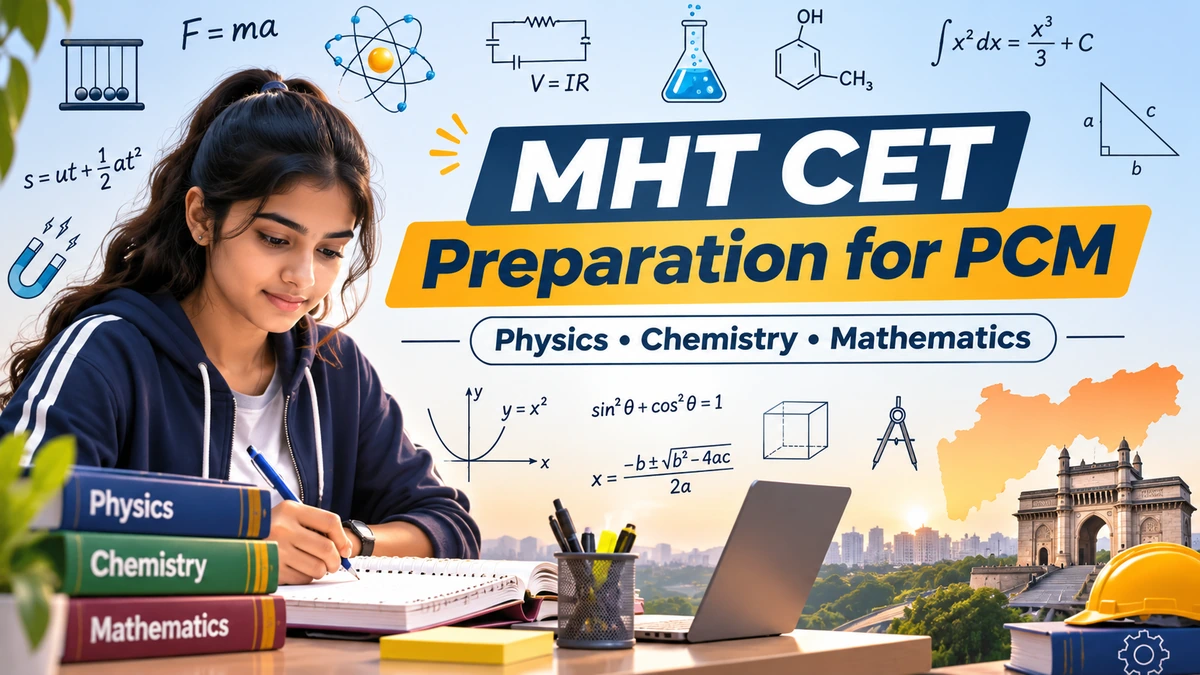
MHT CET 2027 Preparation for PCM: The MHT CET is a state-level entrance examination conducted by the State Common Entrance Test Cell, Maharashtra. It is conducted twice a year for admission to various colleges across Maharashtra.
The examination is divided into two groups: PCM and PCB. The PCM group is for candidates who choose Physics, Chemistry, and Mathematics, while the PCB group is for candidates who select Physics, Chemistry, and Biology.
Candidates seeking admission to engineering courses must appear for the MHT CET 2027 PCM exam to secure admission to leading engineering institutes in Maharashtra. To perform well in the examination, candidates must understand the MHT CET PCM syllabus and exam pattern, which can help them improve their speed, accuracy, scores, and overall performance.
In this blog, SciAstra provides a comprehensive preparation strategy, detailed syllabus, and structured study plan for the MHT CET PCM examination.
MHT CET 2027 Preparation for PCM (Subject-Wise Preparation Strategy)
A subject-wise preparation strategy for MHT CET 2027 can help candidates maintain a balance between Physics, Chemistry, and Mathematics.
Start by building conceptual clarity, followed by regular revision, question practice, solving previous-year questions (PYQs), and attempting mock tests. Spend additional time on topics where you frequently make mistakes or take longer to solve questions.
A detailed subject-wise preparation strategy for the MHT CET PCM exam has been provided below:
MHT CET 2027 Physics Preparation
Effective MHT CET Physics preparation requires a strong understanding of concepts and the ability to apply them to numerical problems.
Since Physics includes both conceptual and numerical questions, candidates should regularly revise formulas and practise problem-solving to improve their performance.
Focus on the following areas during your Physics preparation for the MHT CET 2027 exam:
Strengthen your understanding of fundamental concepts before moving on to advanced questions.
Maintain a formula sheet and revise it regularly.
Practise numerical problems after completing each chapter.
Identify important Physics chapters using the syllabus and PYQs.
Solve MHT CET Physics PYQs to understand the types of questions asked in the examination.
Attempt timed mock tests to assess and improve your speed and accuracy.
Regularly review mistakes related to formulas, calculations, and time management.
MHT CET 2027 Chemistry Preparation
MHT CET Chemistry preparation requires candidates to cover Physical Chemistry, Organic Chemistry, and Inorganic Chemistry.
Use the prescribed textbooks to build a strong foundation and combine conceptual learning with regular question practice.
Focus on the following areas during your Chemistry preparation:
Physical Chemistry: Understand important concepts, revise formulas, and practise numerical problems.
Organic Chemistry: Revise important reactions and concepts, and practise related questions regularly.
Inorganic Chemistry: Focus on textbook concepts, chemical reactions, definitions, and factual information.
Regular Revision: Revise important formulas, reactions, and concepts, and solve Chemistry PYQs after completing each topic.
MHT CET Mathematics Preparation
MHT CET Mathematics preparation requires strong conceptual understanding, familiarity with important formulas, and consistent problem-solving practice.
Candidates should first focus on understanding concepts and formulas before gradually increasing the difficulty level of questions and improving their solving speed.
Follow these tips to strengthen your Mathematics preparation:
Build conceptual clarity before attempting advanced problems.
Create a chapter-wise formula sheet and revise it regularly.
Practise mathematical problems daily to improve your calculation speed.
Use a timer while solving question sets to develop speed and accuracy.
Attempt full-length MHT CET mock tests regularly.
Analyse each mock test to identify calculation errors, weak concepts, and time-management issues.
MHT CET PCM Important Chapters
Candidates should prioritise important chapters while preparing for MHT CET PCM. The following chapters have been identified based on the syllabus, previous-year question papers, and exam trends.
Subject | Important Chapters | What to Focus On |
Physics | Waves, Oscillations, Current Electricity, Electrostatics, Rotational Motion, Electromagnetic Induction, Wave Optics, Modern Physics | Concepts, formulas, numerical problems, and PYQs |
Chemistry | Thermodynamics, p-Block Elements, Chemical Kinetics, Electrochemistry, Solutions, Coordination Compounds, Alcohols, Phenols and Ethers, Aldehydes, Ketones and Carboxylic Acids | Reactions, formulas, concepts, and textbook-based questions |
Mathematics | Integrals, Three-Dimensional Geometry, Probability, Trigonometry, Differential Equations, Straight Lines, Matrices and Determinants, Vectors, Applications of Derivatives | Formulas, problem-solving, speed, and accuracy |
MHT CET 2027 Exam Preparation Tips (Overall Preparation Startegy)
To prepare for the MHT CET 2027 PCM paper, candidates should follow a well-structured study plan. They should focus on building a strong understanding of important concepts, improving speed and accuracy, revising formulas, solving mock tests, and practising regularly to achieve a high rank in the examination.
Important tips that can help candidates improve their MHT CET 2027 scores are as follows:
Focus on Speed and Accuracy
Candidates should practise solving questions within a fixed time limit to improve their speed and accuracy. The time limit should be 3 hours (180 minutes) because the duration of the MHT CET exam is 3 hours.
According to the MHT CET 2027 PCM exam pattern, candidates should allocate the first 90 minutes to Physics and Chemistry questions and the remaining 90 minutes to Mathematics questions.
Candidates should also solve chapter-wise questions and timed mock tests. Start with chapter-wise questions and gradually move on to full-length MHT CET mock tests.
Avoid spending too much time on a single question. If a question takes longer than expected, move on to the next one and return to it later if time permits. This approach will help you manage your time and attempt the question paper more effectively.
Revise Formulas and Important Concepts Regularly
Candidates should regularly revise important formulas, reactions, definitions, and concepts to strengthen their understanding of each topic.
To revise formulas, reactions, definitions and other important topics, they should create separate formula and concept sheets for Physics, Chemistry, and Mathematics, and update them as they complete new topics.
Review these sheets frequently and include short revision sessions in your daily study routine. This will help you retain important information and recall formulas and concepts more easily while solving questions.
Solve MHT CET Mock Tests Within a Time Limit
Practising MHT CET mock tests under timed conditions can help candidates improve speed, accuracy, and time management.
Attempt full-length mock tests in an exam-like environment while following the prescribed time limit. Avoid pausing the test or checking solutions during the attempt.
As aspirants practise more tests, they should focus on increasing the number of questions they can answer correctly within the allotted time.
Analyse Every Mock Test
Candidates should analyse their performance after every mock test. This analysis requires reviewing incorrect and unattempted questions to understand where they went wrong.
Identify whether your mistakes were caused by conceptual gaps, calculation errors, or poor time management. Revisit topics where you performed poorly and practise similar questions before attempting your next mock test.
Maintain an Error Notebook
Maintain an error notebook to record mistakes made during practice sessions and mock tests.
Note frequently repeated errors, difficult questions, weak concepts, and important formulas that you tend to forget.
Review your error notebook regularly to avoid making the same mistakes again. It can also serve as a useful revision resource before full-length mock tests and during the final stages of preparation.
Prioritise High-Weightage Topics
Identify high-weightage topics using the MHT CET syllabus, previous-year question papers, and recent exam trends.
Dedicate additional time to frequently asked topics and practise the types of questions commonly seen in the examination. Prioritising these chapters can help you improve your scoring potential. However, make sure you also cover the remaining syllabus.
MHT CET Preparation Study Plan 2027
Candidates should follow a structured study plan to complete the MHT CET PCM syllabus on time. A good preparation strategy should include concept learning, question practice, regular revision, and mock tests.
Focus on maintaining consistency rather than studying for long hours without adequate breaks or a clear plan.
Here is a suggested study plan for MHT CET PCM preparation.
Daily MHT CET Study Timetable
A balanced daily study routine should include all three subjects, along with PYQ practice and revision.
Physics: Study important concepts and practise numerical problems.
Chemistry: Focus on theory, chemical reactions, and formula revision.
Mathematics: Practise problem-solving and improve calculation speed.
PYQs: Solve previous-year questions from topics you have already completed.
Revision: Review formulas, reactions, and difficult concepts regularly.
Adjust the time spent on each subject according to your strengths, weaknesses, and preparation level.
Conclusion
Preparing for MHT CET 2027 requires consistency, a structured study plan, and regular practice. Candidates should focus on strengthening their concepts, identifying weak areas, and dedicating sufficient time to revision and problem-solving.
Follow a realistic study schedule, complete the syllabus on time, and regularly assess your performance through mock tests. A well-planned preparation strategy can help you improve your score, achieve a competitive rank, and increase your chances of securing admission to leading institutes in Maharashtra.