
The official NEST 2027 syllabus PDF is expected to be released along with the NEST 2027 notification in the first week of January 2027 on the official website, nestexam.in.
Based on previous years' information, the NEST syllabus comprises topics from the NCERT Class 11 and Class 12 textbooks of Physics, Chemistry, Biology, and Mathematics.
In 2026, the exam authority updated the syllabus topic list in accordance with the units prescribed in the NCERT Class 11 and Class 12 PCMB textbooks. Candidates can refer to the latest NEST syllabus for Physics, Chemistry, Mathematics, and Biology available on this page.
Candidates are advised to thoroughly review all the important topics listed here, as questions in previous NEST examinations have been based on these areas. The subject-wise PDF syllabus for NEST 2027 will be made available on this page as soon as it is officially released.
Note:
The information provided here is based on the previous year's information brochure of NEST. If there are changes in the NEST exam syllabus in 2027, the page content will be updated accordingly.
NEST 2027 Exam Pattern
Candidates who are going to appear for NEST in 2027 must know the pattern of the exam, as the question paper structure will be based on it. Check out the NEST 2027 pattern below:
Feature | Details |
Exam Mode | Online (Computer-Based Test – CBT) |
Exam Level | National level (Undergraduate entrance exam) |
Test Language | English only |
Question Type | Objective-type questions: • Multiple Choice Questions (MCQs) • Multiple Selection Questions (MSQs) |
Total Questions | 80 |
Total Marks | 200 |
What is the syllabus of the National Entrance Screening Test (NEST)?
The syllabus of NEST is based on the NCERT Class 11 and Class 12 curricula of Physics, Chemistry, Biology and Mathematics.
The official PDF for the syllabus is available below:
Where can I get the official NEST syllabus PDF?
The official NEST syllabus PDF is released by the NEST authorities and is hosted on the NEST exam website (nestexam.in). The syllabus for the 2027 session of the exam has not been released yet. Once it is released, the official syllabus PDF will be provided here.
Is Biology compulsory in NEST?
No, Biology and Mathematics are not compulsory in NEST. There are four sections in the NEST question paper: Physics, Chemistry, Mathematics, and Biology.
While calculating the scores of candidates, the three subjects in which they scored the highest are considered.
For admission to the 5‑year Integrated MSc in Biological Sciences, candidates must have studied Biology as one of their Class 11 and 12 subjects.
Is the NEST syllabus different from the JEE Main syllabus?
In general, the core topics in Physics, Chemistry, and Mathematics are the same as Class 11–12 NCERT, so they largely overlap with typical JEE/Board‑level syllabi.
However, the emphasis in NEST is more on conceptual understanding and application rather than heavy-level problem-solving, and the pattern includes a General / Biology‑focused section for Integrated MSc candidates.



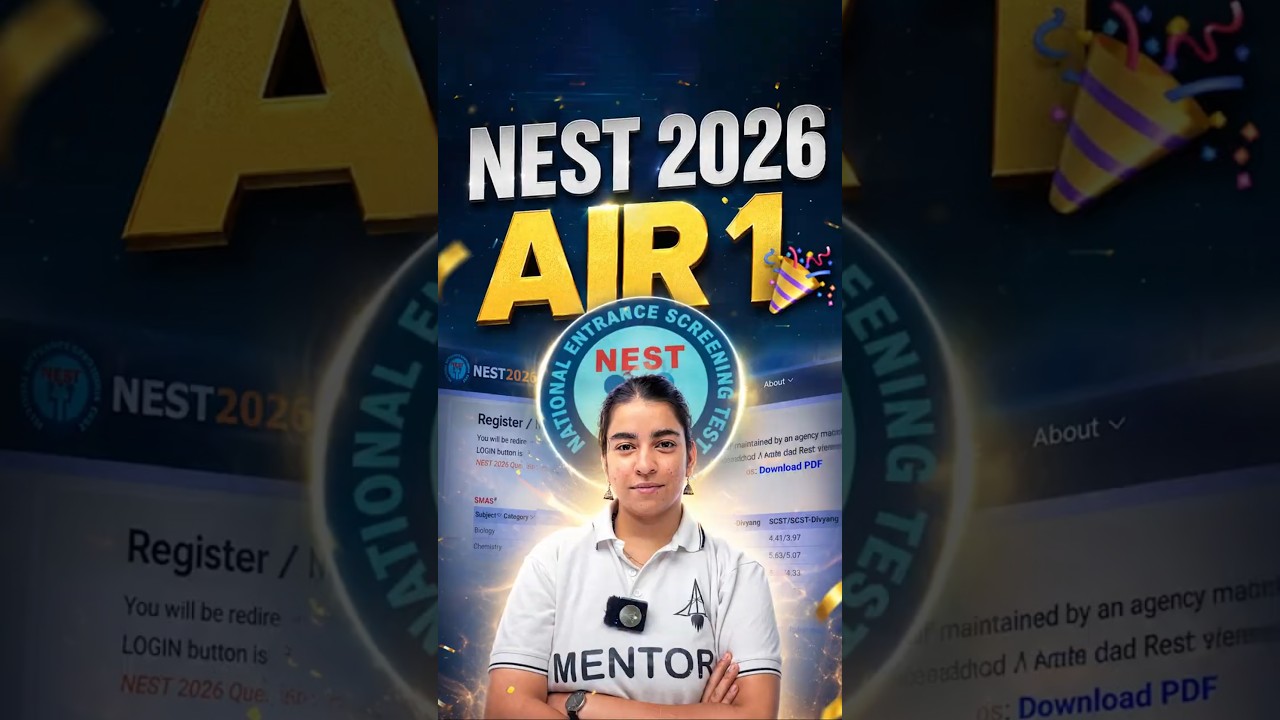
AIR 1 in NEST 2026 Achieved by SciAstra Student
The NEST 2026 AIR 1 has been secured by a SciAstra student, marking a significant milestone. The result demonstrates outstanding performance and serves as an inspiration for future science aspirants.
Refer to the following to learn how to check NEST 2026 result:
NEST 2027 Syllabus (Subject-Wise)
The syllabus of NEST 2027 will be based on Class 11 and Class 12 NCERT textbooks. Check out the subject-wise syllabus below.
NEST 2027Physics Syllabus
The Physics section in NEST tests candidates’ understanding of the laws of Physics and their applications in the real world. Check out the topics covered in the NEST 2027 syllabus for Physics below:
NEST 2027 Syllabus (Physics) | |
Class 11 Physics Topics |
|
Class 12 Physics Topics |
|
NEST 2027 Chemistry Syllabus
The Chemistry syllabus of NEST includes concepts, reactions, equations, and numerical problem-solving from Class 11 and Class 12. The topics covered in the NEST Chemistry syllabus are the following:
NEST 2027 Syllabus (Chemistry) | |
Class 11 Chemistry Topics | Unit I: Some Basic Concepts of Chemistry
Unit II: Structure of Atom
Unit III: Classification of Elements and Periodicity
Unit IV: Chemical Bonding and Molecular Structure
Unit V: Chemical Theromdynamics
Unit VI: Equilibirium
Unit VII: Redox Reactions
Unit VIII: Organic Chemistry - Some Basic Principles and Techniques
Unit IX: Hydrocarbons Aliphatic Hydrocarbons
Aromatic Hydrocarbons
|
Class 12 Chemistry Topics | Unit I: Solutions Types of solutions, expression of concentration of solutions of solids in liquids, solubility of gases in liquids, solid solutions, Raoult’s law, colligative properties - relative lowering of vapor pressure, elevation of boiling point, depression of freezing point, osmotic pressure, determination of molecular masses using colligative properties, abnormal molecular mass, Van't Hoff factor. Unit II: Electrochemistry Redox reactions, EMF of a cell, standard electrode potential, Nernst equation and its application to chemical cells, Relation between Gibbs energy change and EMF of a cell, conductance in electrolytic solutions, specific and molar conductivity, variations of conductivity with concentration, Kohlrausch's Law, electrolysis and law of electrolysis (elementary idea), dry cellelectrolytic cells and Galvanic cells, lead accumulator, fuel cells, corrosion. Unit III: Chemical Kinetics Rate of a reaction (Average and instantaneous), factors affecting rate of reaction: concentration, temperature, catalyst; order and molecularity of a reaction, rate law and specific rate constant, integrated rate equations and half-life (only for zero and first order reactions), concept of collision theory (elementary idea, no mathematical treatment), activation energy, Arrhenius equation. Unit IV: d and f Block Elements General introduction, electronic configuration, occurrence and characteristics of transition metals, general trends in properties of the first row transition metals – metallic character, ionization enthalpy, oxidation states, ionic radii, colour, catalytic property, magnetic properties, interstitial compounds, alloy formation, preparation and properties of K2Cr2O7 and KMnO4. Lanthanides - Electronic configuration, oxidation states, chemical reactivity and lanthanide contraction and its consequences. Actinides - Electronic configuration, oxidation states and comparison with lanthanides. Unit V: Coordination Compounds Coordination compounds - Introduction, ligands, coordination number, colour, magnetic properties and shapes, IUPAC nomenclature of mononuclear coordination compounds. Bonding, Werner's theory, VBT, and CFT; structure and stereoisomerism, importance of coordination compounds (in qualitative analysis, extraction of metals and biological system). Unit VI: Haloalkanes and Haloarenes Haloalkanes: Nomenclature, nature of C–X bond, physical and chemical properties, optical rotation mechanism of substitution reactions. Haloarenes: Nature of C–X bond, substitution reactions (Directive influence of halogen in monosubstituted compounds only). Uses and environmental effects of - dichloromethane, trichloromethane, tetrachloromethane, iodoform, freons, DDT. Unit VII: Alcohols, Phenols and Ethers Alcohols: Nomenclature, methods of preparation, physical and chemical properties (of primary alcohols only), identification of primary, secondary and tertiary alcohols, mechanism of dehydration, uses with special reference to methanol and ethanol. Phenols: Nomenclature, methods of preparation, physical and chemical properties, acidic nature of phenol, electrophilic substitution reactions, uses of phenols. Ethers: Nomenclature, methods of preparation, physical and chemical properties, uses Unit 8: Aldehydes, Ketones and Carboxylic Acids Aldehydes and Ketones: Nomenclature, nature of carbonyl group, methods of preparation, physical and chemical properties, mechanism of nucleophilic addition, reactivity of alpha hydrogen in aldehydes, uses. Carboxylic Acids: Nomenclature, acidic nature, methods of preparation, physical and chemical properties; uses. Unit IX: Amines Amines: Nomenclature, classification, structure, methods of preparation, physical and chemical properties, uses, identification of primary, secondary and tertiary amines. Diazonium salts: Preparation, chemical reactions and importance in synthetic organic chemistry. Unit X: Biomolecules Carbohydrates - Classification (aldoses and ketoses), monosaccahrides (glucose and fructose), D-L configuration oligosaccharides (sucrose, lactose, maltose), polysaccharides (starch, cellulose, glycogen); Importance of carbohydrates. Proteins - Elementary idea of- amino acids, peptide bond, polypeptides, proteins, structure of proteins - primary, secondary, tertiary structure and quaternary structures (qualitative idea only), denaturation of proteins; enzymes. Hormones - Elementary idea excluding structure. Vitamins - Classification and functions. Nucleic Acids: DNA and RNA. |
NEST 2027 Mathematics Syllabus
The Mathematics section is designed to assess candidates’ knowledge of topics such as algebra, probability, and geometry but is not limited to these topics. Check out all the important topics for the NEST 2027 Mathematics syllabus below:
NEST 2027 Syllabus (Maths) | |
Class 11 Mathematics Topics | Unit I: Sets and Functions
Unit II: Algebra
Unit III: Coordinate Geometry
Unit IV: Calculus
Unit V: Statistics and Probability
|
Class 12 Mathematics Topics | Unit I: Relations and Functions
Unit II: Algebra
Unit III: Calculus
Unit IV: Vectors and Three-dimensional Geometry
Unit V: Linear Programming Problem
Unit VI: Probability
|
NEST 2027 Biology Syllabus
To score well in the Biology section, candidates must prepare according to the NEST Biology syllabus. All the important topics related to the syllabus are listed as follows:
NEST 2027 Syllabus (Biology) | |
Biology Class 11 Topics | Unit I: Diversity of Living Organism
Unit II: Structural Organization in Plants and Animals
Unit III: Structure and Function
Unit IV: Plant Physiology
Unit V: Human Physiology
Unit VI: Reproduction
Unit VII: Genetics and Evolution
Unit VIII: Biology and Human Welfare
Unit IX: Biotechnology and its Applications
Unit X: Ecology and Environment
|
Biology Class 12 Topics | Unit I: Reproduction
Unit II: Genetics and Evolution
Unit III: Biology and Human Welfare
Unit IV: Biotechnology and its Applications
Unit V: Ecology and Environment
|
What are the best books for NEST exam preparation?
The best books for NEST 2026 are those that focus on conceptual clarity and application-based learning. SciAstra books are specifically designed for IAT and NEST, covering the full syllabus with structured theory and practice. Additionally, NCERT books should be used alongside them for building strong fundamentals in all four subjects.
Should I use separate books for each subject of NEST or combo booksets?
Ideally, students should start in Class 11 to build strong fundamentals gradually and prepare for NEST. However, Class 12 students and droppers can still achieve excellent results with a focused and structured study plan. Using well-organised resources like SciAstra books helps streamline preparation even with limited time.
NEST 2027 Syllabus PDFs (Subject-Wise)
NISER Bhubaneswar and DAE CEBS, University of Mumbai, will release the PDFs of the NEST 2027 syllabi at nestexam.in. SciAstra will provide the subject-wise NEST 2027 syllabus as PDFs below:
NEST 2026 Syllabus PDFs (Subject-Wise)
The subject-wise PDFs for NEST 2026 syllabus are available below:
NEST 2026 Physics Syllabus PDF | Download |
NEST 2026 Chemistry Syllabus PDF | Download |
NEST 2026 Biology Syllabus PDF | Download |
NEST 2026 Mathematics Syllabus PDF | Download |
NEST 2025 Physics Syllabus PDF | Download |
NEST 2025 Chemistry Syllabus PDF | Download |
NEST 2025 Biology Syllabus PDF | Download |
NEST 2025 Mathematics Syllabus PDF | Download |
How can I prepare for the NEST exam?
To prepare for the National Entrance Screening Test (NEST), candidates must know the syllabus of the exam. Thereafter, they can use the following preparation tips:
Learn all the topics in the NCERT Class 11 and Class 12 Physics, Chemistry, Biology and Mathematics syllabi. The NEST syllabus is based on these NCERT syllabi.
Solve NEST PYQs
Use the best books for NEST. Learn concepts and solve practice papers from it.
Solve NEST Mock Test
Are NCERT books enough for NEST preparation?
NCERT books are essential for building a strong foundation, especially in Chemistry and Biology. However, they are not sufficient alone. NEST requires deeper conceptual understanding and application-based practice, so students should supplement NCERT with exam-focused resources like SciAstra books and mock test series.
How many months are sufficient for NEST exam preparation?
Ideally, 6–12 months of dedicated preparation is sufficient for the preparation. However, if your basics are already strong, even 3–4 months of focused study with regular practice can yield good results.
For a quick revision, candidates can take a highly affordable NEST Mock Test (FOCUS Test) by SciAstra.
This test is based on the actual NEST exam pattern and simulates conditions the same as the real exam.
Is coaching necessary to crack the NEST exam?
No, coaching is not mandatory. But preparation can feel overwhelming without guidance from experienced and knowledgeable mentors. That makes the process difficult and lengthy.
At SciAstra, we offer NEST preparation courses where our mentors from NISER Bhubaneswar, IISERs, and IITs help you crack the exam.
These courses come in different price ranges to suit every student's budget.


