NEST 2026 Chapter Wise Weightage: NEST 2026 exam is scheduled to be held on June 6, 2026, at multiple exam centres to test candidates’ domain knowledge in Physics, Chemistry, Mathematics and Biology subjects.
To prepare well and achieve high scores in the exam, candidates must thoroughly review the NEST 2026 high-weightage topics, which are designed to help aspirants prepare strategically.
With a vast NEST 2026 syllabus, candidates need to identify chapters and topics that carry higher weightage and are frequently asked in the exam. Candidates must note that focusing on these NEST 2026 expected important areas not only helps in effective time management but also increases candidates’ chances of scoring well within the limited preparation time.
It has been observed that over the years, analysis of previous years’ question papers has revealed certain recurring concepts and chapters that play a crucial role in determining the NEST cut-off 2026. Understanding these NEST 2026 high-weightage topics allows students to prioritise revision, strengthen conceptual clarity, and practice relevant questions more efficiently.
To academically support the students, the SciAstra academic team has meticulously prepared the NEST 2026 topic-wise weightage and trend analysis for Physics, Chemistry, Mathematics, and Biology. While preparing for the exam, aspirants must review the NEST 2026 trends and weightage to focus on the most important topics and attempt as many mock tests as possible.
Why Know NEST Chapter Wise Weightage?
It is essential for candidates to understand that while preparing for NEST 2026, their top most priority should be to cover the entire syllabus thoroughly. To enhance their preparation and achieve a higher score, candidates should be aware of the chapter-wise weightage based on previous year trends.
Here are the reasons why an aspirant should refer to the NEST chapter-wise weightage:
Smart Preparation: Knowing the analysis of the topics will help the candidates in prioritising the high-weightage topics, ensuring efficient use of study time.
Better Time Management: This will help the candidates allocate more time to frequently asked chapters.
Improved Accuracy: When the candidates emphasise more on the high-weightage topics, this activity will help the candidates in reducing the confusion during the NEST exam.
Strategic Revision: The test takers will get guidance on which areas to revise more intensively before the test.
Boosts Confidence: On the exam day, it is important for the test takers to be in a full concentration and confidence mode. Knowing high-weightage topics will significantly reduce exam anxiety and build a focused mindset.
Higher Scoring Potential: Concentrating on high-weightage areas increases the overall NEST score and increases higher chances of getting admissions in the course they want to pursue among the NEST 2026 participating universities.
NEST 2026 Topic-Wise Weightage
It is important for the candidate to know the topic-wise weightage as it will help them in identifying high-scoring areas, plan a balanced study schedule, and allocate more time to chapters that are frequently tested. It will also help the candidates to avoid the over-preparation of the low-yield topics and ensure effective utilisation of revision time.
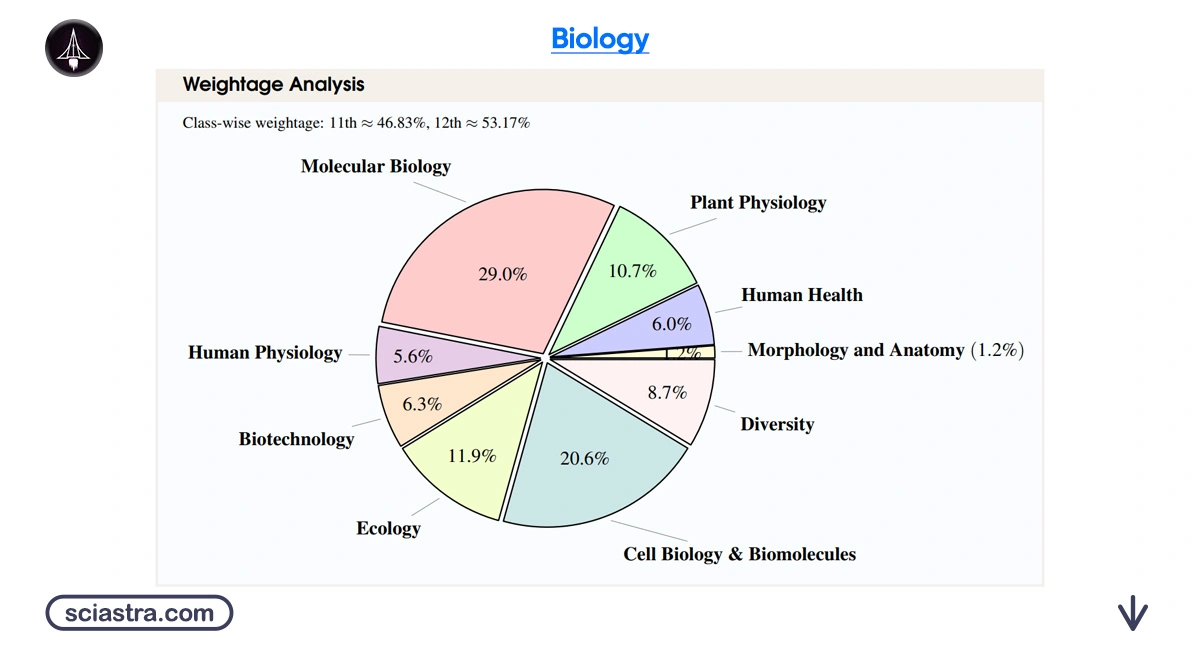
For example, subjects like Mechanics/ and its properties of matter, Electricity, Optics in Physics, Organic and Physical Chemistry concepts, Differential calculus and Algebra in Mathematics, and Molecular Biology, Cell Biology and Biomolecules in Biology often carry significant importance in the NEST exam.
NEST Biology Topic-Wise Weightage
Check out the NEST 2026 biology topic-wise weightage (Tentative) from here:


NEST Physics Topic-Wise Weightage
Check out the NEST 2026 physics topic-wise weightage (Tentative) from here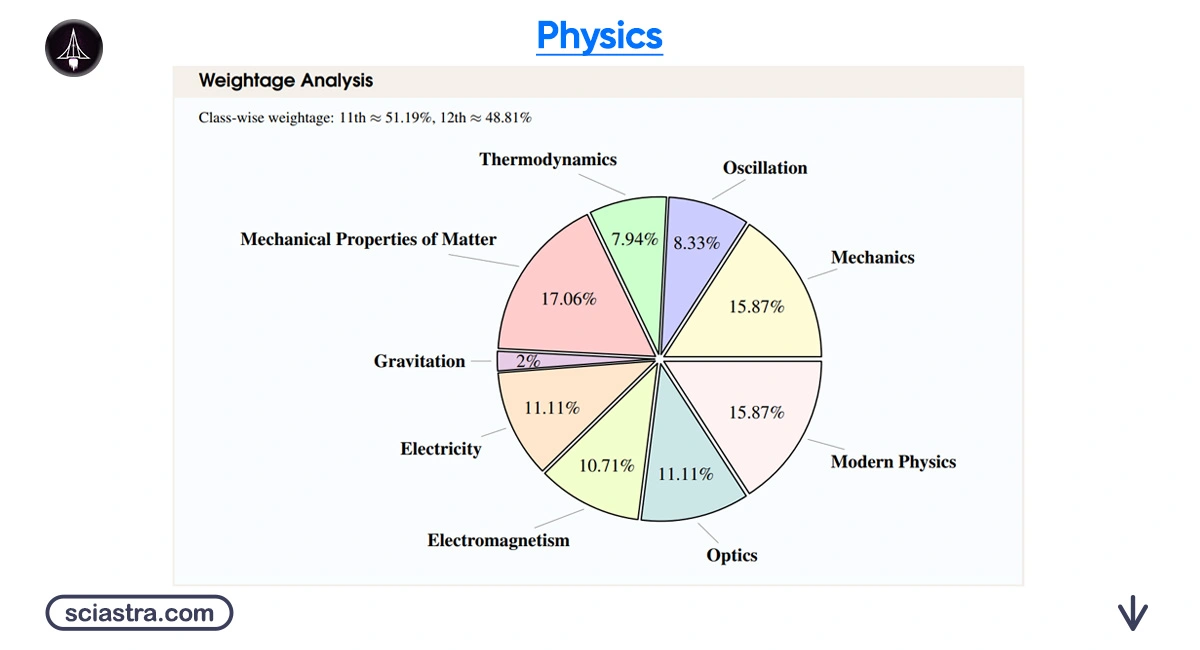
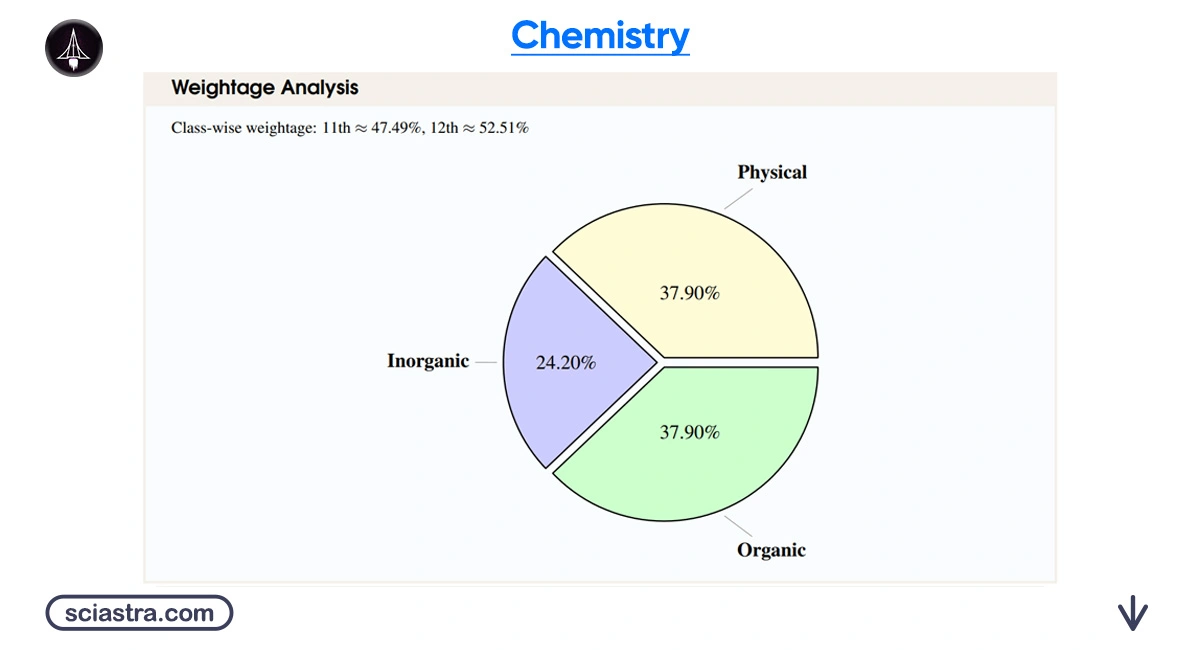
NEST Chemistry Topic-Wise Weightage
Check out the NEST 2026 chemistry topic-wise weightage (Tentative) from here:
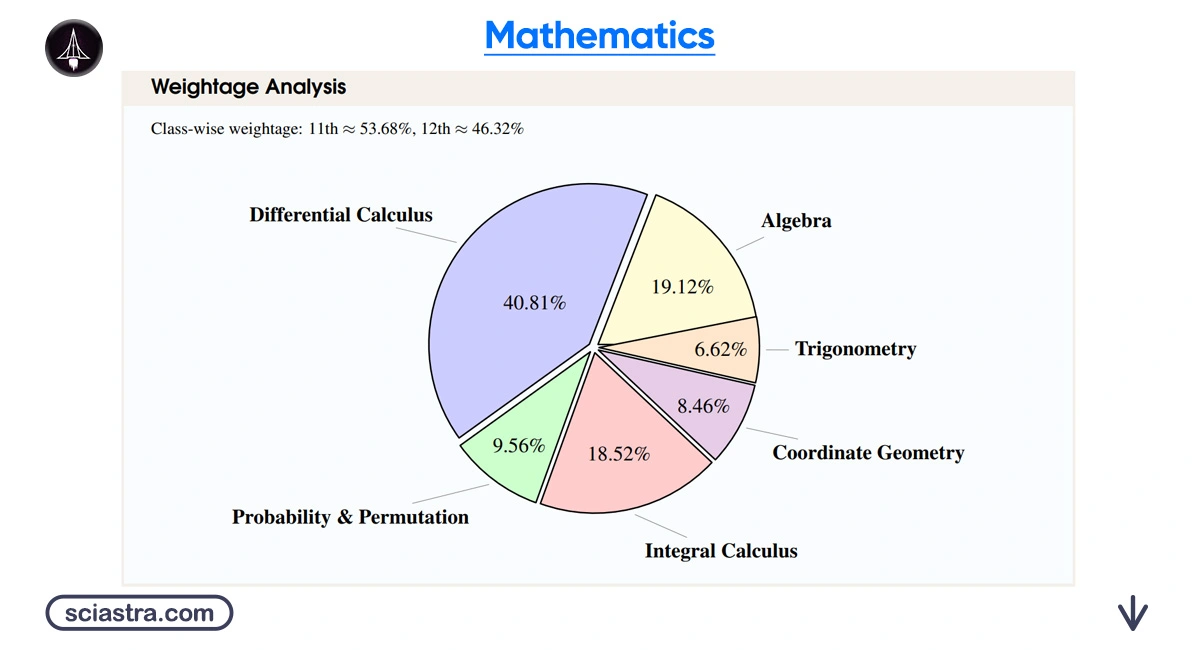
NEST Mathematics Topic-Wise Weightage
Check out the NEST 2026 mathematics topic-wise weightage (Tentative) from here:
NEST Previous Year Trend Analysis
The NEST Previous Year Trend Analysis will provide valuable insights for the candidates in order to understand the exam’s evolving pattern, which subjects and topics are frequently tested. It is important for the candidates to understand that reviewing past question papers reveals consistent emphasis on core concepts in Physics, Chemistry, Mathematics, and Biology. Knowing NEST previous year question papers and trends will also show a balanced distribution of difficulty levels, with a mix of conceptual and analytical questions.
In this section, candidates can find a subject-wise breakdown of important chapters and topics for NEST 2026, based on past trends and the NEST exam pattern. This will help the candidates in building a targeted preparation approach using these insights to enhance performance and boost confidence on exam day.
NEST Biology Previous Year Trend Analysis
Check out the NEST Biology Previous Year Trend Analysis from here:
Biology | ||||||||||
Section | Years → | 2021 | 2022 | 2023 | 2024 | 2025 | ||||
Chapters | S1 | S2 | S1 | S2 | S1 | S2 | S1 | S2 | ||
Diversity | 2 | 2 | 2 | 1 | 2 | 2 | 3 | 2 | 1 | |
Morphology and Anatomy | - | 1 | - | - | - | - | - | 1 | 1 | |
Cell Biology and Biomolecules | Cell Biology | 2 | 1 | 1 | 1 | 3 | 1 | 1 | 3 | 3 |
Biomolecules | 1 | 2 | 1 | - | 1 | 1 | 3 | 2 | 2 | |
Plant Physiology | 2 | 1 | 3 | 2 | 3 | 3 | 3 | - | 3 | |
Human Physiology | 1 | - | 2 | 1 | 1 | - | 1 | 1 | 1 | |
Molecular Biology | Genetics | 2 | 2 | 2 | 3 | 2 | 3 | 2 | 2 | 2 |
Molecular Biology | 3 | 3 | 1 | 1 | 1 | - | 2 | 1 | 2 | |
Evolution | - | 1 | 3 | 2 | 1 | 3 | 1 | 2 | 1 | |
Human Health | Human Health & Disease, and Microbes in Human Welfare | 1 | 1 | - | - | 1 | 1 | 1 | 1 | 1 |
Reproduction | 1 | - | - | - | - | - | - | - | - | |
Biotechnology | 1 | 2 | 1 | 2 | - | 1 | 1 | 3 | - | |
Ecology | 1 | 1 | 1 | 4 | 2 | 2 | 2 | 2 | 3 | |
NEST Physics Previous Year Trend Analysis
Check out the NEST Physics Previous Year Trend Analysis from here:
Physics | ||||||||||
Years → | 2021 | 2022 | 2023 | 2024 | 2025 | |||||
Section | Chapters | S1 | S2 | S1 | S2 | S1 | S2 | S1 | S2 | |
Mechanics | Unit & Dimensions | 1 | - | 3 | 1 | - | 1 | - | 1 | 2 |
Kinematics | - | 1 | - | 2 | - | - | - | - | 1 | |
Laws of Motion | - | - | 1 | 2 | - | - | - | - | - | |
Work Power Energy | 1 | - | - | - | - | - | 1 | - | 1 | |
System of Particles | 1 | 1 | - | - | - | - | - | - | - | |
Rotation | 1 | 1 | 2 | - | - | 1 | 2 | - | - | |
Oscillation | Simple Harmonic Motion | - | - | - | - | - | 1 | 2 | 2 | 2 |
Waves | - | - | 1 | - | 1 | 1 | - | - | 1 | |
Mechanical Properties of Matter | Properties of Matter | 1 | 1 | 1 | 2 | 2 | 1 | 2 | 2 | - |
Fluid Mechanics | - | 1 | 1 | 3 | 2 | - | - | - | - | |
Kinetic Theory of Gases | 1 | 1 | 1 | 1 | - | 1 | 2 | 2 | - | |
Thermodynamics | 2 | 2 | 1 | - | 2 | 1 | 1 | 1 | 3 | |
Gravitation | - | - | - | - | 1 | 1 | - | 2 | 1 | |
Electricity | Electrostatics | 1 | 1 | 2 | 3 | 1 | - | - | 1 | 1 |
Capacitors | - | - | - | 1 | 1 | 1 | 1 | - | - | |
Current | 1 | - | - | - | - | 1 | 1 | - | 1 | |
Electromagnetism | Magnetism | 1 | 1 | - | - | 2 | 1 | 1 | 1 | 1 |
Electromagnetic Induction | - | 1 | - | - | - | - | 1 | 2 | - | |
Alternating Current | - | - | - | - | - | - | - | - | - | |
Electromagnetic Waves | - | - | 1 | - | 1 | 1 | - | - | 1 | |
Optics | Ray Optics | 2 | 1 | - | 1 | 1 | 2 | 3 | 1 | 2 |
Wave Optics | - | 3 | - | - | - | 1 | - | 1 | - | |
Modern Physics | Modern Physics | 4 | 2 | 2 | 1 | 3 | 2 | 3 | 4 | 2 |
Semiconductors | - | - | 1 | - | - | - | - | - | 1 | |
NEST Chemistry Previous Year Trend Analysis
Check out the NEST Chemistry Previous Year Trend Analysis from here:
Chemistry | ||||||||||
Years → | 2021 | 2022 | 2023 | 2024 | 2025 | |||||
Section | Chapters | S1 | S2 | S1 | S2 | S1 | S2 | S1 | S2 | |
Physical | Some Basic Concepts of Chemistry | - | - | - | - | - | - | - | - | 1 |
Atomic Structure | 1 | 1 | 1 | 2 | 1 | 1 | 1 | - | 1 | |
Thermodynamics | 1 | 1 | 3 | 2 | 1 | - | 1 | 2 | 2 | |
Equilibrium | 1 | - | 2 | 1 | - | 1 | 2 | 2 | 1 | |
Solution | 1 | 1 | - | - | 1 | 1 | - | - | - | |
Electrochemistry | 1 | - | - | - | - | 2 | - | 2 | 1 | |
Chemical Kinetics | - | 1 | 1 | 2 | 1 | 1 | 2 | 1 | 1 | |
Inorganic | Periodicity | - | - | - | - | - | 1 | - | 1 | 1 |
Chemical Bonding | 3 | 2 | 1 | 1 | 2 | - | 2 | 1 | 2 | |
Coordination Chemistry | 1 | 1 | 2 | 1 | 1 | 1 | 1 | 3 | 2 | |
D & F block | - | 2 | - | - | 1 | - | 3 | 1 | 1 | |
Organic | Introduction to Organic and GOC | - | - | 2 | - | 1 | - | 1 | - | - |
Hydrocarbon | 2 | 2 | - | 2 | 1 | 2 | 1 | 1 | - | |
Alcohol Phenol and Ether | - | - | - | - | - | 1 | 2 | 1 | 1 | |
Haloalkanes and Haloarenes | 1 | 1 | - | - | 1 | 1 | - | - | 1 | |
Aldehyde Ketone and Carboxylic Acids | 2 | - | 1 | 2 | 2 | 1 | 2 | 2 | 3 | |
Amines | - | 2 | 2 | 1 | - | - | - | 2 | 1 | |
Biomolecules | 1 | - | 1 | - | - | 1 | 1 | 1 | 1 | |
NEST Mathematics Previous Year Trend Analysis
Check out the NEST Mathematics Previous Year Trend Analysis from here:
Mathematics | ||||||||||
Years → | 2021 | 2022 | 2023 | 2024 | 2025 | |||||
Section | Chapters | S1 | S2 | S1 | S2 | S1 | S2 | S1 | S2 | |
Algebra | Set Theory | - | 2 | 1 | 1 | - | - | - | - | - |
Quadratic Equation & Complex Number | 2 | 2 | 3 | 2 | 1 | 1 | 1 | 1 | 3 | |
Sequence & Series | 1 | - | - | 1 | 1 | - | - | - | - | |
Binomial Theorem | - | - | - | - | - | - | - | - | - | |
Matrices & Determinants | - | 1 | 1 | 1 | 2 | - | 1 | 2 | - | |
Differential Calculus | Basic Maths | 3 | 2 | 4 | 1 | - | 1 | 2 | 2 | 2 |
Relation | - | - | - | 1 | - | 1 | 1 | - | 1 | |
Functions & Inverse Trigonometric Function | 3 | 1 | 1 | - | 2 | 1 | 2 | 2 | 1 | |
Application of Derivative | - | - | - | - | 3 | 1 | - | - | - | |
Integral | - | 1 | 2 | 2 | 2 | - | 3 | 3 | - | |
Limit | - | - | - | - | - | - | - | - | 1 | |
Continuity | - | - | 1 | 1 | 1 | - | - | - | - | |
Differentibility | - | 1 | 1 | 1 | 1 | - | 3 | - | 1 | |
Probability and Permutation | Permutation & Combination | 2 | 1 | 1 | 1 | 2 | 3 | - | - | - |
Probability & Statistics | 1 | - | 1 | 1 | 1 | 1 | 1 | 1 | 2 | |
Trigonometry | 2 | 2 | 2 | 2 | - | 3 | 2 | 2 | - | |
Integration | Integral Calculus | - | - | - | - | - | - | 1 | 1 | - |
Definite Integral | 1 | 2 | - | 1 | - | 2 | 1 | 1 | 3 | |
Differential Equations | 1 | - | - | - | - | - | 1 | 1 | 1 | |
Coordinate Geometry | Straight Line | - | - | - | - | 1 | 1 | 3 | - | 1 |
Circle | - | - | - | 1 | - | 1 | - | 3 | 1 | |
Conic Section | 1 | 1 | - | 1 | 2 | - | 1 | 1 | 1 | |
Vector & 3D | - | 2 | 1 | 1 | - | 1 | - | - | 2 | |
What is a Good Score in NEST 2026?
A good score in the NEST 2026 exam will specify the minimum marks candidates are required to score in order to qualify for the admissions process in the participating institutes (NISER/UM DAE-CEBS). Before appearing for the exam, candidates must check out the expected NEST cut off so that must know the minimum marks that they must achieve in the NEST exam.
College Name | General | OBC | SC | ST | JK |
NISER | Above 95 | 84+ | 58+ | 48+ | 85+ |
CEBS | 100+ | 90 | 65+ | 55+ | 95+ |
Start Your NEST 2026 Preparation
Every year, the difficulty level and competition for the NEST exam continue to rise, making early and strategic preparation essential for success. With expert guidance from dedicated mentors at SciAstra, you can strengthen your preparation and secure admission to prestigious BSc-MSc degree programme at NISER Institute and UM-DAE-CEBS (University of Mumbai).
Explore the NEST 2026 preparation batches offered by SciAstra and choose the one that best fits your goals — start your journey today!
Check out IAT/NEST 2026 Exam Preparation Courses for Class 11, Class 12 and Droppers from here:
Read More: NEST 2026 Selection Process