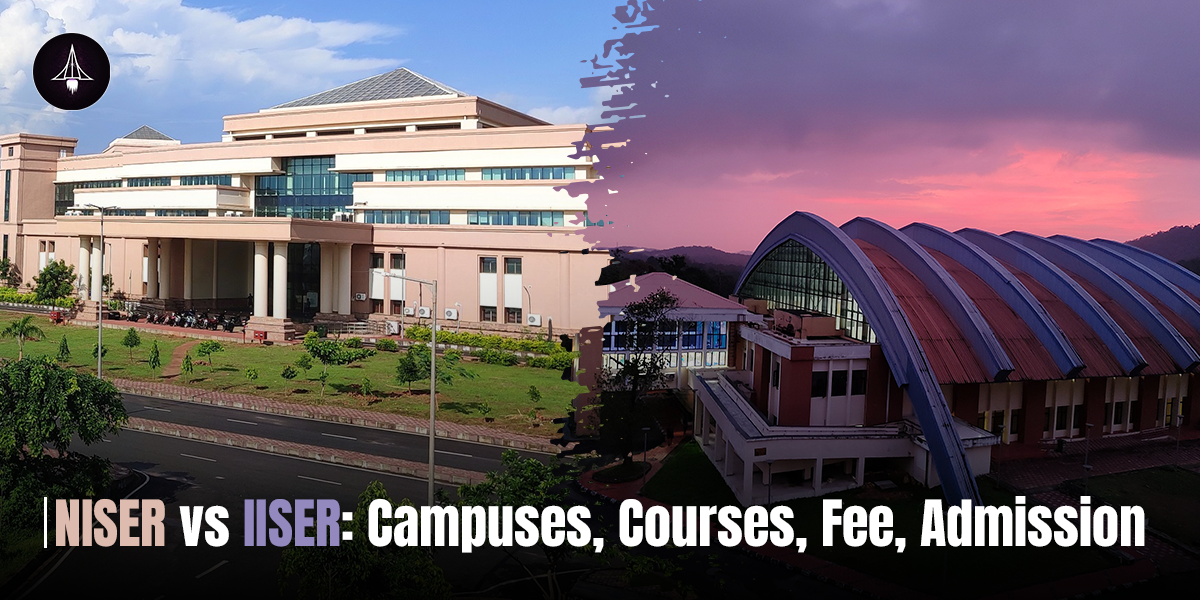
The Indian Institutes of Science Education and Research (IISERs) and the National Institute of Science Education and Research (NISER) are two premier institutions that offer research education in India.
Students aiming to become researchers and scientists can consider these two institutes to pursue UG, PG, or PhD-level education for their pragmatic approach towards science and research.
Despite their similar goals and approach, IISERs and NISER differ in several key aspects, such as admission process, course structure, governing bodies, and career opportunities.
This SciAstra article highlights these key differences between IISERs and NISER to help students make decisions about which of these institutes they want to apply for admission. The key parameter they should consider while making the decision is that the education and facilities at the institute they choose meet their educational and career goals.
What are IISERs?
Indian Institutes of Science Education and Research (IISERs) are a group of seven institutes located in different parts of India, dedicated to imparting science education and developing practical research skills in students. These are Institutes of National Importance, established by an Act of Parliament.
IISERs are located in Pune, Kolkata, Mohali, Thiruvananthapuram, Tirupati, Bhopal, and Berhampur.
What is NISER?
The National Institute of Science Education and Research (NISER) is a research institute located in Bhubaneswar, Odisha. It is affiliated with Homi Bhabha National Institute (HBNI), Mumbai, a deemed research university that oversees academic programmes at institutions that are part of the Department of Atomic Energy (DAE) structure.
IISER Vs NISER: Key Details and Comparison
IISERs and NISER are reputed institutes for developing scientific minds in India. Check out the detailed comparison between these institutes below:
IISER Vs NISER: Campuses
There are a total of seven campuses of IISERs in India. The locations of each campus are mentioned below. NISER has one campus in Jatni, Bhubaneswar. Complete details about it are mentioned below.
IISER Campuses
The seven IISERs are listed below:
IISER Campus | City | State |
IISER Pune | Pune | Maharashtra |
IISER Kolkata | Mohanpur | West Bengal |
IISER Mohali | Mohali | Punjab |
IISER Bhopal | Bhopal | Madhya Pradesh |
IISER Thiruvananthapuram | Thiruvananthapuram | Kerala |
IISER Tirupati | Tirupati | Andhra Pradesh |
IISER Berhampur | Berhampur | Odisha |
NISER Campus
The National Institute of Science Education and Research (NISER), Bhubaneshwar, is a unique institution in India, committed to the generation, dissemination and preservation of knowledge in basic sciences, integrated with the goal of creating a zeal and fervour in the minds of the young buds of the nation towards a scientific temper.
The Institute is affiliated with Homi Bhabha National Institute (HBNI), Mumbai, a deemed research university that oversees academic programmes at Institutions that are part of the Department of Atomic Energy (DAE) structure.
The NISER campus is situated on 300 acres of land, generously donated by the people of Odisha, in Jatni town, 25 km from the centre of the city of Bhubaneswar. The Institute started functioning from the current campus in July 2015, nine years since 28th August 2006, when the then Prime Minister of India, Shri Dr. Manmohan Singh, announced the proposal for its establishment. The institute was officially founded on 6th September 2007 after the approval of the Union Cabinet. This day is celebrated as the foundation day of the institute. The academic programme was inaugurated by the Chief Minister of Orissa – Shri Naveen Patnaik, on 10th September 2007 at the Institute of Physics campus. The Institute at the Jatni campus was formally inaugurated on February 7, 2016.
IISER Vs NISER: Courses & Admission Process
The details about the courses offered by IISERs and NISER are mentioned below:
IISER Courses
IISERs offer 5-Year BS-MS Dual Degree programmes, BTech, MSc, PhD, and Integrated PhD courses. Candidates must check the official website of each IISER for details about the courses offered by the institute. The admission processes for all these courses are mentioned below:
IISER 5-Year BS-MS and BTech Admission Process
Admissions to the 5-year BS-MS Dual Degree Programmes and BTech Programmes offered by IISERs are conducted through the IISER Aptitude Test (IAT).
To gain admission to these courses, candidates who meet the IAT eligibility criteria must fill out the IAT application form, download the exam admit card, and appear for the test. The IAT 2026 will be conducted on June 7, 2026.
Thereafter, candidates who qualify for the exam will be required to register for IAT counselling. They will be offered seats based on their IAT ranks and institute-wise IAT cutoffs.
IISER MSc Admission Process
Admission to the MSc programmes offered by IISERs is based on one of two methods: national-level online screening tests in each subject conducted by the institutes. Selection from candidates shortlisted based on the screening test occurs through interviews conducted by the respective schools.
IISER PhD Admission Process
PhD admissions at IISERs are based on scores from entrance exams such as the National Eligibility Test (UGC-NET/CSIR), NBHM, etc. Before applying for a PhD programme at an IISER, visit the institute’s official website and check the eligibility criteria to confirm which entrance exams it accepts.
IISER Integrated PhD Admission Process
IISERs accept scores from the Joint Entrance Screening Test (JEST) or IIT Joint Admission Test (IIT JAM) for Integrated PhD admissions. Again, visit the institute’s official website and check the eligibility criteria to confirm which entrance exams it accepts.
NISER Courses
NISER Bhubaneswar offers 5-year Integrated MSc courses in Physics, Chemistry, Mathematics and Biology, 2-year MSc Programme in “Medical & Radiological Physics” + 1 Year Internship (MSc MRP), PhD and Integrated PhD courses. The admission process for each course is mentioned below:
NISER Bhubaneswar Courses 2026 | |
Courses | Admission Process |
| Admission through National Entrance Screening Test (NEST) |
| Admission to the 2-year MSc Programme in “Medical & Radiological Physics” + 1 Year Internship is offered through IIT Joint Admission Test for Masters (IIT JAM) and Joint Entrance Screening Test (JEST), followed by a written test and/or interview. Candidates only need to qualify in one of the two entrance exams, IIT JAM or JEST, to become eligible to apply. |
| NISER offers two types of PhD programmes, PhD and Integrated PhD. Candidates can pursue a PhD at NISER Bhubaneswar after Master’s Degree. Candidates who have completed a Bachelor’s Degree can apply for the Integrated PhD at the institute. This programme is a combination of an MSc and a PhD. Candidates are shortlisted based on the eligibility criteria of the respective schools of NISER and/or scores in the national examinations such as CSIR-UGC-NET/GATE/JEST/GPAT/DBT/ICMR/JGEEBILS. This is followed by written tests and/or interviews conducted by respective schools of NISER Bhubaneswar. Each school has different eligibility criteria for PhD admissions. |
| |
IISER Vs NISER: Fees and Scholarships
IISERs: There is no guaranteed institute scholarship for BS-MS students at IISERs unless they qualify for INSPIRE Scholarship or other external fellowships. Annual fees for these courses generally range from INR 80,000–INR 90,000 (INR 40,000–INR 50,000 for SC/ST students), making them more expensive than NISER.
NISER: NISER Bhubaneswar provides an annual scholarship/stipend (NEST 2026 stipends/scholarship) of INR 60,000 (INR 5,000/month via INSPIRE/DISHA) and INR 20,000 summer internship grant to all students admitted to its 5-year Integrated MSc courses. NISER Bhubaneswar fees for 5-year Integrated MSc programmes are less than INR 20,000 per year for General/OBC categories (INR 10,000 for SC/ST).
IISER vs NISER: Seats
IISERs and NISER are reputed institutes for developing scientific minds in India. Check the detailed comparison between these institutes below:
IISER Seat Intake 2026 for BS-MS, BS and BTech Programmes
Refer to the following table to check the IISER seat intake 2026 for 5-year BS-MS, BS and BTech courses:
IISER / Course | Programme Type | Number of Seats |
IISER Berhampur | BS-MS | 300 |
IISER Bhopal | BS-MS | 300 |
IISER Kolkata | BS-MS | 280 |
IISER Kolkata (Computational and Data Sciences) | BS-MS | 30 |
IISER Mohali | BS-MS | 275 |
IISER Pune | BS-MS | 288 |
IISER Tirupati | BS-MS | 250 |
IISER Thiruvananthapuram | BS-MS | 320 |
IISER Bhopal (Electrical Engineering and Computer Science) | BTech | 75 |
IISER Bhopal (Chemical Engineering) | BTech | 40 |
IISER Bhopal (Data Science and Engineering) | BTech | 80 |
IISER Bhopal (Economic Sciences) | BS | 55 |
IISER Tirupati (Economic and Statistical Sciences) | BS | 50 |
Total (BS-MS Programmes) | — | 2043 |
Total (BS/BTech Programmes) | — | 300 |
Grand Total (All Programmes) | — | 2343 |
NISER Seat Intake 2026 for 5-Year Inegrated MSc Programme
Check out the number of seats to which NISER Bhubaneswar and DAE CEBS are offering admissions through NEST 2026:
NEST 2026 Seat Intake | ||
Category | NISER Seats | UM-DAE CEBS |
Unreserved (UR) | 101 | 23 |
UR - EWS | 0 | 6 |
OBC - NCL | 54 | 15 |
SC | 30 | 9 |
ST | 15 | 4 |
Divyagjan | 5% seats in each category (UR)-05; (OBC-NCL)-03; (SC)-02; (ST)-01 | 5% seats in each category |
Total Seats | 200 | 57 |
J & K, Ladakh | 2 | 2 |
Total intake (including J & K, Ladakh) | 202 | 59 |
Conclusion
In conclusion, both the Indian Institutes of Science Education and Research (IISERs) and the National Institute of Science Education and Research (NISER) stand out as top-tier institutions for science education and research in India. While IISERs offer the advantage of multiple campuses, diverse course options, and a larger number of seats, NISER provides a more focused academic environment with strong financial support through scholarships and lower fees.
The choice between IISERs and NISER ultimately depends on a student’s priorities, whether they are broader exposure and flexibility or affordability and assured financial aid. Factors such as admission pathways (IAT vs NEST), course structure, research opportunities, and long-term career goals should be carefully evaluated before making a decision.
Both pathways lead to excellent academic and research careers, and students can confidently choose either based on their individual preferences and aspirations in the field of science.
Crack IAT 2026 in Just 2 Months
Feeling confused, overwhelmed, or running out of time to prepare for IAT 2026 & NEST 2026?
Don’t worry—we’ve got you covered.
Introducing the SciAstra IAT & NEST Crash Course 2026 (Offline)
A power-packed programme specially designed for students who want maximum results in minimum time.
Turn your last 2 months into your biggest advantage.
Why This Course Works:
✔️ Structured Offline Classes (Mon–Sat) – Stay consistent with expert guidance
✔️ Daily Practice Papers (Printed) – Build speed, accuracy & confidence
✔️ 8 Full-Length Mocks (6 IAT + 2 NEST, CBT Mode) – Real exam experience
✔️ FREE IAT & NEST 2026 Focus Test Series – Extra edge for final revision
✔️ Private WhatsApp Support Group – Get doubts solved instantly
✔️ FREE SciAstra T-Shirt – Because you’re part of something bigger
Perfect for late starters and serious aspirants who want focused, result-driven preparation.
Limited time left. Limited seats available.
👉 Enroll Now and take the first step toward cracking IAT 2026 & NEST 2026!
FAQs:
- What are the main differences between NISER and IISER programs?
- Major Selection: NISER students choose their major in the second year, while IISER students choose theirs in the third year (some IISERs offer pre-majors).
- Thesis Duration: NISER offers two years for the master's thesis (4th & 5th year), whereas IISERs offer only one year (5th year).
- Thesis Location: NISER students generally do their thesis within the institute, while IISERs allow students to pursue thesis projects at other institutes.
- What scholarships are available?
Both NISER and IISER students can qualify for the DBT Inspire Scholarship, but eligibility is limited for IISER students. However, all National Institute of Science Education and Research students receive an annual scholarship of ₹80,000.
- Which institute offers more course flexibility?
IISERs offer a wider range of majors, including computer science, earth and environmental science, and economic sciences, compared to NISER.
- How many seats are available at NISER and IISERs?
There are significantly more seats available at IISERs (around 1933) compared to NISER (around 200) due to the existence of seven IISERs across India.
- What entrance exams do NISER and IISERs conduct?
NISER conducts NEST (National Entrance Screening Test), while IISERs conduct IAT (IISER Aptitude Test). Both exams are challenging but less competitive than NEET or JEE Mains. NEST is considered slightly tougher than IAT.
- Where are NISER and IISER campuses located?
NISER has one campus in Bhubaneswar, Odisha. IISERs has seven campuses spread across Kolkata, Pune, Mohali, Bhopal, Thiruvananthapuram, Tirupati, and Berhampur (under construction).
- Which institute is better, NISER or IISER?
Both NISER and IISERs are excellent options for science aspirants. The "better" institute depends on your individual priorities. Consider factors like course preferences, scholarship opportunities, preferred location, and the importance of an external thesis project.

Comments (1)