




.webp)





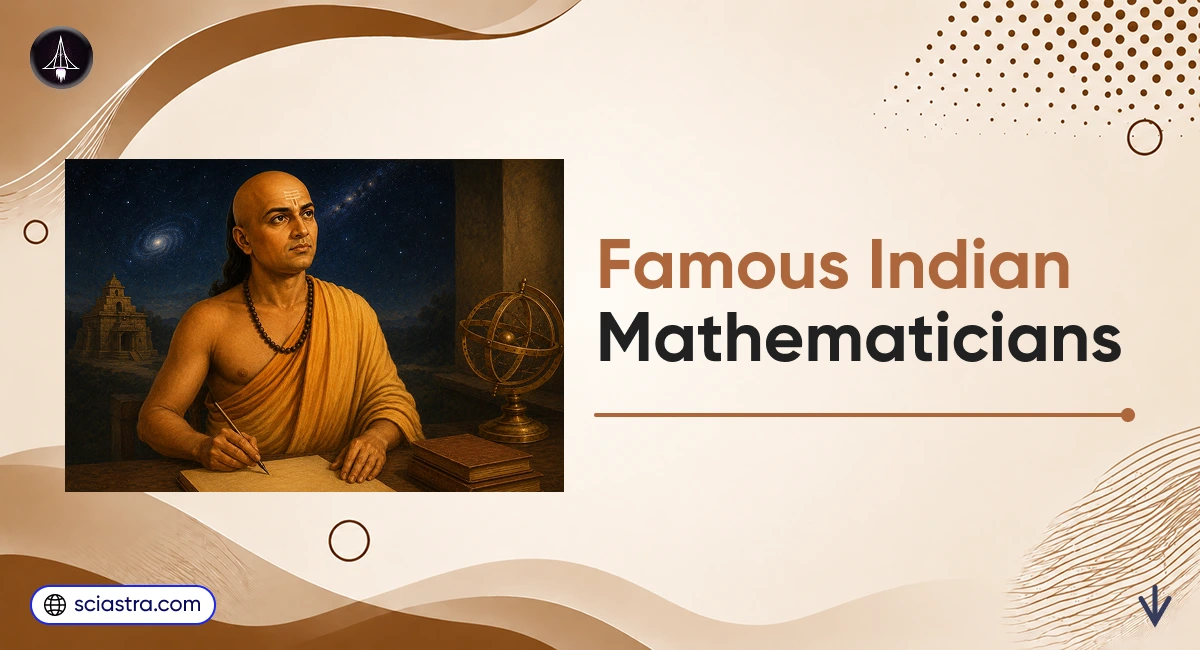
Famous Indian Mathematicians: In ancient times, India had many famous Indian mathematicians. Their contributions to mathematics have revolutionised the vision of mathematics on a global level. From the discovery of zero to introducing modern statistics and number theory concepts to the world, Indian mathematicians have made contributions that continue to influence the world even today.
Mathematics is one of the most important subjects that forms the foundation of multiple subjects, such as science, technology, engineering, research, etc.
This SciAstra blog provides crucial details about ancient, famous Indian mathematicians, describing their history, lifespan, and contribution to shaping the world of mathematics.
History of Mathematics in India
In ancient times, India had many innovative mathematicians who changed the thinking of the world towards mathematics. India has one of the oldest and richest mathematical traditions in the world that was deeply connected with astronomy, architecture, trade, and religious studies. Indian mathematician scholars have played a major role in developing mathematical concepts that later influenced civilisations across the globe.
India has contributed to giving the world one of its greatest mathematical inventions, such as the concept of zero, contributions to trigonometry, and the concept of calculus. Indian mathematicians also developed the decimal number system, which later became the foundation of modern mathematics and computation worldwide.
Famous Indian Mathematicians
The key details about the famous Indian mathematicians are listed below:
Contributions in mathematics that influence modern science and technology
Their subject of expertise
Prizes received (if any)
Books written
Aryabhata (476 CE - 550 CE)
Aryabhata is globally considered one of the greatest mathematicians and astronomers from ancient Indian times. His contributions in mathematics laid the foundation for future mathematical developments in the world.

Aryabhata Details | |
Life Span | 476 CE - 550 CE |
Birthplace | Kusumapura (Present-day Patna, Bihar, India) |
Education | It is believed that he studied at ancient Nalanda University, where mathematics and astronomy were major subjects |
Mathematical Contributions | • He calculated the value of Pi (π) with remarkable accuracy • He developed concepts of algebra and trigonometry. • He introduced methods for solving equations • He worked on the place value system that supported decimal mathematics |
Famous Book | Aryabhatiya |
Recognition & Legacy | India named its first satellite the Aryabhata Satellite in his respect & honour. |
Brahmagupta (598 CE - 668 CE)
Brahmagupta was one of the most brilliant mathematicians in ancient India. He is especially famous for introducing great mathematical rules that involve zero and negative numbers.

Brahmagupta Details | |
Life Span | 598 CE - 668 CE |
Birthplace | Bhinmal, Rajasthan, India |
Education | Brahmagupta studied mathematics and astronomy through traditional Indian scholarly systems, likely connected with the astronomical centre of Ujjain. |
Mathematical Contributions | • He was the first mathematician to define arithmetic operations with zero. • Developed rules for Negative Numbers • Solved Quadratic Equations • Advanced concepts of Algebra and Geometry |
Famous Books | Brahmasphutasiddhanta & Khandakhadyaka |
Recognition & Legacy | Brahmagupta is remembered globally for establishing mathematical rules that shaped the modern arithmetic concept. |
Bhaskara I (600 CE - 680 CE)
Bhaskara I was also a great mathematician who preserved and expanded the work of Aryabhata, which came out as a great revolutionary work, and he also contributed to astronomy and trigonometry concepts.

Bhaskara I Details | |
Life Span | 600 CE - 680 CE |
Birthplace | It is believed that Bhaskara I was born in the Karnataka region, South India |
Education | He learnt mathematics and astronomy under traditional Indian education systems and scholarly traditions. |
Contributions in mathematics | • Bhaskara I Improved Trigonometric Calculations • He wrote a detailed commentary explaining Aryabhata’s mathematical methods • Bhaskara I contributed to astronomical calculations • Improved sine approximation formulas |
Famous Books | Mahabhaskariya & Laghubhaskariya |
Recognition & Legacy | Known for preserving and expanding important mathematical knowledge from ancient India. |
Bhaskara II (1114 CE - 1185 CE)
Bhaskara II played an important role in advancing mathematics and astronomy in ancient India. He was the leader of a cosmic observatory at Ujjain, a main mathematical centre of ancient India.

Bhaskara II Details | |
Life Span | 1114 CE - 1185 CE |
Birthplace | Bijapur (Present-day Karnataka, India) |
Education | Bhaskara II received advanced education in mathematics and astronomy from family scholars and traditional Indian learning systems. |
Mathematical Contributions | • Bhaskara II developed concepts similar to Calculus centuries before Europe • He majorly work in Arithmetic, Algebra, Geometry, and Number Theory concepts • He solved complex equations & Improved astronomical calculations |
Famous Books | Lilavati, Bijaganita, and Siddhanta Shiromani |
Recognition & Legacy | Bhaskara II is considered one of India’s greatest mediaeval mathematicians for advanced discoveries in mathematics. |
Madhava of Sangamagrama (1340 CE - 1425 CE)
Madhava of Sangamagrama was a revolutionary mathematician who founded the most famous Kerala School of Mathematics. He made the best pioneering contributions to the study of infinite series, trigonometry, geometry and algebra.

Madhava of Sangamagrama Details | |
Life Span | 1340 CE - 1425 CE |
Birthplace | Sangamagrama (Present-day Kerala, India) |
Education | Madhava studied under Kerala’s traditional scholarly systems, which focus on mathematics and astronomy. |
Mathematical Contributions | • Madhava developed Infinite Series Expansions • He introduced early mathematical concepts related to Calculus • He advanced Trigonometry calculations • He founded the famous Kerala School of Mathematics |
Famous Work | Venvaroha (works survive mainly through later Kerala school texts) |
Recognition & Legacy | Madhava is recognised by historians as one of the earliest pioneers of calculus. |
Srinivasa Ramanujan (1887 - 1920)
Srinivasa Ramanujan is regarded as one of the greatest mathematical geniuses in global history. Despite having financial struggles and limited formal education, Srinivasa's work amazed all mathematicians worldwide; he did advanced research in infinite series.

Srinivasa Ramanujan Details | |
Life Span | 1887 - 1920 |
Birthplace | Erode, Tamil Nadu, India |
Education | Studied at Town Higher Secondary School, Kumbakonam, and later attended Government Arts College, Kumbakonam, but mostly pursued self-study in mathematics. |
Mathematical Contributions | • Srinivasa Ramanujan did revolutionary work in Number Theory • He made major discoveries in Infinite Series • He advanced the work on Partition Functions • He developed formulas used in advanced mathematical research today |
Famous Work | Ramanujan's Notebooks |
Recognition & Legacy | Srinivasa Ramanujan became a Fellow of the Royal Society in 1918. India celebrates National Mathematics Day on 22 December in his honour. |
Also Read:
Major Contributions of Indian Mathematicians to the World
Indian mathematicians have made great historic contributions in shaping the foundation of mathematics. From ancient civilisations to modern science research, their discoveries have greatly improved mathematics, science, engineering, and technology across the world.
Discovery and Development of Zero
Zero is one of India's great contributions to mathematics, and Brahmagupta was the first Indian mathematician who explained how zero can be used in mathematical calculations.
This discovery changed the thinking towards numbers, and now ZERO becomes the foundation of modern mathematics and computers.
Advances in Algebra
Aryabhata and Bhaskara II developed great methods to solve equations and introduced important algebraic concepts in mathematics that are still studied today. Indian mathematics scholars made major progress in the Algebra concept when it did not become popular globally.
Contributions to Trigonometry
The contributions to trigonometry made a way to study astronomy and understand planetary movements. Aryabhata introduced the early ideas of sine functions, while Bhaskara I also improved trigonometric calculations that help us gain knowledge about scientific studies.
Early Concepts of Calculus
Mathematician Madhava of Sangamagram discovered infinite series expansions which closely resemble the concepts used in modern calculus. Although calculus is often associated with European mathematicians, our ancient mathematician Bhaskara II already worked on mathematical principles which are related to differentiation and advanced calculations before formal calculus was introduced in Europe.
Influence on Modern Statistics and Number Theory
Indian mathematician Srinivasa Ramanujan shaped modern mathematics through work in number theory and statistics. He made extraordinary discoveries in number theory and made important contributions to modern statistics that are widely used in research and data science in today’s world.
Get One Step Ahead Towards Becoming a Mathematician with SciAstra
A successful mathematician starts with a strong undergraduate foundation. Whether your goal is to study mathematics at premier institutes like IISERs, IISc, NISER, ISI, or CMI, the right preparation can open the doors to some of India's most prestigious mathematics and research programmes. SciAstra provides specialised mentorship, structured learning, and exam-focused preparation for both pathways, IAT/NEST and ISI/CMI, helping aspiring mathematicians build the problem-solving skills needed for success.
Crack IAT & NEST and Pursue Mathematics at IISERs & NISER
Prepare for IAT (BS-MS Dual Degree Mathematics) and NEST (5-Year Integrated MSc in Mathematics) with SciAstra’s expert-led courses and get the following:
Live interactive classes taught by mentors from top research institutes
Comprehensive study material covering the complete syllabus
Mock tests and PYQs for exam practice
Dedicated doubt-solving support for better concept clarity
Personalised mentorship and preparation guidance
A structured roadmap to secure admission into India’s top science institutes
The perfect start for students aiming to build a career in mathematical sciences
Check the details below 👇


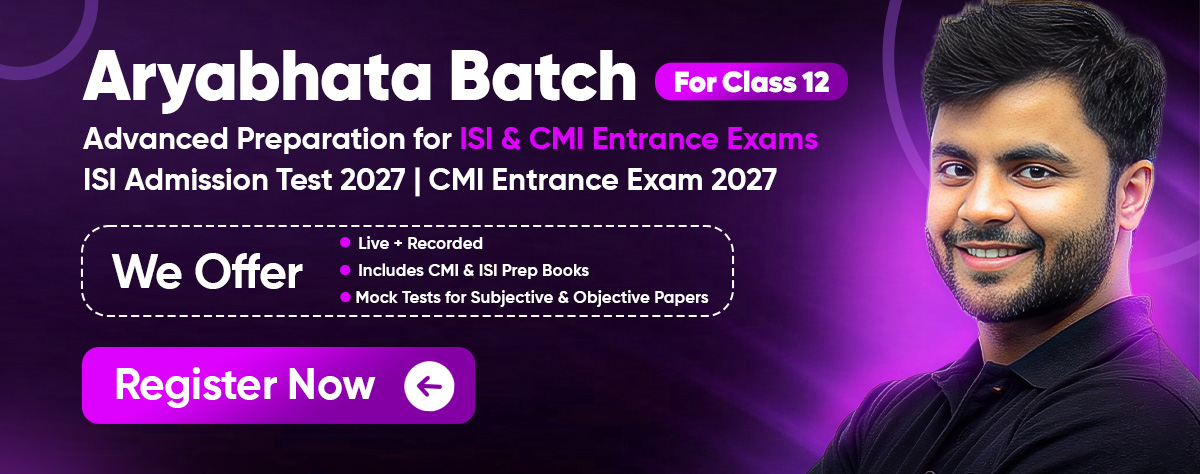
Target ISI & CMI with the Aryabhata Batch
Dreaming of studying mathematics at ISI or CMI? Prepare with SciAstra’s Aryabhata Batch and get the following:
Specialised preparation designed for ISI and CMI entrance exams
Learn advanced problem-solving techniques for challenging mathematics questions
Practice both subjective and objective question patterns
Regular mock tests to improve speed, accuracy, and exam confidence
Guidance from experienced mentors familiar with ISI and CMI admission requirements
A focused preparation strategy to help you secure admission into India’s top mathematics institutes
Start your mathematical journey today and take the first step towards becoming the mathematician you aspire to be with SciAstra.
Conclusion
Indian mathematicians have made many extraordinary contributions in mathematics that transformed the world of mathematics forever. Mathematicians worked towards the invention of zero, algebra, trigonometry, calculus, and number theory, which have helped growth in modern science and technology.
India is home to superminds who took revolutionary steps in mathematics which transformed the foundation of mathematics forever. They introduced many great inventions to the world, which later became a crucial part of today’s science and computational technology.
Read More: