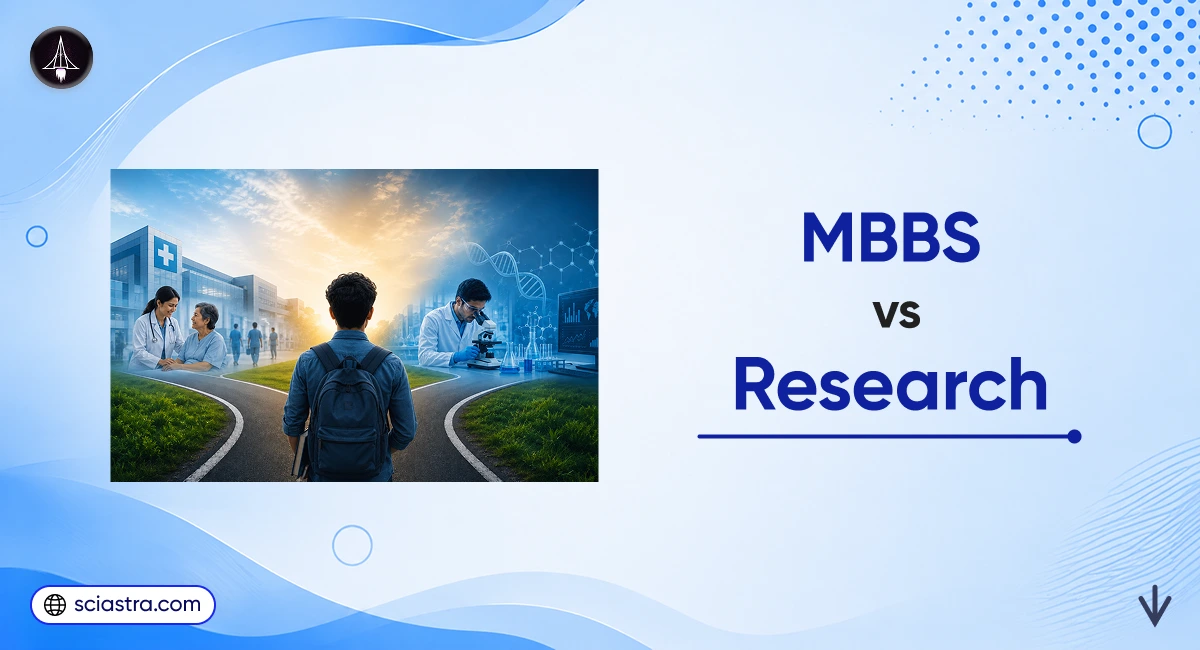
MBBS vs NEET: For most of the science students in India, they prefer to become doctors and engineers, and a PCB student’s default dream is MBBS through the NEET exam. Parents, schools, and coaching institutes inculcate students' minds with only one manifesto ie, “Become a doctor.”
In recent years, repeated NEET controversies, paper leak allegations, and increasing student stress have raised a serious question: Is NEET really the only path for a bright science student?
At the same time, there are many top NIRF ranking research institutes like IISc, IISERs, NISER and IITs, which provide natural science and mathematics courses like BS-MS/BS/BTech courses that lead to top careers in research, industry, data science, AI, and academia. In order to get admission in these institutes, candidates need to take the IAT and NEST exams.
NEET Exam: Controversies, Competition and Student Concerns
In the last few years, NEET has been in the news for all the wrong reasons: alleged paper leaks, court cases, grace marks disputes, and demands for re-exams. In fact, for this year’s session, the NEET 2026 exam was earlier conducted on May 3, 2026 and later, due to paper leak allegation, got rescheduled to be re-conducted on June 21, 2026.
It is advisable for the candidates, before making their career choices in NEET, to check out the harsh reality.
Limited government MBBS seats: Every year, lakhs of students appear for NEET, but government seats are only a small fraction of the total aspirants.
Only 2.71% of the total candidates who appeared for the examination successfully secured admission to an MBBS program in a government medical college.
High fees in private colleges: Many students who do not get a government seat are forced to consider costly private or deemed universities, which can mean a huge financial burden for families.
Long and uncertain journey: Even after MBBS, the competition for PG seats (MD/MS) is intense, which means many more years of exams, coaching, and stress.
One-exam dependency: For lakhs of students, their entire future feels tied to one exam on one day, which increases anxiety and pressure.
Because of this, a growing number of students and parents are asking:
“If NEET doesn’t work out, do we have any equally prestigious scientific options?”
The answer is YES. Through pure science and research pathways.

Research vs MBBS: Which Career Path Is Right for You?
A research career is ideal for students who genuinely enjoy Physics, Chemistry, Mathematics, Biology, and want to discover, innovate, and solve problems, not just study for clinical practice. Here is how MBBS vs Research broadly compares:
Aspect | MBBS | Research Degrees (via IAT/NEST etc.) |
Main focus | Clinical medicine, treating patients | Scientific discovery, lab work, innovation in science and technology |
Typical degree | MBBS, then MD/MS | BS, BS-MS, integrated BSc-MSc in sciences |
Entrance exam | NEET-UG | IISER Aptitude Test (IAT), National Entrance Screening Test (NEST) |
Seats & competition | Very high competition, limited govt seats | Competitive but with multiple institutes & programmes |
Career paths | Doctor in hospitals/clinics, medical teaching | Research scientist, industry R&D, data science, academia, policy, startups |
Financial cost | Govt medical is affordable, private often very high | Many research institutes offer low fees and good scholarships |
For a student who loves science more than just “becoming a doctor”, research can be a more satisfying and flexible path.
IAT 2027: The Pathway to India’s Leading Research Institutes
One of the most important NEET alternatives for science-loving students is the IAT – IISER Aptitude Test.
What is IAT?
IISER Aptitude Test (IAT), is a national-level entrance examination that is conducted annually to provide admissions to the BS-MS/BS/Btech degree courses offered at the finest research institutes across the nation.
Candidates selected through the IISER entrance exam 2027, they will be getting admissions to the premier institutes like IISc, IIT (Madras, Guwahati), IISERs, IACS and IIEST Shibpur.
IAT 2026 Courses Offered at IISERs
Before applying for the IISER entrance exam, the candidates must know the courses offered by the participating institutions. This will help them figure out their choice and career in science institutes.
Course/Programme | Duration | Institute(s) Offering the Programme |
BS-MS (Dual Degree) Programme | 5 Years | All IISERs |
BS-MS (Dual Degree) in Computational and Data Sciences | 5 Years | IISER Kolkata |
BS Degree in Economic Sciences | 4 Years | IISER Bhopal |
BS Degree in Economic and Statistical Sciences | 4 Years | IISER Tirupati |
BS-MS with a Major in Geology | 5 Years | IISER Mohali |
BS-MS with a Major in Environmental Sciences | 5 Years | IISER Mohali |
BTech in Chemical Engineering | 4 Years | IISER Bhopal |
BTech in Electrical Engineering and Computer Science | 4 Years | IISER Bhopal |
BTech in Data Science and Engineering | 4 Years | IISER Bhopal |
Also Read: IAT 2027 Courses Offered
IISER 2027 Exam Highlights
The interested candidates need to know the exam highlights before the IISER 2027 Preparation. Check out the complete details here:
Particulars | Details |
Exam Name | IISER Aptitude Test (IAT) 2027 |
Exam Level | National Level Undergraduate Entrance Exam |
Purpose | Admission to BS-MS/ BS/ Btech Degree programmes offered by IISERs and participating institutes |
Exam Mode | Computer-Based Test (CBT) / Online Mode |
Exam Frequency | Once a Year |
Duration | 3 Hours (180 Minutes) |
Medium of Exam | English and Hindi |
Question Type | Multiple Choice Questions (MCQs) with Single Correct Answer |
Total Questions | 60 Questions |
Subjects Covered | Physics, Chemistry, Mathematics, and Biology |
Questions per Subject | 15 Questions from each subject |
Maximum Marks | 240 Marks |
Marking Scheme | +4 for Correct Answer, -1 for Incorrect Answer, 0 for Unattempted Questions |
Official Website | Link will be provided once it's made live by the officials for the session 2027-2028 |
IAT Exam Date 2027
Since the officials have yet to release the IAT 2027 exam schedule, here is the tentative timeline (based on the 2026 exam calendar) mentioned:
Event Name | Tentative Dates |
IAT 2027 Notification | First Week of February 2027 |
IISER 2027 Application Form Start Date | First Week of March 2027 |
IISER 2027 Application Form End Date | Second Week of April 2027 |
IAT 2027 Application Correction Window | Third Week of April 2027 |
IISER Aptitude Test 2027 | First Week of June 2027 |
IAT 2027 Provisional Answer Key | First Week of June 2027 (After the successful conduct of the exam) |
IAT 2027 Student Response Sheet | Second Week of June 2027 |
IAT 2027 Result Release Date | Fourth Week of June 2027 |
NEST 2027: Gateway to NISER and CEBS Integrated MSc Programmes
Apart from the IISER Aptitude Test, candidates can also explore another entrance exam, i.e, NEST (National Entrance Screening Test), from here:
What is the National Entrance Screening Test (NEST)?
The National Entrance Screening Test (NEST) is a national-level entrance examination conducted for admission to five-year integrated programmes in Physics, Chemistry, Mathematics, and Biology offered at two institutes: the National Institute of Science Education and Research (NISER), Bhubaneswar, and the University of Mumbai–Department of Atomic Energy Centre for Excellence in Basic Sciences (UM–DAE CEBS), both of which function under the Department of Atomic Energy (DAE), Government of India.
NEST 2027 Eligibility Criteria
NISER Bhubaneswar and CEBS Mumbai have prescribed specific eligibility criteria for admission to their five-year Integrated MSc programmes through NEST 2027. Only candidates who fulfil these requirements will be eligible to apply for the examination. Check out the NEST 2027 eligibility criteria below.
NEST 2027 Eligibility Criteria | |
Qualification |
|
Minimum Qualifying Marks |
|
Age Limit |
|
Citizenship | Indian |
How SciAstra Helps Students Build a Research Career
Most school systems and coaching centres do not properly guide students about IAT, NEST, or research careers. This is where SciAstra plays a crucial role.
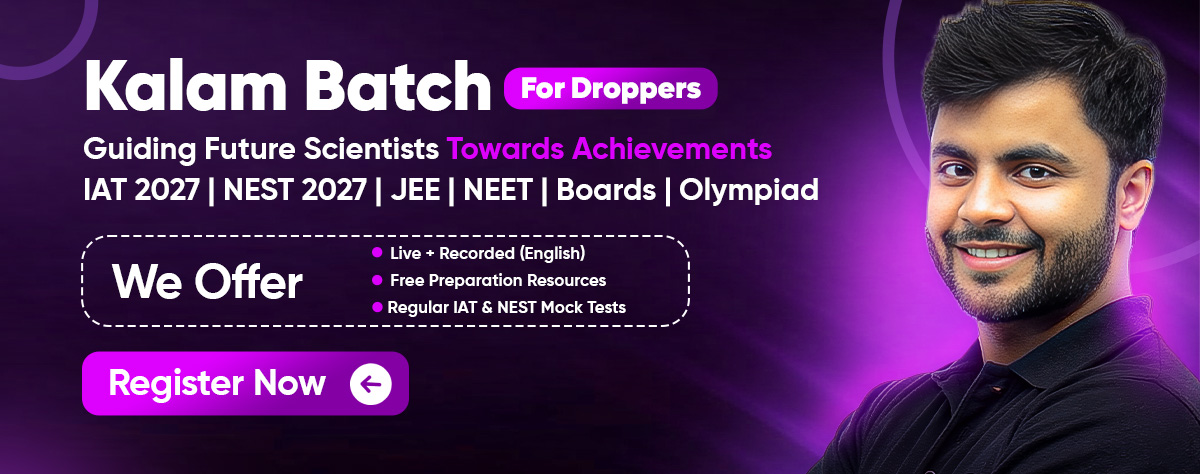
SciAstra is a specialized coaching platform focused on science research education for UG courses such as BS-MS/BS/BSc-MSc. The platform is well-known among aspirants of IAT and NEST, and helps students in several ways:
Dedicated online and offline batches for IAT/NEST preparation, designed specifically for research entrance exams in India.
Complete study material including concept books, practice books, and previous year question (PYQ) books tailored to IAT and NEST exam pattern.
Mock tests and test series that simulate the real exam environment, helping students build speed, accuracy, and confidence.
Crash courses for students who start late but want a focused, exam-centric revision for IAT/NEST.
Mentorship from research scholars and top-rankers who have actually studied at IISc, IISERs, and similar institutes, so students get real, practical guidance about careers, research culture, and opportunities.
Conclusion: Choose What Fits You, Not Just The Trend
If you truly want to serve patients and are passionate about clinical work, MBBS through NEET is an honourable path. But if you are the student who loves asking “why?” in Physics, Chemistry, Biology, or Maths, enjoys experiments, and dreams of working on cutting-edge science, then research may be your better path.
You do not need to choose blindly between “doctor or nothing”. With exams like IAT 2026, NEST, and research-focused BS-MS programmes, plus guidance from platforms like SciAstra, you can design a future that matches your strengths and interests.
Read More: