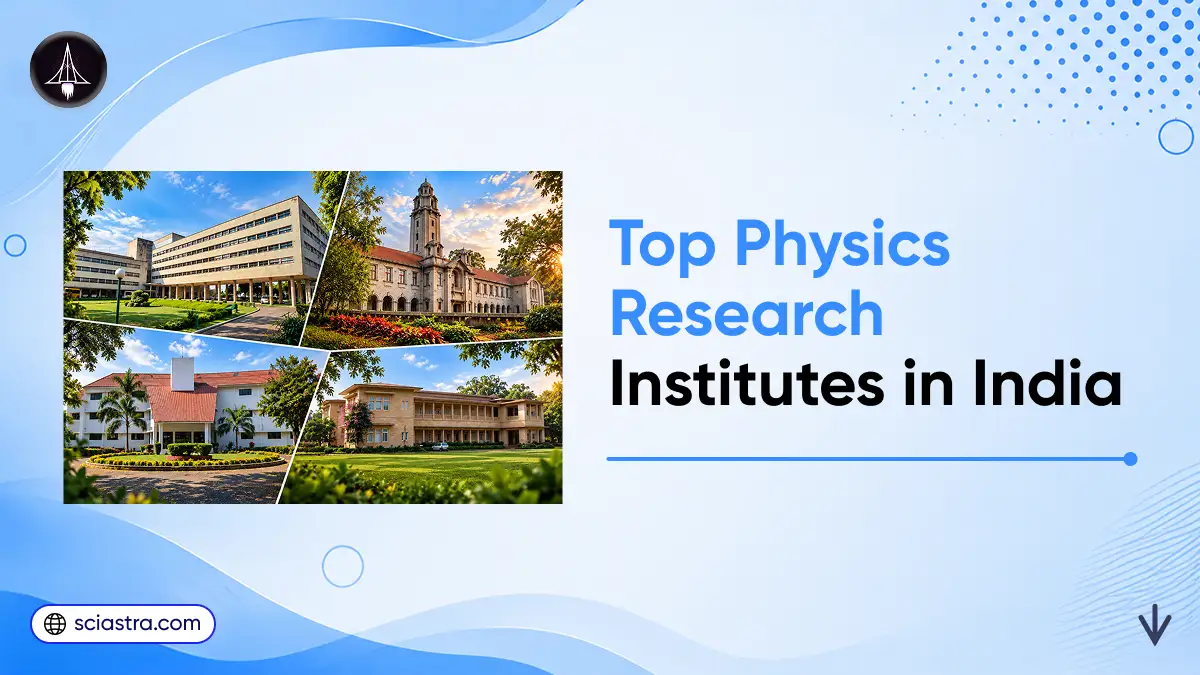
Top Physics Research Institutes: Have you ever wondered how physics explains everything around us, from the way tiny subatomic particles work to the vast universe that is beyond our imagination? The Top Physics Research Institutes in India allow students to explore these questions through research, innovation, and scientific discovery. From the technology we use every day to satellites in space and medical imaging, physics plays an important role in many areas of our lives.
For students who want to build a career in Physics research, studying the subject is only the beginning. It is also important to choose an institute with good laboratories, research facilities, experienced faculty members, and suitable courses. Understanding the admission procedures and post-graduation opportunities can also help you choose the right institution for your career goals.
This SciAstra blog has got you covered. Here, you will find information about the top physics research institutes in India, their departments, admission processes, and major research areas. This will give you a clear and practical overview to help you understand your options and plan your career journey.
Physics Research Institutes in India: NIRF Ranking
If you are looking for the Top Physics Research Institutes in India to pursue a career in physics research, choosing the right institute is an important first step. India has several institutes that support scientific advancement through advanced infrastructure, research facilities, and opportunities for rigorous academic exploration. The National Institutional Ranking Framework (NIRF) evaluates institutes based on parameters such as research quality, academic performance, and overall institutional contribution.
The table below shows the NIRF 2025 Ranking of the best institutes with research ambitions, collaborations, and capabilities in India across all locations, representing physics and related sciences.
NIRF Ranking | Institute Name | Location |
1 | Indian Institute of Science (IISc) | Bengaluru, Karnataka |
2 | Indian Institute of Technology Madras (IIT Madras) | Chennai, Tamil Nadu |
3 | Indian Institute of Technology Delhi (IIT Delhi) | New Delhi, Delhi |
4 | Indian Institute of Technology Bombay (IIT Bombay) | Mumbai, Maharashtra |
5 | Indian Institute of Technology Kharagpur (IIT Kharagpur) | Kharagpur, West Bengal |
6 | Indian Institute of Technology Kanpur (IIT Kanpur) | Kanpur, Uttar Pradesh |
7 | Homi Bhabha National Institute (HBNI) | Mumbai, Maharashtra |
8 | Indian Institute of Technology Roorkee (IIT Roorkee) | Roorkee, Uttarakhand |
10 | Indian Institute of Technology Guwahati (IIT Guwahati) | Guwahati, Assam |
12 | University of Delhi (DU) | Delhi, Delhi |
13 | Saveetha Institute of Medical and Technical Sciences | Chennai, Tamil Nadu |
14 | Vellore Institute of Technology (VIT) | Vellore, Tamil Nadu |
15 | Indian Institute of Technology Hyderabad (IIT Hyderabad) | Hyderabad, Telangana |
16 | Banaras Hindu University (BHU) | Varanasi, Uttar Pradesh |
17 | Tata Institute of Fundamental Research (TIFR) | Mumbai, Maharashtra |
18 | Birla Institute of Technology and Science, Pilani (BITS Pilani) | Pilani, Rajasthan |
19 | Manipal Academy of Higher Education (MAHE) | Manipal, Karnataka |
20 | Jamia Millia Islamia (JMI) | New Delhi, Delhi |
Also read: Top research institutes in India
Top Physics Research Institutes: Courses Offered & Entrance Exams
Students interested in physics research should understand the courses, career pathways, and admission criteria offered by different institutes. Top Physics Research Institutes in India for UG, PG, and Doctoral Programmes are offered across all prominent fields of physics. This section outlines the important particulars of these institutes, such as research areas, courses that can be pursued, and entrance exams, thereby providing students with an understanding of the available options to pursue a career in physics research.
Indian Institute of Science (IISc), Bangalore
The Indian Institute of Science (IISc), Bengaluru, one of the oldest and foremost institutions in India engaged in sustained basic and applied scientific research, was founded by visionary industrialist Jamsetji Tata in 1909. The Indian Institute of Science (IISc) is located on a 400-acre campus and is widely known for its impactful research in the basic sciences and interdisciplinary research.
The Department of Physics at IISc carries out high-end research in many fields. It is consistently ranked as the best institute for research in India. The Indian Institute of Science (IISc) is a great place to pursue a career in physics and related sciences.
The table below highlights key information, including the programmes offered, entrance exams, and stipends, to help you explore the institute and plan your career path.
Category | Details |
Research Areas | Astrophysics and CosmologyBiophysicsCondensed Matter Physics (Theory & Experiment)PhotonicsPlasma PhysicsQuantum Technology |
Programmes Offered | PhD in PhysicsIntegrated PhD in PhysicsMTechMTech (Research)M.S. (Research) |
Entrance Exams | PhD: GATE / CSIR-UGC NET / UGC-NET / JEST (as applicable), followed by institute-level selectionIntegrated PhD: JAM / JEST / Institute-specific admission process (as applicable).MTech: GATE.MTech (Research): GATE.M.S. (Research): Institute-specific admission process (as applicable). |
Stipends / Fellowships | PhD: JRF – ₹37,000/month; SRF – ₹42,000/month (up to 5 years).Integrated PhD: ₹16,000/month initially; JRF – ₹37,000/month; SRF – ₹42,000/month (as applicable).MTech (Research): ₹12,400/month (up to 2 years).MTech: ₹12,400/month (up to 2 years).M.S. (Research): No institute fellowship specified in the provided information. |
Also read:
Indian Institute of Technology Madras (IIT Madras)
IIT Madras, founded in 1959, is one of the top institutions in India for scientific research and higher education. At the institute, physics students have access to advanced facilities for their research, along with many interdisciplinary collaborations and opportunities to participate in work related to emerging areas of fundamental and applied physics. The Department of Physics develops scientific knowledge through theoretical and experimental research across a range of specialisations.
Refer to the table below for key details, including the programmes offered, entrance exams, and stipends, to better understand the opportunities available at the institute.
Category | Details |
Research Areas | Gravitation & Cosmology; Theoretical High Energy Physics; Condensed Matter Physics (Theory & Experiment); Low-Dimensional & Nanomaterials; Magnetism & Magnetic Materials; Soft Condensed Matter & Biological Physics; Quantum Information & Quantum Field Theory; Atomic & Molecular Physics; Optics & Photonics; Nuclear & High Energy Physics; Dielectric Materials & Microwave Physics; Thin Films & Multifunctional Materials; Alternative Energy & Photovoltaics; Device Physics; Ultra-Fast Dynamics; Dynamical Systems. |
Programmes Offered | BS ProgrammeDual Degree (BS-MS)BTech (Engineering Physics)Interdisciplinary Dual Degree (Physics)MScMTech FMNTPhD in Physics |
Entrance Exams | BS Programme / BS-MS / Engineering Physics / Interdisciplinary Dual Degree: Admission through JEE (as per the institute admission process).MSc: Institute-specific admission process (as applicable).MTech: Valid GATE score.PhD: Valid GATE, CSIR-UGC JRF / UGC-JRF, JEST, or DST INSPIRE Fellowship (provisional offer). |
Stipends / Fellowships | Candidates can refer to the official website to check the course-wise details for IIT Madras. |
Note: CFTI candidates with an MSc, integrated MSc, dual degree (BS-MS), or BTech with the required CGPA criteria may also be eligible for PhD admission as per institute norms.
Indian Institute of Technology Delhi (IIT Delhi)
Founded in 1961, the Department of Physics at IIT Delhi is one of India's premier academic and research centres for physics. The department has modern experimental laboratories and advanced computing resources, as well as centralised research core facilities to support a diverse range of interdisciplinary scientific exploration. Specialised and advanced experimental techniques for materials characterisation, microscopy, spectroscopy, thin-film fabrication, and computational studies are also useful to researchers.
In addition to its robust research ecosystem, IIT Delhi facilitates collaboration with universities and research organisations in India, as well as industry partners across the globe. It has a collaborative ecosystem where students and researchers are part of multidisciplinary projects, keeping them informed about contemporary developments in physics.
The following table presents key information on programmes offered, entrance requirements, and stipends to help you explore opportunities at IIT Delhi.
Category | Details |
Research Areas | Astronomy and Astrophysics; Quantum Effects in Gravity; Quantum-to-Classical Transition; Astrophysical Magnetic Fields; Solar Astrophysics; Computational and Statistical Physics; Condensed Matter Physics (Theory & Experiment); High Energy Physics; Optics and Photonics; Physics of Quantum Matter and Information Systems; Plasma Physics. |
Programmes Offered | PhD in Physics; MSc in Physics; MTech in Applied Optics; MTech in Solid State Materials; MTech in Optoelectronics and Optical Communication; BTech in Engineering Physics. |
Entrance Exams | BTech (Engineering Physics): Admission through JEE Advanced (as per institute admission process).MSc in Physics: Admission through IIT JAM (as per institute admission process).MTech Programmes: Admission through GATE (as per institute admission process).PhD in Physics: Admission through institute-specific selection process based on eligibility criteria and relevant national-level qualifications (as per institute norms). |
Stipends / Fellowships | Candidates can check the official website for the latest fellowship details. |
Also read-
Indian Institute of Technology Bombay (IIT Bombay)
The Department of Physics in IIT Bombay is one of the oldest and premier physics departments in India. The department offers a strong academic and research environment, combining fundamental physics with interdisciplinary applications to promote scientific innovation.
It has sophisticated experimental labs, extensive computational resources, and specialised research facilities that allow top-notch research in various areas of physics. Collaborations between national and international universities, research organisations, and industrial partners also help students and researchers learn about ongoing developments in science.
The institute sees research as an integral part of its focus, along with providing world-class technologies and newly developed tools to bring interdisciplinary learning under one roof through collaborative projects. These resources and the guidance provided by motivated mentors help students cultivate strong analytical and problem-solving skills while working towards greater contributions to physics and related fields.
Check out the important details about courses, admission pathways, and fellowship options available at the institute.
Category | Details |
Research Areas | Astronomy, Cosmology and Gravity; Condensed Matter Experiments; High Energy Experiments; Optics and Photonics; Quantum Information Theory; Soft Matter, Biophysics and Nonlinear Dynamics; Theoretical Condensed Matter Physics; Theoretical High Energy Physics. |
Programmes Offered | BTech in Engineering Physics; Dual Degree Programme; MSc in Physics; PhD in Physics. |
Key Physics Courses | Quantum Mechanics; Electromagnetic Theory; Classical Mechanics; Statistical Physics; Condensed Matter Physics; Atomic and Molecular Physics; Nuclear and Particle Physics; Optics and Photonics; Quantum Electronics; Nanoscience and Semiconductor Devices; Mathematical Physics; Computational and Numerical Methods in Physics. |
Entrance Exams | BTech / Dual Degree: Admission through JEE Advanced (as per institute admission process).MSc in Physics: Admission through IIT JAM (as per institute admission process).PhD in Physics: Admission through institute-specific selection process with eligibility through relevant national-level qualifications (as per institute norms). |
Stipends / Fellowships | PhD students may receive fellowships through government and semi-government agencies such as CSIR, UGC, DAE, DST, DBT, and NBHM. A valid Junior Research Fellowship (JRF) award letter from the respective agency is required. The fellowship amount and duration are based on the norms of the awarding agency. |
Indian Institute of Technology Kharagpur (IIT Kharagpur)
IIT Kharagpur is the oldest and first Indian Institute of Technology in India, established in 1951, and today it works as a premier institute for higher education and scientific research. The Department of Physics offers a research-oriented academic environment with well-equipped laboratories and instrumentation facilities, along with computational studies of theoretical aspects.
The department promotes interdisciplinary research through partnerships with other science and engineering departments, allowing students to simultaneously contribute to both fundamental scientific issues and technology-based project areas. Access to central research facilities and opportunities for national and international collaboration with academic institutions are also among the advantages for researchers. All these resources create a robust environment for research and innovation in advanced physics.
The table below provides important details about courses, admission pathways, and postdoctoral fellowships available at the institute.
Category | Details |
Research Areas | Astroparticle Physics; Astrophysics; Atmospheric Chemistry and Physics; Beyond Standard Model Physics; Biochemistry and Biophysics; Biological Physics; Computational Physics; Cryophysics; Experimental Condensed Matter Physics; High Energy Physics; Laser Physics; Low Temperature Physics; Mathematical Physics; Particle Physics; Physics of Topological Materials; Physics of Ultracold Atom; Soft Matter Physics; Statistical Physics; Theoretical Biophysics; Theoretical Condensed Matter Physics; Theoretical High Energy Physics; Waves in Geophysics and Oceanography. |
Programmes Offered | Minor in Physics (under the new curriculum). |
Key Physics Courses | Quantum Physics; Classical Dynamics and Special Relativity; Electromagnetism; Quantum Mechanics; Statistical Physics; Condensed Matter Physics; Nuclear Physics; Physics Department Electives; Physics Laboratory Course. |
Entrance Exams | PhD in Physics: Valid GATE, CSIR-UGC NET / UGC-JRF, JEST, or DST INSPIRE Fellowship (as per institute eligibility criteria), followed by institute-level selection. |
Stipends / Fellowships | Post-Doctoral Fellowship: Level 1 – INR80,000/month; Level 2 – INR90,000/month; Level 3 – INR1,00,000/month.Contingency Grant: INR50,000/year. |
Note (Eligibility)
Applicants must hold a degree awarded by a recognised Indian or foreign university/institute.
Candidates must be below 32 years of age at the time of application. Age relaxation for reserved categories will be applicable as per Government of India norms.
Meeting the eligibility criteria does not guarantee selection; candidates will be shortlisted for interviews based on qualifications, suitability, experience, and institute requirements.
Indian Institute of Technology Kanpur (IIT Kanpur)
IIT Kanpur was founded in 1959 and is one of India's leading institutions for science and engineering research. The Department of Physics provides an academic landscape supported by advanced laboratories and sophisticated instrumentation, as well as high-performance computational facilities, contributing to a research-oriented atmosphere. This is further supported by the availability of libraries and databases that allow students and researchers to perform quality theoretical analyses, computational simulations, and experimental procedures.
The department encourages interdisciplinary collaboration with diverse science and engineering fields, allowing researchers to pursue new ideas that are academically and technologically relevant. Students benefit from international research led by national and global universities and research organisations while contributing to cutting-edge physics and related advances.
The table below provides key details about the programmes offered, entrance exams, and stipends to help you understand the institute better and plan your career journey.
Category | Details |
Research Areas | Atomic and Molecular Physics; Plasma Physics; Biological and Statistical Physics; Computational Physics; Dynamical Systems; Turbulence and Non-linear Physics; Fluid Dynamics; Evolutionary Games; Soft Matter and Active Matter; Particle Physics; Beyond Standard Model Phenomenology; Quantum Field Theory; Astrophysics and Cosmology; String Theory and Quantum Gravity; Biophotonics; Light-Matter Interaction; Photonics; Quantum Optics; Laser Cooling and Trapping; Condensed Matter Physics (Experimental & Theoretical); Topological and Nanomaterials; Magnetism and Superconductivity; Semiconductor and Magnetoelectronic Devices; Ion Beams and Nuclear Physics Techniques. |
Programmes Offered | PhD Programme in Physics. |
Entrance Exams | PhD: Candidates with a master's degree or a 4-year BS degree with a strong academic record can apply. Candidates can check the admission details/exam requirements from the official website. |
Stipends / Fellowships | Candidates can check the official website for the latest fellowship details. |
Note- Student scholarships and Financial Aid provided by IIT Kanpur are as follows:
Srikant Mishra Memorial Scholarship: Awarded to a UG student in the 2-year MSc Physics programme based on MCM-Donor criteria.
Bhagavatula Project Scholarship: Awarded for the best project selected by the Physics Department among MSc students at the end of the project course.
Smt. Padmavathy & Prof. R. Sankar Scholarship: Awarded to a 2nd-year UG student in the 2-year MSc Physics programme based on MCM-Donor criteria.
PSB Prasad Memorial Scholarship: Awarded to a UG student in the 2-year MSc Physics programme based on MCM-Donor criteria.
Indian Institute of Technology Roorkee (IIT Roorkee)
IIT Roorkee is one of the oldest technical institutions in India, set up in 1847 as the Thomason College of Civil Engineering, and it was given the status of IIT in 2001. The Department of Physics is an experimental research area focused on modern laboratories. Such resources allow students and researchers to carry out high-quality scientific experiments in theoretical and experimental physics.
Interdisciplinary collaboration across all science and engineering disciplines is highly encouraged, allowing researchers to pursue cutting-edge research at the intersection of fundamental scientific questions and technological applications. Students are exposed to state-of-the-art research and opportunities for collaborative research with national and international research institutions.
The following table provides a quick overview of the institute’s programmes, admission process, and stipend details to help you plan your career.
Category | Details |
Research Areas | Atmospheric and Space Physics; Atomic and Molecular Physics; Condensed Matter Physics; High Energy Physics; Nuclear and Accelerator Physics; Photonics, Plasmonics and Quantum Optics. |
Programmes Offered | BTech in Engineering Physics; BS-MS in Physics; MSc in Physics; MTech in Solid State Electronic Technology; MTech in Photonics; Other Physics-related Courses. |
Entrance Exams | BTech Engineering Physics: Admission through JEE Advanced (as per institute admission process).BS-MS Physics: Admission through IIT JAM (as per institute admission process).MSc Physics: Admission through IIT JAM.MTech Programmes: Admission through GATE- PhD in Physics: Admission through national-level qualifications such as GATE / JRF / NET, followed by the institute-level selection process. |
Stipends / Fellowships | Candidates qualifying for national-level tests such as GATE / JRF / NET are eligible for Institute Assistantship.ASEAN Doctoral Fellowship: ₹31,000/month for the first two years and ₹35,000/month for the remaining duration, along with an annual research grant of up to ₹1,70,000 for research expenses (maximum duration up to 5 years). ICCR Fellowship: Covers tuition fees, accommodation, and living allowances as per prescribed rules. |
Indian Institute of Technology Guwahati (IIT Guwahati)
IIT Guwahati came into existence in 1994, distinguished as one of India's top-tier second-generation IITs with a significant focus on research and innovation. The Department of Physics provides a vibrant research-oriented academic environment and is well equipped with modern laboratories, experimental facilities, and computational resources for scientific investigation.
EMR's research across diverse science and engineering disciplines promotes interdisciplinary projects that fuse fundamental physics and emerging technologies. The academic exchange enabled by collaborations with national and international institutions is also an advantage, exposing researchers to cutting-edge developments in modern physics.
Check out the table below, which highlights important information about available programmes, admission exams, and stipends to help you make informed career decisions.
Category | Details |
Research Areas | Condensed Matter Physics; Laser and Photonics; High Energy Physics; Gravitation; Astrophysics and Cosmology; Quantum Field Theory; Quantum Computation. |
Programmes Offered | MSc in Physics; BTech in Engineering Physics; PhD Programme in Physics. |
Entrance Exams | BTech in Engineering Physics: Admission through JEE Advanced (as per institute admission process).MSc in Physics: Admission through IIT JAM (as per institute admission process).PhD in Physics: Candidates can check the official institute website for the latest PhD admission eligibility criteria and entrance requirements. |
Stipends / Fellowships | PhD research is supported through post-doctoral fellowships selected via the institute’s IPDF programme and the national-level NPDF scheme. Candidates can check the official institute website for the latest fellowship details, eligibility criteria, and stipend information. |
Also read- BS Programme offered by IIT Guwahati
University of Delhi (DU)
Founded in 1922, the Department of Physics at the University of Delhi is one of the oldest centres for physics education and research in India. The department offers a research-oriented academic ecosystem with state-of-the-art laboratories, instrumentation facilities, and computational facilities for experimental and theoretical research work. The department promotes interdisciplinary research with several national laboratories as well as academic institutes in India and abroad. Collaborative projects, seminars, workshops, and scientific conferences for students and researchers create a strong basis for innovation in physics at the highest level.
The table below outlines the major details, including programmes, entrance exams, and stipends, to help you understand the available opportunities.
Category | Details |
Research Areas | Condensed Matter Physics; High Energy Physics; Nuclear Physics; Astrophysics and Cosmology; Quantum Information; Quantum Optics; Atomic and Molecular Physics; Materials Science. |
Programmes Offered | BSc (Physics); MSc in Physics; PhD in Physics. |
Entrance Exams | BSc (Physics): Admission through CUET-UG (as per DU admission process). MSc Physics: Admission through CUET-PG (as per DU admission process). PhD Physics: Admission through the university-level PhD admission process (as per DU norms). |
Stipends / Fellowships | PhD scholars may receive fellowships through national-level funding agencies, as per eligibility criteria. Candidates can check the official DU website for the latest fellowship details. |