




.webp)






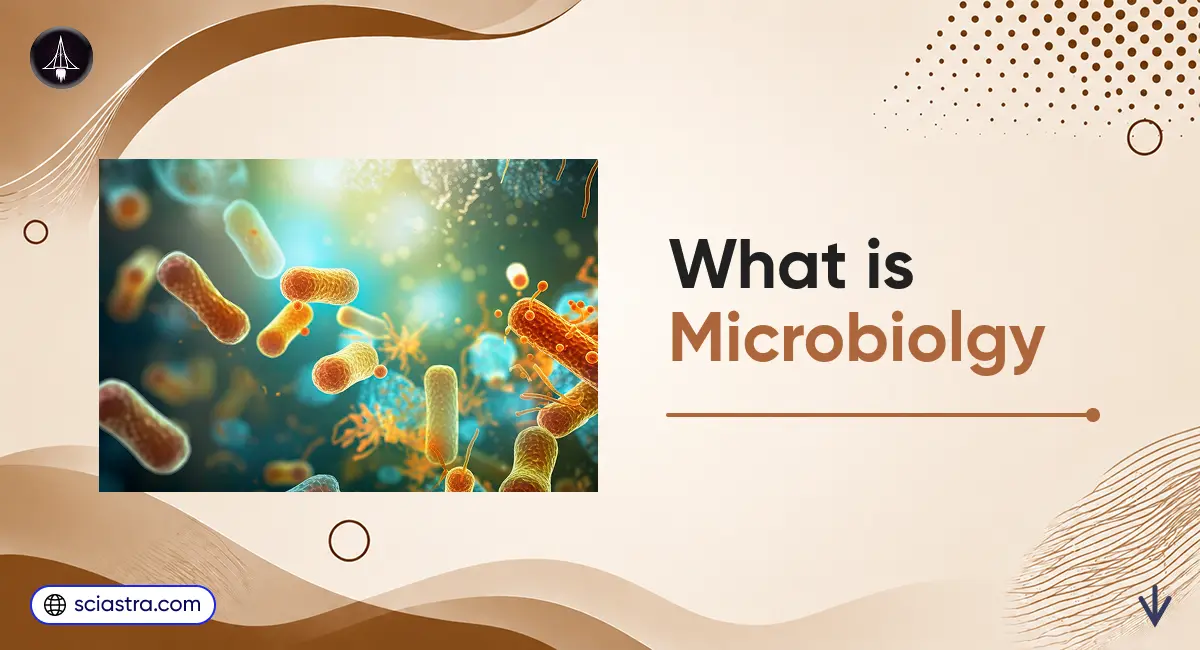
Microscopic organisms are tiny living organisms that exist all around us and can be found in the air, water, soil, food, and even inside our bodies. They are too small to be seen with the naked eye, yet they have a significant impact on our lives and the world around us. While some microorganisms are beneficial and help produce essential products such as medicines and food, others can cause infections and diseases. Therefore, it is important to study these organisms through a branch of science known as microbiology.
This SciAstra article provides all the key details about microbiology, including its definition, applications, higher education opportunities, and the entrance exams related to this field.
What is Microbiology?
Microbiology comes across every day in our lives, even if we do not notice it. When scientists develop antibiotics to treat infections, create vaccines to prevent diseases, or use bacteria to make products like yoghurt and cheese, microbiology is playing an important role behind all processes. The nature of microbiology shows that it is one of the most essential fields in understanding life and improving human health.
Microbiology definition
Microbiology is a branch of biology that focuses on the study of microscopic organisms, such as bacteria, viruses, fungi, algae, and protozoa. This field allows scientists to understand how these organisms grow, function, interact with their environment, and impact living organisms.
Importance of microbiology
The secret life of microbes is invisible. Microbes are involved in all areas of human life, such as the environment and plants, and help us to know what is harmful to humans, food, animals, or plants. Microorganisms also help us develop medicines and vaccines, improve food safety, and discover new ways to save the environment.
Applications Areas of Microbiology
Microbiology is one of the most important branches of science because its applications expand across multiple areas such as healthcare, agriculture, food production, environmental protection, and advanced research.
Here are some important application areas of microbiology:
Medical Microbiology:
Medical microbiology describes the role of microscopic organisms that cause disease in humans. They help scientists understand bacteria, viruses, fungi, and parasites, allowing them to develop suitable treatments and preventative measures. In addition, they play a central role in producing vaccines, antibiotics, and diagnostic tests in modern medicine.
Food Microbiology:
Food microbiology helps to study the role of microorganisms in food production, preservation, and food safety. Some of these microorganisms are used to make yoghurt, cheese, bread, and fermented foods. Food quality is also maintained to ensure that food is safe.
Agricultural Microbiology:
Agricultural microbiology studies the microorganisms that improve plant growth and soil health. Some beneficial bacteria fix nitrogen into soil nutrients, which supports crops' growth. This allows farmers to protect their crops from harmful plant diseases and improve their farming productivity.
Industrial Microbiology:
Industrial microbiology examines the use of microorganisms in large-scale industrial productions. They are used to make enzymes, alcohol, antibiotics, organic acids, and biofuels. These processes help produce some of the important commercial products.
Environmental Microbiology:
Environmental microbiology deals with the role of microorganisms in environmental balance. Microorganisms play a fundamental role in the disposal of waste materials, and they are indispensable in sewage treatment.
Pharmaceutical Microbiology:
Pharmaceutical microbiology is defined as working in conjunction with the pharmaceutical sciences and focuses on the use of microorganisms in developing and testing medicines. This branch of science is utilised by scientists to manufacture medicines, which include antibiotics, vaccines, and other pharmaceutical products that are used in the treatment of diseases and boost public health.
Biotechnology:
In biotechnology, microbiology helps students to understand how scientists are using microorganisms to do scientific research. It plays an important role in DNA research, genetic engineering, and the development of genetically modified organisms (GMOs), which have applications in healthcare, agriculture, and many other industries.
Also Read:
Microbiology: Higher Studies and Research Opportunities
The microbiology branch offers excellent opportunities for students who want to continue higher education and build careers in scientific research. After completing undergraduate studies in microbiology or related subjects, students can pursue advanced degrees such as master's degrees, integrated research programmes, and doctoral studies to gain specialised knowledge.
Higher studies in microbiology allow students to explore advanced topics such as molecular biology, immunology, biotechnology, genetic engineering, environmental microbiology, and medical microbiology fields.
Research Opportunities in Microbiology
Microbiology is one of the fastest-growing scientific fields that offers a wide range of research opportunities for students who are interested in discovering how microscopic organisms affect our lives and the environment.
Research in microbiology plays a major role in solving real-world problems related to human health, agriculture, food production, biotechnology, and environmental sustainability.
Here are some major research opportunities in microbiology that a student can pursue:
Disease and Infection Research:
In this field, research scientists study harmful microorganisms to understand how infectious diseases spread and how new treatment methods can be developed to fight diseases.Vaccine Development:
Microbiology research plays an important role in developing vaccines that protect humans from dangerous diseases caused by viruses and bacteria.
This field of research helps humans to take control over the spreading of the COVID-19 disease.
Antibiotic Research:
In the field of antibiotic research, scientists majorly work on discovering new antibiotics and improving existing medicines to fight bacterial infections and diseases.Genetic and DNA Research:
Genetic and DNA research helps scientists in studying microbial genes to understand heredity, mutations, and genetic engineering applications. Nowadays this study gets very advanced, and humans now can interpret genetics and DNA.Biotechnology Research:
In biotechnology research microorganisms are used to develop biofuels, enzymes, medicines, and advanced biological technologies.Agricultural Research:
Through agricultural research, researchers study about beneficial microbes that improve soil fertility, increase crop production, and protect plants from diseases.Environmental Research:
This field of microbiology helps scientists to study waste decomposition, pollution control, sewage treatment, and nutrient recycling in ecosystems.
Also Read:
Microbiology: Exams for Research Careers
Entrance exams help students to build a research career in microbiology; they can prepare for national-level entrance examinations that provide admission to top science institutes and research-focused academic programmes. These examinations help students to begin their journey toward becoming researchers, scientists, and biotechnology professionals.
Here are some important exams for which students can appear to make research careers in microbiology:
IISER Aptitude Test (IAT)
The IAT exam is conducted for admission to premier research institutes in India, such as the Indian Institutes of Science Education and Research (IISER). It allows students to enrol in BS-MS dual-degree programmes and build a strong foundation in research-orientated fields, including microbiology, biotechnology, and biological sciences.
Also Read:
National Entrance Screening Test (NEST)
The NEST exam provides admission to institutes such as the National Institute of Science Education and Research (NISER) and research-orientated science programmes. It is an excellent choice for those students who are interested in scientific research and advanced biological studies. The subject microbiology is offered as an elective subject by the School of Biological Sciences at NISER Bhuabneswar.
Also Read:
Council of Scientific and Industrial Research NET (CSIR-NET)
CSIR-NET is a national-level examination for those students who want to pursue research fellowships and careers in the scientific research field after completing postgraduate studies. Students prepare for this exam to enrol in a PhD degree.Indian Institute of Science Entrance Exams
The Indian Institute of Science (IISc Bengaluru) conducts its own institute-specific entrance examinations for students seeking admission to advanced research-based programmes. Students who are interested in advanced research can apply for research-based programmes in life sciences and microbiology.
Prepare for IAT and NEST with SciAstra
If you are planning to pursue undergraduate (UG) science and research programs at IISc Bengaluru, IISERs, IACS Kolkata, IIEST Shibpur, IIT Madras, or IIT Guwahati, you can seek admission through the IISER Aptitude Test (IAT).
If you want to pursue a 5-year Integrated MSc in Physics, Chemistry, Mathematics, or Biology, NISER Bhubaneswar and CEBS are excellent choices. To gain admission to these programs, you must appear for the National Entrance Screening Test (NEST).
Not sure how to begin your preparation or which strategy to follow? SciAstra can help you with expert guidance, structured study material, mock tests, and courses specially designed for IAT and NEST preparation.
Check out the IAT & NEST preparation courses below and start preparing with the right guidance.



Also Read:
Top 10 Biology Research Institutes in India
University Entrance Examinations
In India, many universities conduct their university-based entrance exams for master's and PhD programmes in microbiology, biotechnology, and related life science fields.
Career Opportunities in Microbiology
Microbiology has very versatile career opportunities for students; it is a rapidly growing field that offers a wide range of career opportunities in healthcare, biotechnology, pharmaceuticals, food production, agriculture, environmental science, and research. Microorganisms play an important role in every industry, and professionals with expertise in microbiology are in demand for scientific research, product development, quality testing, and healthcare-related work.
Students who study microbiology can choose a good option from several rewarding career paths depending on their interests and specialisation.
Here are the following good career opportunities in microbiology:
Microbiologist
Microbiologists do research about microorganisms such as bacteria, viruses, fungi, and protozoa to understand their structure, behaviour, and effects on living organisms.Research Scientist
Research scientists' work is to conduct experiments and scientific studies to develop new medicines, improve healthcare technologies, and make discoveries which are related to microorganisms and biotechnology.Clinical Laboratory Technician
These professionals work in hospitals and diagnostic laboratories, where they examine biological samples to detect infections, identify disease-causing microorganisms, and support medical diagnosis to improve the healthcare system.Food Safety Officer
A food safety officer's job is to ensure that food products are safe for consumption by testing for harmful microorganisms and maintaining hygiene and quality standards during the food production process.Pharmaceutical Researcher
Pharmaceutical researchers work on the development and testing of medicines, vaccines, antibiotics, and other healthcare products that help to prevent and treat diseases.Biotechnology Scientist
Biotechnology scientists use microorganisms to do research about genetic engineering, DNA research, and the development of advanced biological technologies which are used in medicine, agriculture, and industrial production.Quality Control Analyst
Quality control analysts do tests about products in industries such as pharmaceuticals, food manufacturing, and biotechnology to ensure they meet safety, purity, and quality standards before reaching consumers.
Also Read:
How to Become an Astronaut in India
Conclusion
Microbiology is one of the most important branches of science that helps us to understand the microscopic organisms' impact on our lives and Earth. From studying about bacteria, viruses, fungi, and other microorganisms to developing medicines, improving food production, supporting agriculture, and protecting the environment, microbiology has become an essential part of modern scientific research & progress.
This field has wide applications in healthcare, biotechnology, pharmaceuticals, environmental science, and industrial development, which make it a highly valuable field of study. Through higher studies and examinations such as the IISER Aptitude Test and National Entrance Screening Test (NEST) exams, students can enter top research institutes and contribute to future advanced developments in science.