


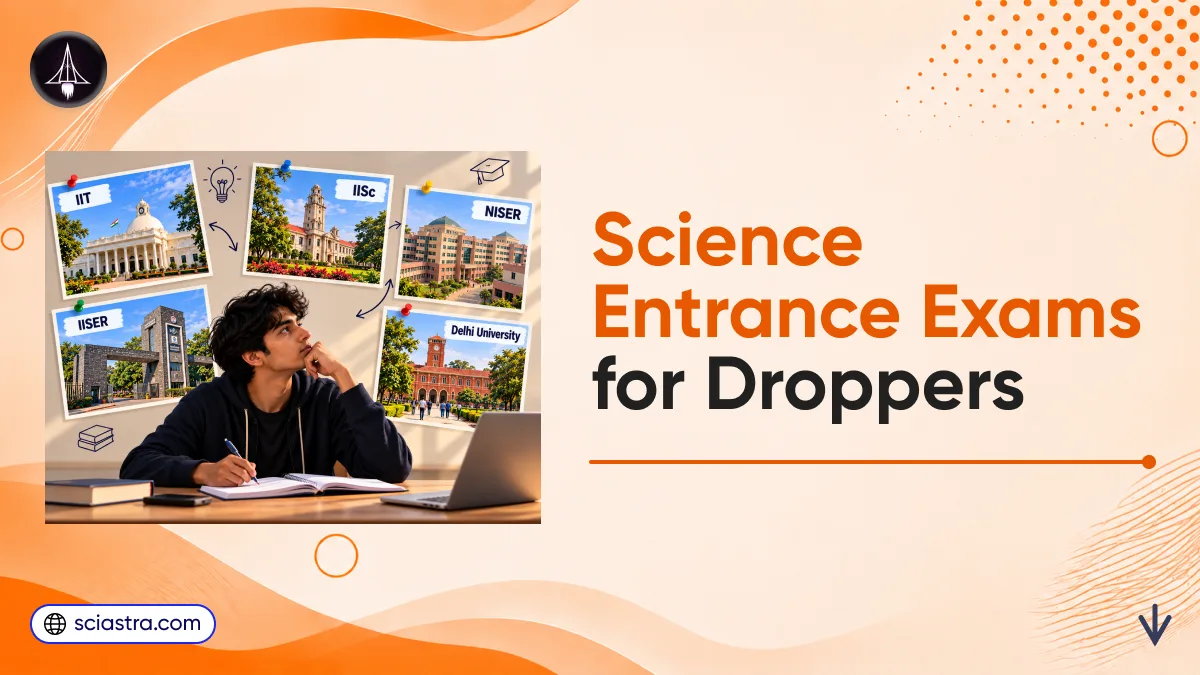
A drop year can feel like a second attempt at the same future. But what if you want to explore a different one? Perhaps you enjoy biology without wanting to practise medicine, love mathematics without wanting a conventional engineering degree, or see yourself teaching science.
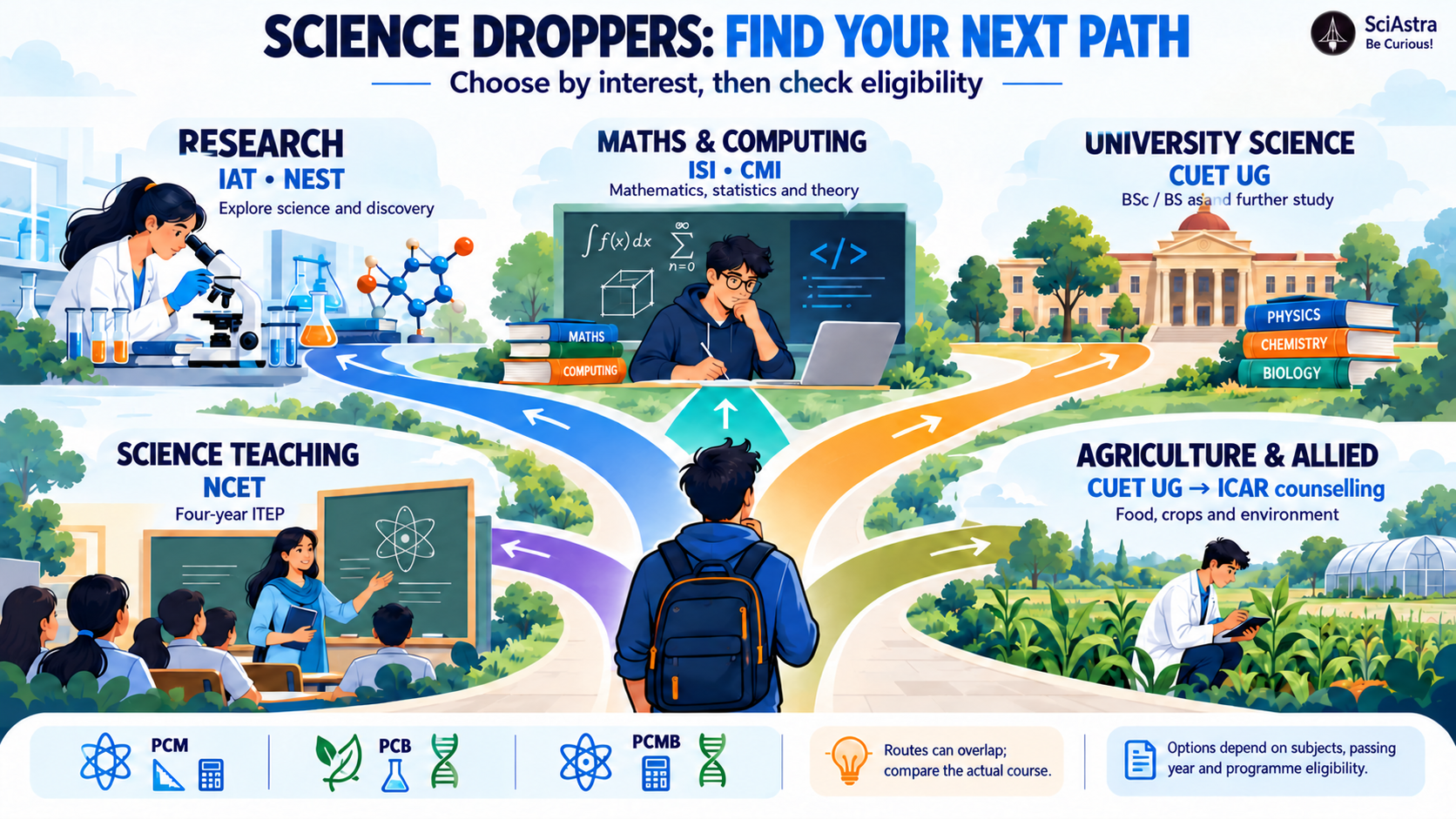
Science entrance exams for droppers can lead towards research, university science degrees, mathematics, statistics, agriculture and teacher education. The challenge is choosing a route that matches your interests, Class 12 subjects and eligibility. This guide compares IAT, NEST, ISI, CMI, CUET UG, NCET and the CUET-based ICAR agriculture admission route. Explore SciAstra’s science entrance exam calendar, IAT guide and free career counselling alongside these comparisons to build a practical shortlist.
Which Science Entrance Exams Can Droppers Consider?
These seven options cover six entrance tests, and one separately explained admission route: CUET (ICAR-UG) uses CUET UG scores for agricultural admissions.
Exam or admission route | Main course direction | Interest it may suit |
IAT | IISER BS-MS and other notified undergraduate programmes | Scientific investigation and interdisciplinary learning |
NEST | Five-year integrated MSc at NISER and UM-DAE CEBS | Basic sciences and research |
ISI Admission Test | B Stat (Hons), B Math (Hons) | Statistics, mathematics and quantitative reasoning |
CMI Entrance Exam | BS (Hons) programmes in mathematics and related combinations | Mathematical thinking, theoretical computing or physics |
CUET UG | University BSc/BS and other notified degrees | Subject specialisation and flexible university choices |
NCET | Four-year Integrated Teacher Education Programme, including science combinations | School teaching and education |
CUET-based ICAR UG route | Agriculture and allied undergraduate programmes | Crops, food systems, environment and applied science |
Science Entrance Exam Eligibility Criteria
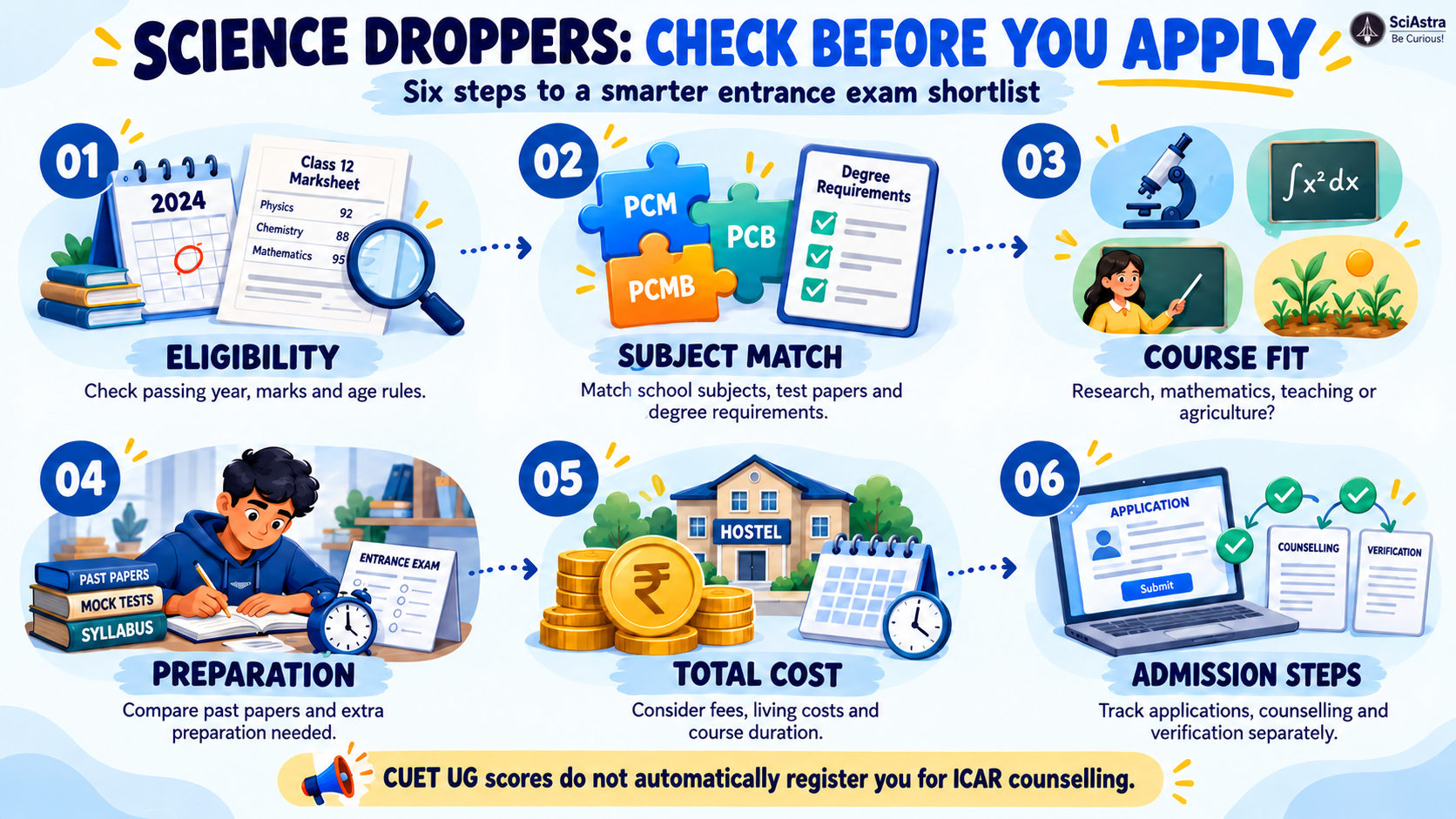
Being a dropper does not establish eligibility by itself. Your passing year, subjects, marks, age where applicable, and target programme all matter. Exam eligibility and admission eligibility are separate checks.
Entrance exam/admission route | Passing-year eligibility for 2027 | Subjects and academic requirements |
IAT 2027 | Expected: Class 12 passed in 2025 or 2026, or appearing in 2027, if the existing three-year window continues | At least three subjects from Physics, Chemistry, Mathematics and Biology. Previous threshold: 60% aggregate, relaxed to 55% for SC/ST/PwD. Refer to IAT Eligibility Criteria 2027 |
NEST 2027 | Expected: Class 12 passed in 2025 or 2026, or appearing in 2027, if the existing window continues | At least three PCMB subjects in Classes 11–12. Previous threshold: 60% aggregate, or 55% for SC/ST/Divyangjan |
ISI Admission Test 2027 — B Stat/B Math | Students who passed in 2025 or 2026 may consider applying; 2027 appearing candidates must satisfy qualification requirements by the prescribed deadline | Class 12 or equivalent with Mathematics and English, under the currently published programme requirements. Refer to NEST Eligibility Criteria |
CMI Entrance Exam 2027 | 2025/2026 pass-outs and 2027 appearing candidates should check the forthcoming application conditions; the current page lists no restricted passing-year window | Published undergraduate qualification: Class 12 or equivalent. The entrance examination requires strong mathematical aptitude. |
CUET UG 2027 | Expected: Class 12 passed candidates, including 2025/2026 pass-outs, and candidates appearing in 2027 | Required board subjects, CUET papers and minimum marks depend on the selected university and degree. Refer to CUET Eligibility Criteria 2027 |
NCET 2027 | 2025/2026 pass-outs and 2027 appearing candidates can investigate suitable ITEP options; final eligibility depends on 2027 rules | Class 12 or equivalent; minimum marks and science subject combinations depend on the institution and programmes. Refer to NCET 2027 Eligibility Criteria |
CUET-based ICAR UG admission 2027 | 2025/2026 pass-outs and 2027 appearing candidates may be considered subject to the forthcoming ICAR and university conditions | Previous rules required at least three core subjects from Physics, Chemistry, Mathematics, Biology and Agriculture/Inter-Agriculture; relevant CUET subjects must match Class 12 subjects |
Which Science Entrance Exams Match Your Course Interests?
IAT Exam For Students Who Want to Explore Science Through Research
The IISER Aptitude Test is a route to IISER undergraduate programmes, including the five-year BS-MS. It suits students interested in experiments, scientific questions and studying across disciplines before specialising.
The paper covers Physics, Chemistry, Mathematics and Biology. Your favourite subject may guide your eventual specialisation, but preparation must account for the actual entrance syllabus.
For IAT 2027, eligible Class 12 passing years included 2024, 2025 and 2026. At least three subjects from PCMB were required; the general aggregate threshold was 60%, with 55% for SC/ST/PwD candidates. Certain programmes require Class 12 Mathematics.
NEST For Research Oriented Integrated MSc
The National Entrance Screening Test admits students to the five-year integrated MSc programmes at NISER Bhubaneswar and UM-DAE CEBS Mumbai.
Consider it if you want sustained study in basic sciences with research exposure. It is a different academic experience from choosing a professionally regulated medical degree.
Who Should Consider NEST?
NEST exam 2027 may suit you if you enjoy understanding scientific concepts, investigating questions and applying knowledge to unfamiliar problems. It is particularly relevant for students exploring biology, chemistry, physics or mathematics beyond conventional medical and engineering degrees.
For a NEET dropper, it offers a different direction towards studying living systems and biological research. For a PCM dropper, it opens opportunities to explore physical and mathematical sciences. Your choice should depend on whether you enjoy research-oriented learning and want to study science in depth.
ISI For Mathematics, Statistics and Analytical thinking
The ISI Admission Test is particularly relevant to B Stat (Hons) and B Math (Hons). These programmes suit students who enjoy reasoning, probability, mathematical structure and challenging problems.
Which Courses Can You Pursue Through ISI?
Programme | Main areas of study | Possible future directions |
B Stat (Hons), Kolkata | Statistics, probability, mathematics and computing | Statistical research, analytics, higher studies and quantitative applications |
B Math (Hons), Bengaluru | Mathematics, with supporting study in statistics, computing and physics | Mathematical research, higher studies and applied mathematics |
Both programmes in the ISI Admission Test 2026 build foundations for further study and careers requiring analytical thinking. The right choice depends on whether you are more interested in understanding data and uncertainty or exploring mathematical structures and reasoning.
Also Read:
CMI For Mathematics With Computing or Physics
The CMI Entrance Exam is conducted annually by the Chennai Mathematical Institute to provide admission to undergraduate, postgraduate, and PhD programmes. CMI is one of the top institutes in India that offers higher education and research in mathematics, computer science and data science.
Its undergraduate entrance description identifies a mathematics aptitude test containing objective questions and longer problems. It is not a combined Physics, Chemistry, Mathematics and Computer Science entrance paper.
CMI Exam Preparation 2027 should be started earliest for interested applicants. CMI is worth investigating if you enjoy working through difficult mathematical questions and explaining each step of a solution. Its programmes can build foundations for higher studies and careers in mathematical sciences, theoretical computing and related quantitative fields.
CUET UG For University Science Degrees
CUET exam is a national-level entrance examination conducted to provide admissions to UG courses across domains like Science, Humanities, Commerce and others. Candidates who are PCM or PCB students can take the CUET 2027 exam for admissions to the BSc courses at top NIRF universities like the University of Delhi, BHU, AMU, JNU and other CUET participating universities.
It is worth considering if you want to specialise in a subject and later explore postgraduate study, research or other careers. A university BSc route can also support research ambitions when combined with suitable projects and further training.
Choose test papers from the eligibility requirements of your intended degree. A strong score in the wrong combination may not qualify you for admission.
NCET For Students Interested in Teaching Science
The National Common Entrance Test is used for admission to the four-year Integrated Teacher Education Programme at participating institutions.
For a science student, a suitable BSc-BEd combination may connect disciplinary learning with teacher preparation. Confirm the subject specialisation and school stage offered by the institution.
NCET preparation includes teaching aptitude and other prescribed components alongside domain subjects. It therefore needs a different plan from an exclusively PCMB entrance.
Use the NTA NCET portal and its university-wise eligibility mapping. Completing a teacher-education programme does not automatically provide a government teaching job; applicable recruitment and teacher-eligibility requirements remain separate.
CUET Based ICAR UG For Agriculture and Allied Sciences
The CUET UG-based ICAR admission route is worth considering for science droppers interested in agriculture, food production, sustainability and applied sciences. It uses CUET UG scores for admission through ICAR counselling to participating agricultural universities and programmes. Candidates must complete the applicable counselling process separately; appearing for CUET UG does not automatically register them for ICAR admission.
Which Courses Can You Explore?
Depending on the participating university and your subject eligibility, options can include:
Area of interest | Courses to investigate |
Crops and agricultural systems | BSc (Hons) Agriculture |
Fruits, vegetables and plantation crops | BSc (Hons) Horticulture |
Forests and natural resources | BSc (Hons) Forestry |
Food processing and production | BTech Food Technology or Dairy Technology |
Agricultural machinery and technology | BTech Agricultural Engineering |
Biological applications | BTech Biotechnology, where offered |
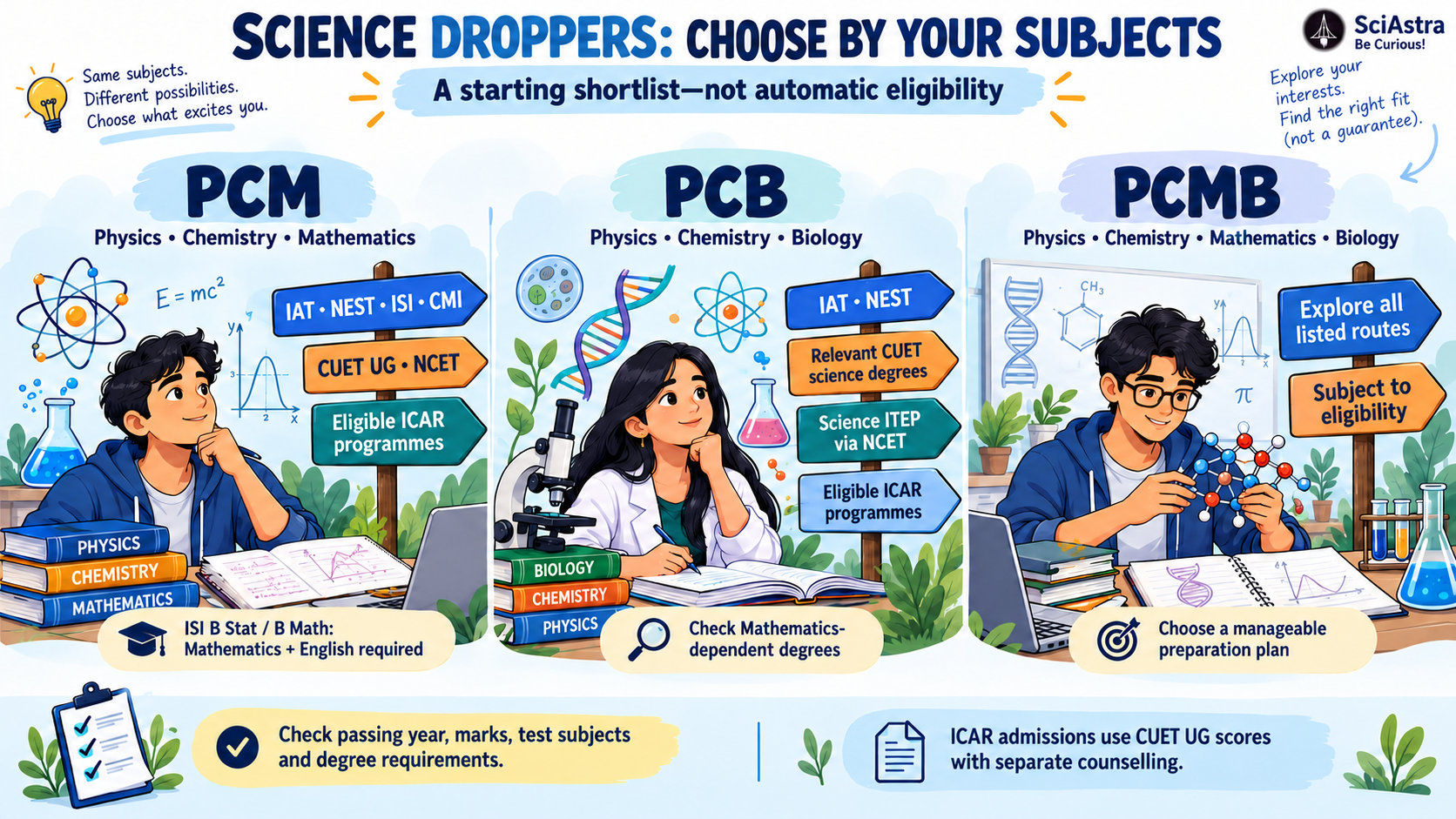
Which Exams Suit PCM, PCB and PCMB Droppers?
Match your school subjects with programme requirements. This is a shortlisting guide, not a blanket eligibility certificate.
Class 12 combination | Options worth investigating | Main check |
PCM | IAT, NEST, ISI, CMI, CUET UG, NCET and eligible ICAR programmes | Biology in broad-science tests; degree-specific subject requirements |
PCB | IAT, NEST, relevant CUET UG degrees, science ITEP options and eligible ICAR programmes | Mathematics-dependent degrees and the fourth subject in IAT |
PCMB | All listed routes, where other conditions are met | Preparation workload and precise course requirements |
For ISI B Stat/B Math, Mathematics and English are required. For CMI, a PCB-only student should not confuse the broad published qualification with readiness for a mathematics-intensive entrance.
How Should You Choose Exams by Future Career Goals?
Research and Higher studies
IAT and NEST are strong routes to investigate for basic-science research. ISI and CMI are relevant to mathematical, statistical and computational interests. CUET-based degrees can also lead towards research through appropriate training and further study.
No entrance exam makes you a scientist immediately. Projects, subject knowledge, postgraduate choices and often doctoral training shape that journey. Explore SciAstra’s guide to becoming a scientist for the broader pathway.
General BSc-MSc and wider career flexibility
If you want a subject-based undergraduate degree before deciding your specialisation, compare CUET university options. Examine the actual degree structure, project component and eligibility for the postgraduate programmes you may pursue.
A BSc is not automatically a final decision about your profession. It can be a foundation, provided you deliberately build skills and experience.
Teaching, agriculture and quantitative careers
For school teaching, investigate NCET-based science ITEP courses. For agriculture, compare ICAR programmes according to whether you prefer crops, fieldwork, food processing or technology.
For quantitative careers, inspect ISI, CMI and relevant university courses for their balance of theory, statistics and computing.
These are possible directions, not guaranteed employment outcomes. Career preparation continues after admission.
What Other Factors Should Droppers Use to Divide These Exams?
Passing year, marks and admission restrictions
First separate eligible options from ineligible ones. A second dropper must check the exact permitted passing years; “no age limit” does not remove a passing-year restriction. For 2027 applications, do not simply shift every 2026 eligibility date forward by one year. Wait for the relevant official rule.
Preparation overlap and assessment style
Next group exams by the extra work they require. Broad PCMB preparation, mathematical problem solving, CUET subject papers and NCET teaching aptitude are different preparation demands. Compare your current readiness using official past papers. A familiar syllabus can still be assessed through unfamiliar question styles.
Course duration, costs and learning environment
Compare total fees, hostel costs, scholarships, location, medium of instruction and the years of study involved. Count only funding you qualify for under the applicable conditions. Also consider whether you prefer laboratory work, proofs, fieldwork or explaining ideas to others. An attractive institute name cannot substitute for enjoying the course.
How Can Droppers Build a Manageable Entrance Exam Plan?
Start with one main goal and compatible alternatives
Choose a primary course direction, then identify additional routes you would genuinely accept. For example, a research-focused student may compare IAT and NEST with selected CUET science programmes. A mathematics-focused student may compare ISI, CMI and suitable university degrees.
These are planning examples, not universal exam bundles. Remove any option for which you are ineligible or cannot prepare realistically.
Maintain a separate admission tracker
Track registration, subject choices, exam dates, results, university applications, counselling and document verification independently. Completing an exam form does not necessarily register you for every admission process using its score.
Review your preparation through timed practice and an error log. SciAstra’s CUET preparation guide can support the university entrance part of your plan.
Use eligibility to narrow the list, course interests to set priorities and preparation overlap to keep the plan manageable. Research, mathematics, university science, teaching and agriculture all deserve an informed comparison.