How to Prepare for IAT 2027 Chemistry Section: The IISER Aptitude Test (IAT) 2027 will tentatively be held in the first week of June 2027. Candidates aiming for admission to UG courses offered by IISERs and IISc Bangalore through it must start exam preparation right away.
Candidates must prepare strategically for all sections of the IAT, including Physics, Chemistry, Maths, and Biology. This SciAstra article is particularly dedicated to IAT 2027 Chemistry preparation. Check out the preparation tips for the section here.
IAT 2027 Overview
The IAT 2027 will tentatively be conducted in the first week of June 2027, for admission to Integrated BS-MS, BS and BTech programmes offered by IISERs and other popular research institutes such as IIT Guwahati, IIT Madras, IISc Bengaluru, IIEST Shibpur and IACS Kolkata. The IAT 2027 application form is likely to be released in the first week of March 2027.
If you are going to appear for the IISER Aptitude Test in 2027, check out all the important details about the test below.
Features | Details |
Exam Name | IISER Aptitude Test (IAT), IISER Entrance Exam |
Exam Organising Institute | One of the IISERs |
Exam Level | Undergraduate Level |
Courses Offered |
|
Exam Mode | Online |
Exam Frequency | Once a year |
Registration Fee | Gen/OBC/OBC-NCL/EWS - INR 2,000 SC/ST/KM/PwD - INR 1,000 |
Type of Question | Multiple Choice Question (60 questions) |
IAT Marking Scheme |
|
Official Website |
Also Read:
How to Prepare for IAT 2027 Chemistry Section
Chemistry is one of the sections in the IAT 2027 question paper with 15 questions. Each question carries 4 marks. Therefore, the total marks for the Chemistry section is 60. The preparation tips for the section have been provided as follows.
Understand IAT 2027 Exam Pattern
The first step to score well in the IAT is to understand the structure of the exam. For this, candidates must check the exam pattern and prepare accordingly. The overview of the IAT 2027 exam pattern has been provided below for candidates’ reference.
Features | Details |
|---|---|
Mode of Exam | Online/ CBT |
Medium of Exam | Bilingual (Hindi & English) |
Frequency of Exam | Once in a year |
Number of Sections | 4 Sections:
|
Number of Questions | 60 Questions |
Types of Questions | Multiple Choice Questions (MCQ) |
Total Marks | 240 Marks |
Marking Scheme | +4 for each correct answer and -1 for each incorrect answer |
Unlock Complete Analysis for IAT Section: Physics, Chemistry, Biology and Maths
The complete chapter-wise trend analysis for IAT from 2017 to 2025 for Physics, Chemistry, Biology, and Maths has been provided in the IISER Aptitude Test - IAT Mock Book.
Click on the link below to purchase it:
IAT 2027 Preparation Book for PCMB | |
IISER Aptitude Test - IAT Mock Book | |
Also Read:
Cover IAT 2027 Chemistry Syllabus
The IAT 2027 syllabus for Chemistry is based on the topics covered in the NCERT Classes 11 and 12 Chemistry textbooks. Understanding the syllabus can help candidates strengthen their theoretical knowledge about the topics.
Check out the IAT 2027 Chemistry syllabus below:
Some Basic Concepts of Chemistry:
Matter and its nature, Dalton's atomic theory: Concept of atom, molecule, element, and compound, Laws of chemical combination, Atomic and molecular masses, mole concept, molar mass, percentage composition, empirical and molecular formulae, Chemical equations, and stoichiometry.
Structure of the Atom:
Discovery of Sub-atomic Particles, Atomic Models, Developments Leading to the Bohr’s Model of Atom, Bohr’s Model for Hydrogen Atom, Towards Quantum Mechanical Model of the Atom, Quantum Mechanical Model of Atom
Classification of Elements and Periodicity in Properties:
Genesis of Periodic Classification, Modern Periodic Law and the Present Form of the Periodic Table, Electronic Configurations of Elements and the Periodic Table, Electronic Configurations and Types of Elements: s-, p-, d-, f- Blocks, Periodic Trends in Properties of Elements.
Chemical Bonding and Molecular Structure
Kössel-Lewis Approach to Chemical Bonding, Ionic or Electrovalent Bond, Bond Parameters, The Valence Shell Electron Pair Repulsion (VSEPR) Theory, Valence Bond Theory, Hybridisation, Molecular Orbital Theory, Bonding in Some Homonuclear Diatomic Molecules, Hydrogen Bonding.
The d-& f-block elements:
Position in the Periodic Table, Electronic Configurations of the dBlock Elements, General Properties of the Transition Elements (d-Block), Some Important Compounds of Transition Elements, The Lanthanoids, The Actinoids, Applications of d- and fBlock Elements.
Coordination compounds:
Werner's Theory of Coordination Compounds, Definitions of Some Important Terms Pertaining to Coordination Compounds, Nomenclature of Coordination Compounds, Isomerism in Coordination Compounds, Bonding in Coordination Compounds, Bonding in Metal Carbonyls, Importance and Applications of Coordination Compounds.
Thermodynamics:
Thermodynamic Terms, Measurement of ΔU and ΔH, Calorimetry, Enthalpy Change, ΔH of a Reaction – Reaction Enthalpy, Enthalpies for Different Types of Reactions, Spontaneity, Gibbs Energy Change and Equilibrium.
Equilibrium:
Equilibrium in Physical Processes, Equilibrium in Chemical Processes – Dynamic Equilibrium, Law of Chemical Equilibrium and Equilibrium Constant, Homogeneous Equilibria, Heterogeneous Equilibria, Applications of Equilibrium Constants, Relationship between Equilibrium Constant K, Reaction Quotient Q and Gibbs Energy G, Factors Affecting Equilibria, Ionic Equilibrium in Solution, Acids, Bases and Salts, Ionization of Acids and Bases, Buffer Solutions, Solubility Equilibria of Sparingly Soluble Salts.
Redox Reactions:
Classical Idea of Redox Reactions-Oxidation and Reduction Reactions, Redox Reactions in Terms of Electron Transfer Reactions, Oxidation Number, Redox Reactions and Electrode Processes.
Solutions:
Types of Solutions, Expressing Concentration of Solutions, Solubility, Vapour Pressure of Liquid Solutions, Ideal and Non-ideal Solutions, Colligative Properties and Determination of Molar Mass, Abnormal Molar Masses.
Electrochemistry:
Electrochemical Cells, Galvanic Cells, Nernst Equation, Conductance of Electrolytic Solutions, Electrolytic Cells and Electrolysis, Batteries, Fuel Cells, Corrosion.
Chemical Kinetics:
Rate of a Chemical Reaction, Factors Influencing Rate of a Reaction, Integrated Rate Equations, Temperature Dependence of the Rate of a Reaction, Collision Theory of Chemical Reactions.
Organic Chemistry– Some Basic Principles and Techniques:
General Introduction, Tetravalence of Carbon: Shapes of Organic Compounds, Structural Representations of Organic Compounds, Classification of Organic Compounds, Nomenclature of Organic Compounds, Isomerism, Fundamental Concepts in Organic Reaction Mechanism, Methods of Purification of Organic Compounds, Qualitative Analysis of Organic Compounds, Quantitative Analysis.
Hydrocarbons:
Classification, Alkanes, Alkenes, Alkynes, Aromatic Hydrocarbons, Carcinogenicity and Toxicity.
Haloalkanes and haloarenes:
Classification, Nomenclature, Nature of C–X Bond, Methods of Preparation of Haloalkanes, Preparation of Haloarenes, Physical Properties, Chemical Reactions, Polyhalogen Compounds.
Alcohols, phenols, and ethers:
Classification, Nomenclature, Structures of Functional Groups, Alcohols and Phenols, Some Commercially Important Alcohols, Ethers.
Aldehydes, ketones, and carboxylic acids:
Nomenclature and Structure of Carbonyl Group, Preparation of Aldehydes and Ketones, Physical Properties, Chemical Reactions, Uses of Aldehydes and Ketones, Nomenclature and Structure of Carboxyl Group, Methods of Preparation of Carboxylic Acids, Physical Properties, Chemical Reactions, Uses of Carboxylic Acids.
Organic compounds containing nitrogen:
Structure of Amines, Classification, Nomenclature, Preparation of Amines, Physical Properties, Chemical Reactions, Method of Preparation of Diazonium Salts, Physical Properties, Chemical Reactions, Importance of Diazonium Salts in Synthesis of Aromatic Compounds
Biomolecules:
Carbohydrates, Proteins, Enzymes, Vitamins, Nucleic Acids, Hormones
Also Read:
How to Prepare for IAT Biology Section
IAT 2027 Important Topics for Good Score


Focus on High-Weightage Topics
The team of expert mentors at SciAstra have analysed the IAT previous years’ question papers from 2017 to 2025 to find out the total number of questions asked from each topic of Chemistry.
Based on the analysis, check out the topic-wise weightage for each Chemistry topic from 2020 to 2025:
Chemistry | |||||||
Section | Chapters | 2020 | 2021 | 2022 | 2023 | 2024 | 2025 |
Physical | Some Basic Concepts of Chemistry | - | - | - | - | - | - |
Atomic Structure | 1 | 1 | 1 | 1 | 1 | 1 | |
Thermodynamics | 1 | 1 | 1 | 2 | 1 | 1 | |
Equilibrium | - | - | 1 | - | - | - | |
Solution | - | - | 1 | 1 | 1 | - | |
Electrochemistry | 1 | 1 | 1 | - | 1 | 2 | |
Chemical Kinetics | 1 | 2 | - | - | 1 | 1 | |
Inorganic | Periodicity | 1 | - | 1 | - | 1 | 1 |
Chemical Bonding | 1 | 3 | 1 | 1 | 2 | 2 | |
Coordination | 2 | 2 | 2 | - | 2 | 1 | |
d- & f- block | - | - | - | - | - | 1 | |
Organic | Introduction To Organic And GOC | - | 2 | 1 | 2 | 1 | - |
Hydrocarbon | 1 | - | 1 | 1 | 1 | - | |
Alcohol, Phenol and Ether | - | - | 1 | - | 1 | - | |
Haloalkanes and Haloarenes | - | 1 | 2 | 1 | - | - | |
Aldehyde, Ketone and Carboxylic Acids | 3 | 2 | - | - | - | 5 | |
Amines | - | - | 1 | - | 1 | - | |
Biomolecules | 1 | - | - | 1 | 1 | - | |
Focus on the Most Important Chapters
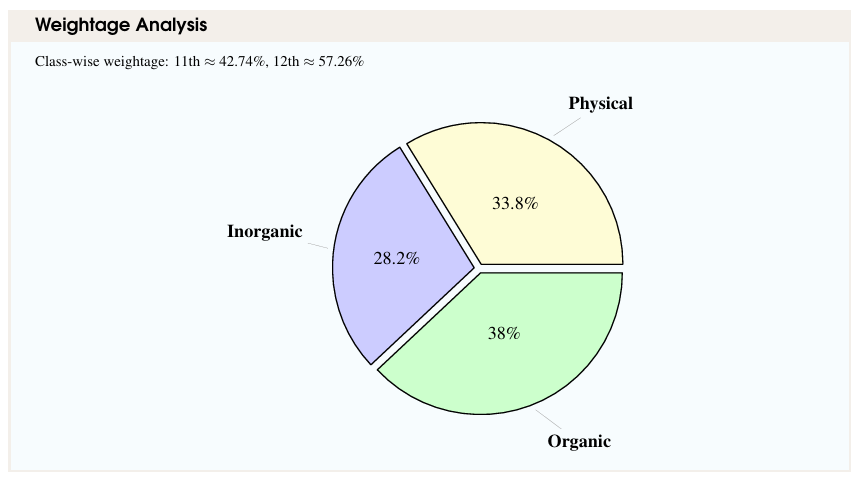
As per the analysis, the SciAstra Team has also identified the most important Chemistry chapters for IAT. The basis of the analysis is calculating the weightage (number) of questions asked from each chapter and expressing it in percentage.
Apparently, the most important Chapter for IAT 2027 Chemistry section is Organic Chemistry as a total of 38% questions have been asked from it in the IAT from 2017 to 2025.
The second most important chapter is Physical Chemistry, with a weightage of 33.8%. The weightage of inorganic chemistry is 38%.
The chapter-wise weightage distribution is available as follows:
Solve IAT PYQs
Solving IAT PYQs can provide candidates with the following benefits and boost their exam preparation:
Help in understanding the overview of the question paper
Practice relevant questions
Increase speed and accuracy in solving questions
Therefore, candidates must solve the IAT PYQs. The link to the PYQs is available below:
IAT Previous Year Question Papers - Click Here
Solve NEST PYQs
It has been noticed that questions similar to NEST have been asked in IAT. The IAT questions are the simplified version of the questions asked in NEST. Therefore, candidates must solve NEST PYQs while preparing for IAT.
Click on the link below to access the NEST PYQs:
NEST Previous Year Question Papers - Click Here
Also check the video below to learn IAT Chemistry Preparation Tips:
Conclusion
Preparing for the IAT 2027 Chemistry section requires a well-planned and consistent approach. By understanding the IAT 2027 exam pattern, thoroughly covering the NCERT-based IAT 2027 syllabus, focusing on high-weightage topics, and practising PYQs and mock tests, candidates can significantly improve their performance. Strategic preparation, guided IAT question paper analysis, and regular revision will help aspirants maximise their Chemistry score and boost their overall chances of securing admission to IISERs or IISc Bangalore.