
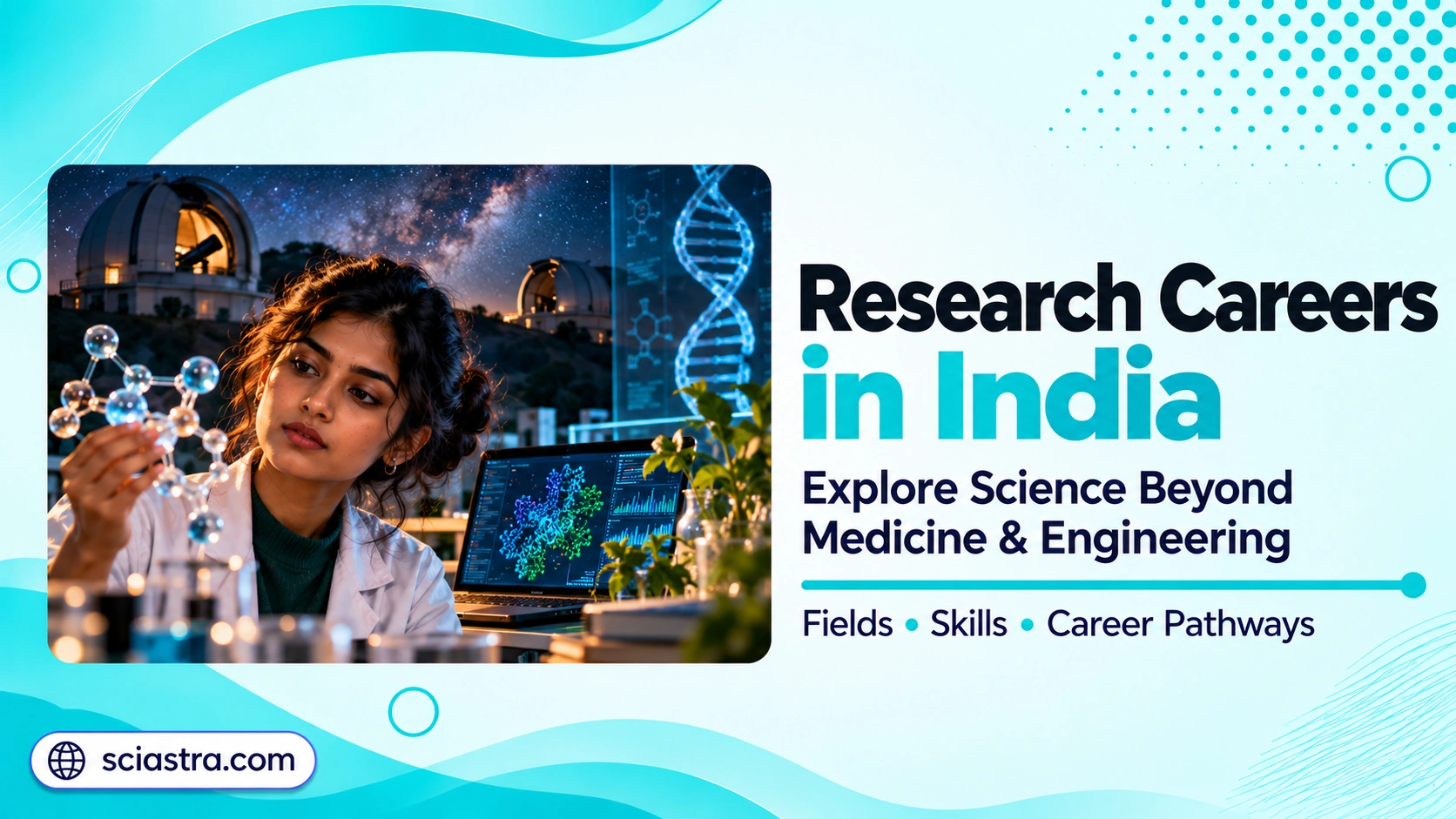
Research Careers in India: You chose science because you wanted to understand how the world works. Yet, when career discussions begin, the conversation often narrows to two questions: “Will you become a doctor or an engineer?” What if the questions that excite you are different?
You might want to understand cancer, discover a cleaner battery, study distant planets or explain how the brain learns. Research careers in India offer ways to pursue these interests through biology, chemistry, physics, mathematics and interdisciplinary science.
If you are exploring how to become a scientist in India, this guide explains why research matters, which opportunities exist and what the journey involves. You can also explore IAT preparation and admission guidance or seek free science career counselling as you compare your options.
What Does a Research Career Actually Involve?
Turning unanswered questions into reliable knowledge
A research career involves asking questions, gathering evidence and developing explanations that others can examine. Depending on the discipline, researchers conduct experiments, analyse datasets, build mathematical models, observe ecosystems or develop new materials.
The work includes reading scientific papers, discussing methods, documenting results and checking whether findings can be reproduced. A result that contradicts your expectation can be valuable if the study was carefully designed.
Research therefore requires more than enjoying science facts. You need to enjoy the process of finding out.
Research connects with medicine and engineering
Medicine, engineering and research overlap. Doctors can conduct clinical research, while engineers can investigate energy systems, electronics or robotics.
However, an MBBS or BTech is not the only starting point. Degrees in basic sciences, mathematics and statistics can also lead towards research. The appropriate route depends on the scientific problem and the qualifications required for a particular role.
Why Are Research Careers Important for the Future?
Major challenges need new scientific knowledge
Better treatments, reliable energy storage, safer water and climate adaptation require evidence that does not appear automatically. Researchers investigate mechanisms, test possible solutions and identify limitations before those solutions are widely adopted.
For students, this creates a useful way to think about careers: start with a problem you care about, then identify the science needed to address it.
India is supporting strategic research areas
India's National Quantum Mission has an approved outlay of ₹6,003.65 crore for 2023–24 to 2030–31. Its focus includes quantum computing, communication, sensing, and materials.
The BioE3 policy similarly supports biotechnology research, entrepreneurship and high-performance biomanufacturing.
These initiatives indicate national research priorities. They do not guarantee employment for every graduate. Students should look at the laboratories, training opportunities and advertised roles developing around these areas.
Scientific disciplines increasingly work together
A biological question may require programming. A battery problem may combine chemistry, physics and materials science. Satellite observations can support environmental research through statistics and computation.
This makes a strong foundation valuable. Students who understand their main subject and can work across disciplines have more ways to contribute as research questions evolve.
Which Research Career Opportunities Exist in India?
Check out the reasearch oppurtunities based on the stream/degree a student is pursuing:
Research field | What you can study | Examples of research work | Suitable interests |
|---|---|---|---|
Biology, Biotechnology & Biomedical Research | Genetics, microorganisms, the brain, immunity and disease | Understanding antibiotic resistance, studying cell communication or developing diagnostic tests | Living organisms, health and laboratory experiments |
Physics, Space Science & Quantum Research | Matter, energy, space, light and quantum systems | Analysing telescope observations, studying semiconductors or developing measurement instruments | Understanding how the universe works, mathematics and experimentation |
Chemistry, Materials & Energy Research | Molecules, chemical reactions, batteries and new materials | Testing safer batteries, developing water-treatment materials or improving catalysts | Chemical reactions, laboratory work and solving practical problems |
Mathematics, Statistics & Computational Research | Mathematical patterns, data, algorithms and computer models | Simulating physical systems, analysing biological data or testing AI methods | Logical thinking, mathematics, coding and data analysis |
Environmental, Earth & Agricultural Research | Climate, water, soil, biodiversity, oceans and crops | Investigating groundwater pollution, studying heat-resistant crops or monitoring ecosystems | Nature, fieldwork, sustainability and community problems |
Where Can Research Training Take Your Career?
Career setting | What you could do | What to know |
|---|---|---|
Universities & Academic Institutes | Conduct research, teach students and supervise projects | Qualifications vary; many academic research positions require a PhD |
Public Research Laboratories | Investigate scientific questions and develop solutions aligned with the organisation’s mission | Project appointments, fellowships and permanent scientist posts have different requirements and conditions |
Industry Research & Development | Develop and test medicines, materials, computing methods or energy technologies | Entry may require a bachelor’s degree, master’s degree or PhD, depending on the role |
Startups & Entrepreneurship | Turn research findings into useful products or services | Requires validation, resources, intellectual-property planning and an understanding of users |
Scientific Communication | Explain research through articles, educational content and other media | Strong writing and communication skills are important |
Technology Transfer | Help move scientific discoveries towards practical or commercial use | May require additional knowledge of patents, licensing and business |
Research Management | Coordinate research projects, funding, teams and timelines | Benefits from organisational, budgeting and project-management skills |
How Can You Start a Research Career After Class 12?
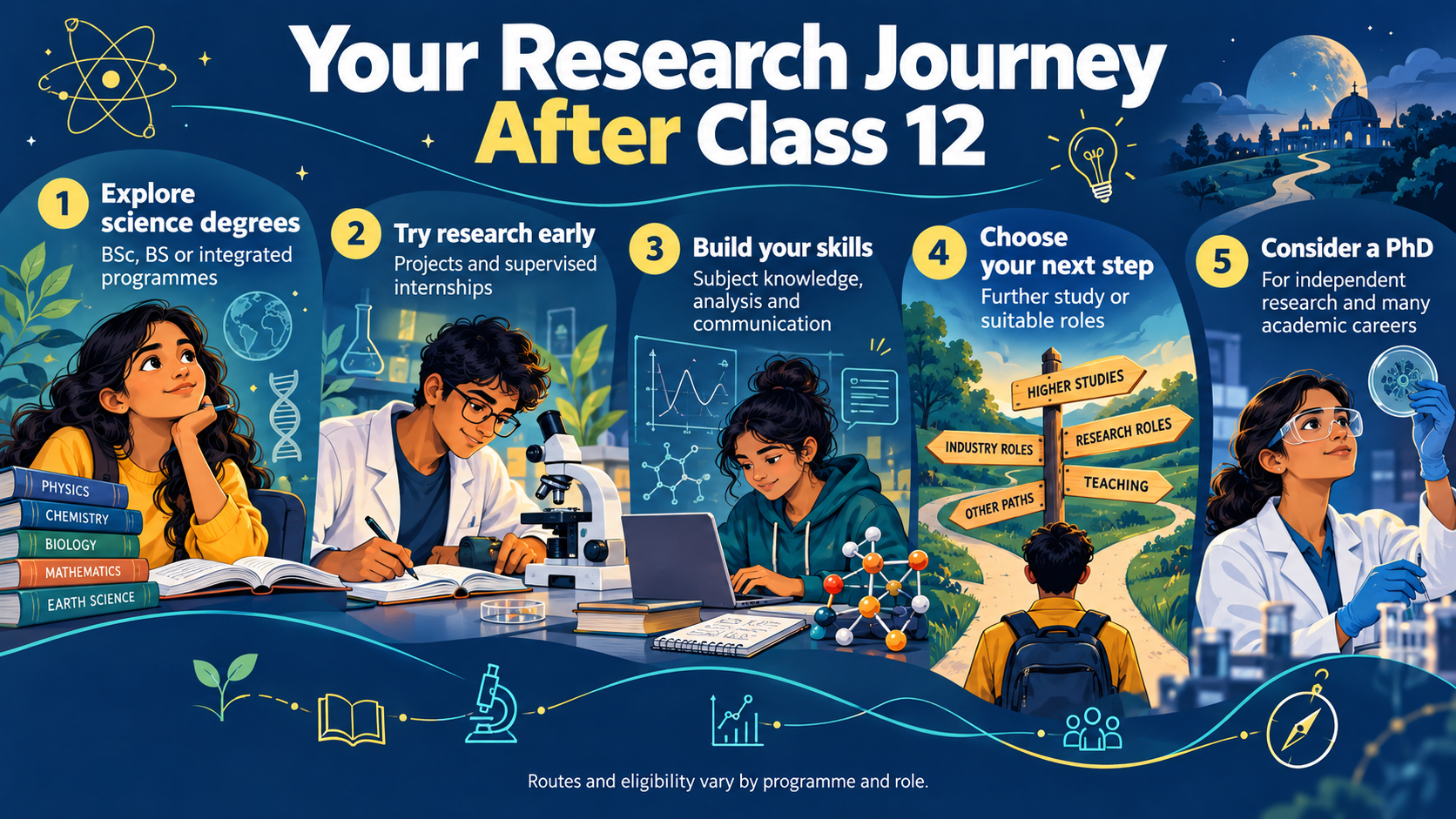
Research Careers: Choose an undergraduate route with research exposure
Several routes can build a foundation for research careers in India:
Route | Entrance Exam Name | What to examine |
IISER science programmes | IAT requirements, curriculum, research projects and subject choices | |
NISER or UM-DAE CEBS integrated MSc | NEST requirements and the five-year research-oriented programme | |
IISc BS (Research) | IISER Aptitude Test | Current admission rules, broad science training and research component |
BSc or BS at a university | Teaching quality, laboratories, faculty interests and project opportunities |
The official IISc programme description includes broad foundational study followed by specialisation and a year-long supervised research project. A university route can also lead to research. Evaluate the training available instead of treating an institute label as the entire career plan.
Research Careers: Build experience before choosing a narrow specialisation
During undergraduate study, explore projects, seminars, reading groups and supervised internships.
Look for opportunities to practise a method and understand why it is used. A small, carefully documented project can teach more than collecting participation certificates.
When contacting a potential supervisor, explain the question or method that interests you. Show that you have read about their work, and be realistic about your current knowledge.
Research Careers: Understand postgraduate and doctoral options
A common pathway is undergraduate study, postgraduate specialisation and a PhD. Integrated programmes combine some stages, while certain doctoral programmes accept eligible four-year degree holders.
Requirements depend on the institution, discipline and admission cycle. Entrance tests and interviews may be involved.
A PhD is particularly relevant for independent research and many academic careers. It is not compulsory for every laboratory, analytical or research-support position. Read actual role descriptions before committing to a qualification.
Which Skills Help Students Succeed in Research?
Scientific reasoning and quantitative confidence
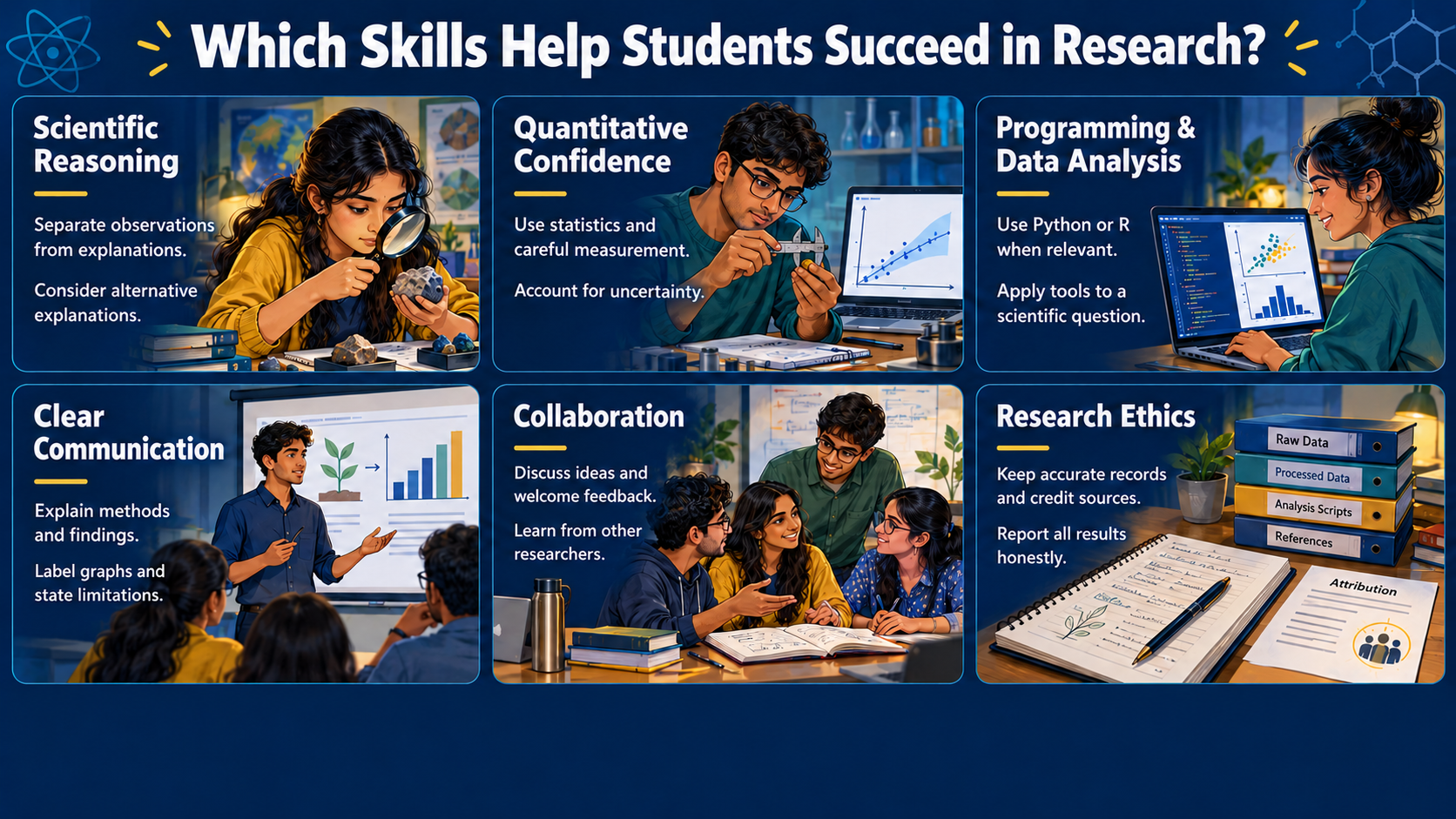
Researchers need to distinguish an observation from an explanation. They must ask whether the evidence supports a conclusion and whether alternative explanations remain possible.
Statistics, measurement and uncertainty are important across many disciplines. Programming tools such as Python or R can help with analysis when relevant to the project.
Learning software becomes more useful when you apply it to a scientific question, rather than memorise commands without context.
Communication, collaboration and research ethics
Research is collaborative. Scientists explain methods, discuss criticism, prepare reports and help colleagues understand their results.
Ethical practice includes accurate records, proper attribution and honest reporting. Researchers must not hide inconvenient results or treat an attractive explanation as proven.
These habits can begin early. Keep a project notebook, label graphs clearly, preserve your data and explain what your findings cannot establish.
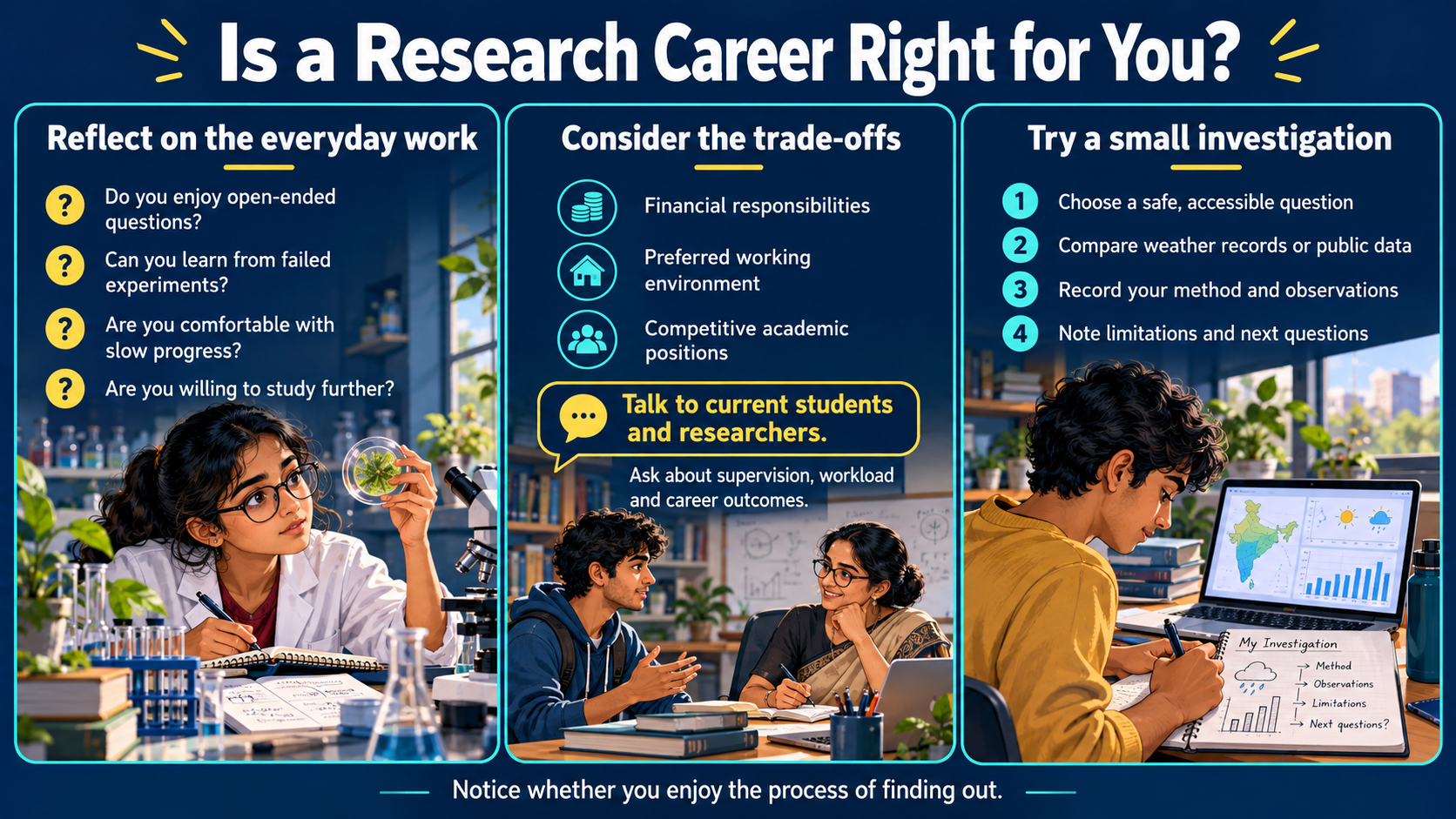
Is a Research Career Right for You?
Consider the everyday work and the trade-offs
Research can be rewarding, but it involves uncertainty. Experiments fail, useful findings take time and long-term academic positions can be highly competitive.
Ask yourself whether you enjoy investigating a question after the easy answers run out. Consider your financial responsibilities, preferred working environment and willingness to undertake further study.
Talk to current students and researchers about supervision, workload and career outcomes. Their everyday experiences can help you judge whether the path suits you.
Try a small investigation before deciding
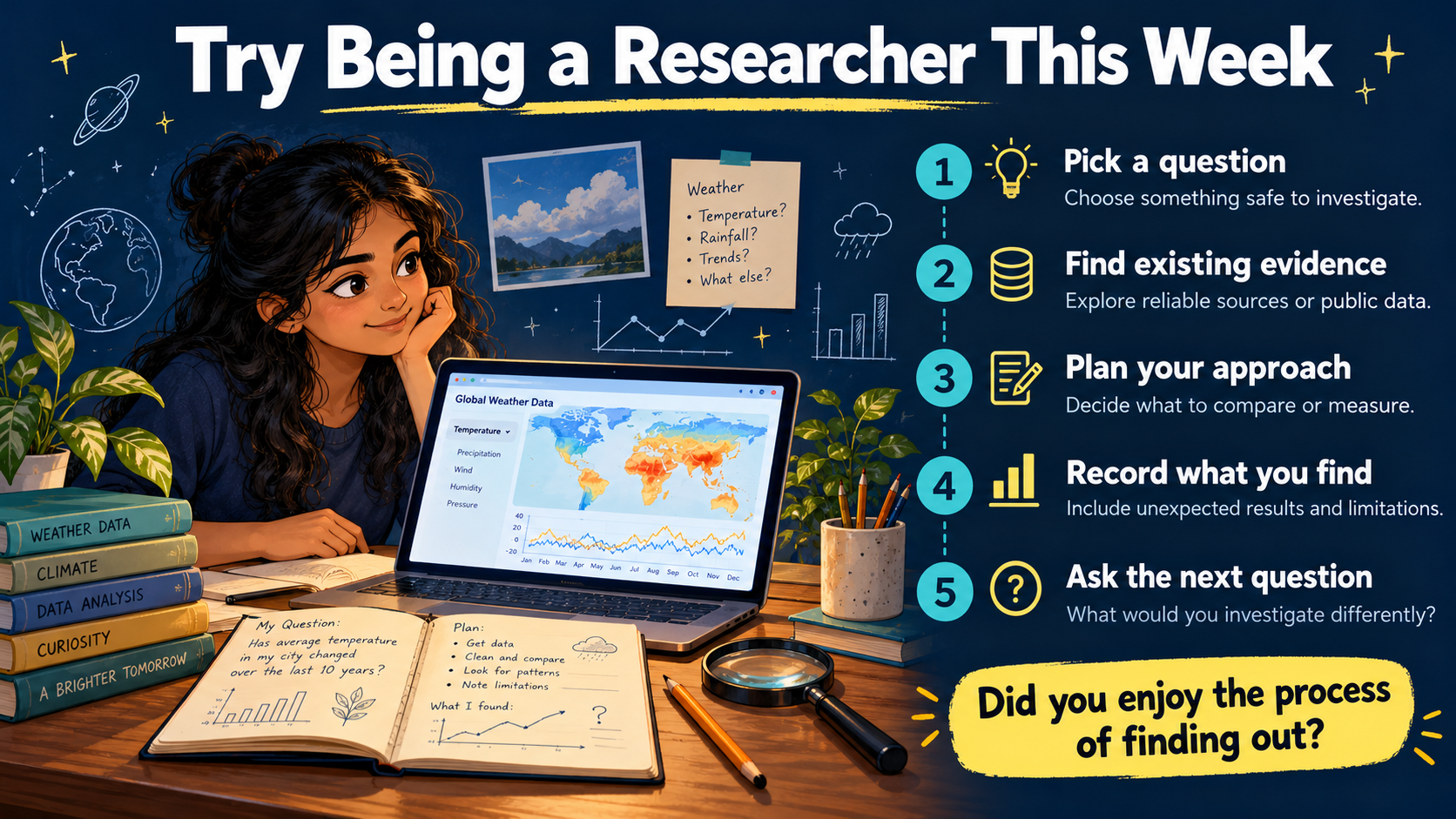
Choose an accessible question: compare local weather records, analyse a public dataset or investigate a concept through a supervised school project.
Write down your method, observations and limitations. Then ask what evidence would improve the investigation.
You do not need a major discovery to test your interest. The useful question is whether the process makes you want to investigate further.