.webp)
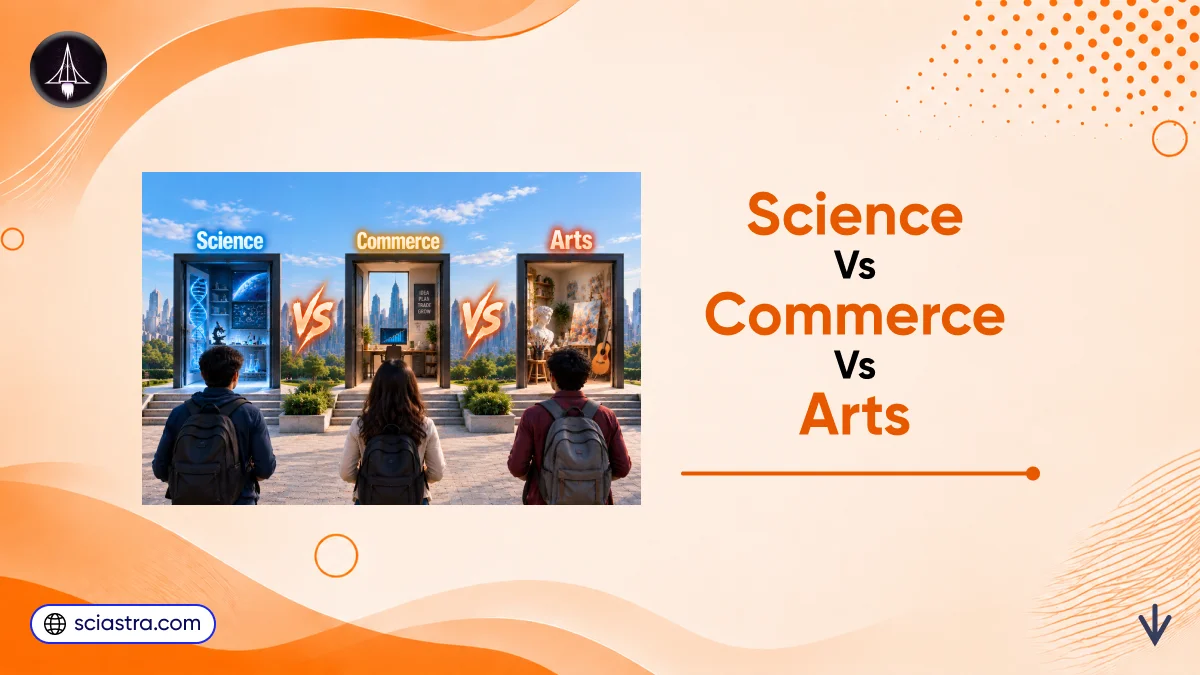
Best Stream After Class 10: If you think that you need to choose science because you are good at studies or that humanities is less likely to give you any career, you might be going in the wrong direction. These notions often end up confusing you further. In fact, Science, Commerce, and Humanities are equally important streams that offer unique ways of learning, higher education options, and a career path. The right choice isn't determined by societal perceptions but by your interests, strengths, and long-term aspirations.
This Sciastra blog compares all three streams in detail, covering their core subjects, career opportunities, benefits, and key differences. You'll also learn how to choose the stream that best aligns with your goals while separating common myths from facts.
Science vs Humanities vs Commerce: Comparison
The following table gives you a brief idea of this comparison to help you identify which stream best aligns with your interests and long-term goals.
Parameter | Science | Commerce | Humanities (Arts) |
Main Focus | Scientific principles, experimentation, mathematics, technology, and understanding the natural world. | Business, finance, economics, trade, accounting, and management. | Human society, culture, history, politics, language, psychology, and social sciences. |
Core Subjects | Physics, Chemistry, Mathematics, Biology, Computer Science (optional), English. | Accountancy, Business Studies, Economics, Mathematics (optional), Entrepreneurship, English. | History, Political Science, Geography, Sociology, Psychology, Economics, English. |
Popular Careers | Doctor, Engineer, Scientist, Pharmacist, Architect, Data Scientist, Researcher, Software Developer. | Chartered Accountant (CA), Company Secretary (CS), Cost and Management Accountant (CMA), Investment Banker, Financial Analyst, Business Consultant, Entrepreneur, Marketing Manager. | Lawyer, Civil Servant, Journalist, Psychologist, Teacher, Professor, Social Worker, Public Policy Analyst, Designer, Content Writer. |
Higher Education Options | BTech, MBBS, BDS, BSc, Integrated MSc, BPharm, BArch, BCA, BS, Nursing, Allied Health Sciences. | BCom, BBA, CA, CS, CMA, BMS, BEcon, Integrated MBA, Finance and Banking programmes. | BA, BA (Hons), BSW, BJMC, LLB (via integrated law programmes), BFA, Design, Psychology, Public Administration, International Relations. |
Best For | Students who enjoy mathematics, science, analytical thinking, experimentation, problem-solving, and technology. | Students interested in business, finance, entrepreneurship, economics, accounting, and decision-making. | Students who enjoy reading, writing, communication, critical thinking, creativity, understanding people, society, and public affairs. |
Science Stream
The science stream is all about making observations, conducting experiments, and drawing conclusions with the help of logical reasoning. This stream develops critical thinking skills and builds knowledge in Physics, Chemistry, Mathematics, and Biology subjects. Students can choose different subject combinations based on their interests and career aspirations, making science one of the most versatile streams after Class 10.
Science Stream Subjects
Check out the following core subjects in the science stream that will help you to develop analytical thinking and scientific reasoning, providing a strong foundation for various STEM careers.
Physics
Physics studies the basic laws that control matter, energy, forces, motion, electricity, and magnetism and even the cosmos. It is important in developing analytical skills and is the foundation of jobs in engineering, space technology, robotics, and applied science.
Chemistry
Chemistry is the study of the structure, properties, and chemical reactions of substances. Chemistry helps learners understand chemical reactions and is important in such subjects as pharmacology, biochemistry, environmental science, materials science, and industry.
Mathematics
Mathematics deals with topics like number theory, algebra, geometry, calculus, probability, and statistics. Mathematics is aimed at fostering analytical skills and numeracy. Mathematics plays a key role in engineering, data science, economics, finance, computer science, and artificial intelligence.
Biology
Biology entails the study of living things, including their anatomy, physiology, genetics, evolution, and ecology. Biology provides the scientific basis for medicine, biotechnology, microbiology, agriculture, environmental science, and biological sciences.
Computer Science
Computer Science acquaints students with such topics as programming, algorithms, data structures, databases, networking, and software development. Computer Science is a valuable course for people who seek to pursue careers in software engineering, cybersecurity, artificial intelligence, and information technology.
Science Stream Career Options
The science stream gives you varied options for a career path, based upon the subjects that you choose in class XI & XII. Regardless of whether you select PCM, PCB, or PCMB as your combination, each one will lead you to specialised courses in your future career path.
Subject Combination | Popular Careers | Popular Courses After Class 12 |
PCM (Physics, Chemistry, Mathematics) | Engineer, Architect, Data Scientist, Software Developer, Defence Officer, Physicist | BTech/BE, BArch, BSc, BS, Integrated MSc, BCA, Defence Academy Programmes |
PCB (Physics, Chemistry, Biology) | Doctor, Dentist, Pharmacist, Nurse, Biotechnologist, Microbiologist, Physiotherapist | MBBS, BDS, BAMS, BHMS, BSc Nursing, BPharm, BPT, BSc Biotechnology, Allied Health Sciences |
PCMB (Physics, Chemistry, Mathematics, Biology) | Doctor, Biomedical Engineer, Research Scientist, Biotechnologist, Clinical Research Professional | MBBS, BTech, BSc, Integrated MSc, Biomedical Engineering, Biotechnology, BS Programmes |
Also read: Top Government Job opportunities for science students
Why choose Science Stream?
Science Stream offers an excellent academic base with many skills that prove beneficial for a wide range of subjects. The science stream is interdisciplinary in nature, giving the student many different options for a future career. Explore the following benefits that make the science stream a favourable one for many students.
1. Diverse Career Options: Science is the foundation that provides access to careers in engineering, medicine, research, technology, environmental sciences, defence, and many more.
2. Good Analytical and Problem-Solving Skills: The subjects in the course help in building logical thinking and reasoning skills, which are beneficial for any profession.
3. Flexible Higher Education Opportunities: Students studying science can opt for various undergraduate courses in STEM subjects, along with other diverse areas, based on their eligibility criteria.
4. Building a Foundation of Research and Innovation: This stream helps the students learn a scientific approach and experimentation, which will be useful for research-based careers.
5. Opportunities in Emerging Industries: Fields such as artificial intelligence, biotechnology, renewable energy, data science, space technology, and robotics increasingly seek graduates with a strong scientific background.
What is the Commerce Stream?
The Commerce stream involves business, finance, economics, and trade education, as well as teaching students about organisation and market structures. The Commerce stream develops financial awareness, analytical thinking, and decision-making abilities, which will be useful in the sphere of business, accounting, management, banking, and entrepreneurship. The core subjects in the Commerce stream include:
Accountancy
Business Studies
Economics
Mathematics (optional)
Entrepreneurship (optional)
Career Options After Commerce
The Commerce course provides many options in the areas of finance, business, accounting, economics, management, and entrepreneurship. Students can pursue professional qualifications or undergraduate programmes based on their interests and career goals.
Commerce Pathway | Popular Careers | Popular Courses After Class 12 |
Accounting & Finance | Chartered Accountant (CA), Cost and Management Accountant (CMA), Auditor, Tax Consultant, Financial Accountant | BCom, CA, CMA, BCom (Hons), Bachelor of Accounting & Finance (BAF) |
Business & Management | Business Manager, Marketing Manager, Human Resource Manager, Entrepreneur, Operations Manager | BBA, BMS, BBM, Integrated MBA, Bachelor of Management Studies |
Economics & Banking | Economist, Financial Analyst, Investment Banker, Banking Professional, Risk Analyst | BA/BSc Economics, BCom, Bachelor of Economics, Banking & Finance Programmes |
What is the Humanities Stream?
The Humanities stream aims to provide knowledge about human societies, culture, history, politics, and human behaviour. The Humanities stream enables the development of analytical, creative, communication, and critical thinking skills and offers careers in law, civil services, media, education, psychology, social sciences, and similar people-focused fields. The core subjects in the Humanities stream include:
History
Political Science
Geography
Sociology
Psychology (Optional)
Career Options After Humanities
The Humanities stream offers diverse career opportunities in law, public administration, media, education, psychology, social sciences, design, and creative industries. Students can choose undergraduate programmes based on their interests and long-term career aspirations.
Humanities Pathway | Popular Careers | Popular Courses After Class 12 |
Law & Public Administration | Lawyer, Civil Servant, Public Policy Analyst, Diplomat, Legal Advisor | BA LLB, LLB (after graduation), BA (Political Science), Public Administration, International Relations |
Social Sciences & Education | Psychologist, Teacher, Professor, Social Worker, Researcher | BA (Psychology), BA (Sociology), BA (History), BA (Geography), BEd (after graduation), Bachelor of Social Work (BSW) |
Media & Creative Fields | Journalist, Content Writer, Public Relations Specialist, Graphic Designer, UX Researcher | BA (Journalism & Mass Communication), BJMC, BA (English), Bachelor of Design (B.Des.), Fine Arts (BFA) |
How to Choose the Right Stream After Class 10
Selection of stream in Class 11 is not merely about opting for those subjects in which one excels. Rather, selection of stream is all about knowing what interests one in learning, what one’s strengths are, and what kind of opportunities one wishes to have in the future. If you have particular curiosity about the way the world operates and are interested in analytical subjects, you may find Science a good choice to go with. The following points may help you determine whether you should go for Science:
Enjoy understanding how and why things operate rather than just remembering facts.
Having an interest in Physics, Chemistry, Maths, Biology, or Computer Science.
Enjoy solving numerical and logical puzzles and applying them to practical situations.
Having analytical, critical thinking, and problem-solving skills.
Curiosity about experimenting and finding answers through investigation and evidential explanations.
Love to deal with numbers, data, scientific ideas, or technology.
Having an interest in pursuing a career in engineering, medicine, pure sciences, technology, data sciences, biotechnology, and interdisciplinary studies.
Science Stream: Quick Facts
Science is not limited to school-level subjects or conventional careers. Its presence across higher education, research, specialised fields and technology can be seen through the following figures:
Area | Factual Insight | What It Shows |
UG Science Enrolment | 55.5 lakh students were enrolled in Science at the undergraduate level according to AISHE 2020–21. | Science remains a major higher-education pathway in India. |
Female Participation | 29.5 lakh female students were enrolled in Science at the undergraduate level, compared with 26 lakh male students. | Women constitute a substantial share of Science enrolment. |
Science at PG Level | Science accounted for around 15% of postgraduate enrolment | Science continues to be a significant pathway beyond undergraduate study. |
Science at PhD Level | Science accounted for around 21% of doctoral enrolment, second to Engineering & Technology (25%). | Science has a strong presence in India's research and doctoral ecosystem. |
Specialised Science Fields | There has been an increase in enrolment in specialised universities relating to fields such as Biotechnology and Forensics, among others, between 2014–15 and 2020–21. | Students can explore emerging and interdisciplinary areas beyond conventional Science careers. |
Practical Learning | Science education involves theoretical concepts as well as laboratory work, experiments, observation and practical application | Science can be a good fit for students who enjoy learning by experimenting and investigating |
Academic Flexibility | Science students may also be eligible for certain non-science undergraduate programmes, depending on the university and programme requirements. | Science does not necessarily mean being restricted to a single career direction. |
Science & CUET | In CUET UG 2024, Chemistry and Physics each recorded around 0.6–0.7 million registrations. | Thus, Science subjects continue to attract substantial interest among students pursuing UG admissions. |
NEET Competition | It is observed that 22.79 lakh candidates registered for NEET (UG) 2026, while 11.21 lakh qualified for admission to undergraduate medical, dental, AYUSH and allied programmes. | Medical education remains highly competitive which makes it important for students to consider the wider range of Science pathways. |
Space Exploration | According to the observations in April 2026, 781 people had flown into space under commonly used definitions based on crossing either the 100-km Kármán line or the U.S. 50-mile boundary. | Thus, Science and engineering knowledge contributes to highly specialised fields such as space exploration. |
Specialised Career Areas | Science can lead to fields including research, biotechnology, forensics, data science, AI, engineering, medicine and space science. | The stream can lead to diverse scientific, technical and interdisciplinary careers. |
Science Entrance Exams
Science students have several entrance examinations to choose from depending on their interests, subjects, and career goals. These exams can provide admission to programmes in engineering, medicine, pure sciences, research, and other disciplines. To explore the top entrance exams for Class 12 Science students, including their eligibility, exam pattern, and courses offered, refer to the following:
IISER Aptitude Test (IAT)
The IISER Aptitude Test (IAT) is an entrance examination conducted to secure admission in undergraduate courses in IISERs. The exam is specifically designed for candidates who have an interest in pure sciences and scientific research. Explore the related blogs below for complete guidance on the exam and admission process.
National Entrance Screening Test (NEST)
NEST is an entrance examination that helps you get into the 5-year integrated MSc course of NISER Bhubaneswar and UM-DAE CEBS Mumbai. This makes it the ideal choice for those students who wish to pursue a career in science and research. Check out the related blogs below for complete information.
Joint Entrance Examination (JEE)
JEE Main and JEE Advanced are the main competitive exams conducted for the purpose of admissions to engineering and technology courses, including IITs, NITs and other institutions.To know more about the JEE examination and admission process, visit the following blogs.
National Eligibility cum Entrance Test (NEET)
NEET-UG is the common entrance examination for admission to undergraduate medical and dental courses, as well as AYUSH courses such as BAMS, BHMS and BUMS.
Explore the blogs below for everything you need to know about the NEET exam and its admission process.
Common University Entrance Test (CUET)
CUET-UG is conducted by the National Testing Agency (NTA) for undergraduate admissions to participating central, state, private and other universities. The exam allows students to apply to a range of programmes based on the subjects and eligibility criteria specified by individual universities. Explore the related blogs below for complete guidance on the exam and admission process.
Also read: Science entrance exam Calendar 2027
Conclusion
One of the first crucial academic choices students make is that of choosing between Science, Commerce, and Humanities after Class 10. Each stream has its unique syllabus, learning environment, possibilities in higher education, and professional perspectives. Those who are interested in understanding the principles of how something works, problem-solving, conducting research and experiments, and discovering new things will find themselves comfortable in the Science stream. From studying for a master's degree or even getting a PhD, Science gives you all the opportunities for developing academically, but also allows you to try different directions as well.
To conclude, the right stream to choose depends solely on your interests, skills, aptitudes, and plans for the future, not the social expectations, trends, or common myths. None of the streams ensures your success by itself; it all comes down to your curiosity, skills, dedication, and ability to learn.